In global economic debates and across broad sections of Argentina, there is a recurring and seductive narrative: a country blessed with such immense natural resources has a straightforward path to development.
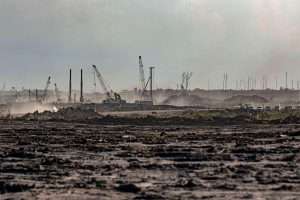
With that illusion, my country plunged headlong into the wells of Vaca Muerta, the gigantic geological formation in Patagonia that holds immense reserves of unconventional gas and oil.
There, in the depths of an oil well, we placed our hopes and longings for rebirth – for an Argentina that would finally be able to reverse the neglect suffered by the vast majority of its people.
However, as the drills dig deeper and the oil and gas gush forth at unprecedented rates, that dream is shrouded in ever-deepening darkness.
This year, production of hydrocarbons in Neuquén province, where Vaca Muerta is located, hit a new record. It now accounts for the majority of oil and gas extracted in Argentina, and is reversing past energy deficits.
But whilst ships laden with crude oil set sail, the economy faces crisis. According to the National Institute of Statistics and Censuses’ wage reports, real wages have fallen by 40% for public sector workers and 25% for those in the private sector since 2015. Education, health and infrastructure funding has fallen by as much as 90%, with profound consequences for public services.
The loss of income and the deterioration in Argentinians’ living conditions have led to a drastic increase in families unable to keep up with their debts in recent months.
The inflow of dollars from the country’s favourable trade balance has never been so substantial and yet the central bank still faces serious difficulties in rebuilding its reserves.
There is an obvious question: why has such a flow of oil wealth failed to stabilise the economy and lead to prosperity?
The mirage of foreign exchange
A key part of the problem is that, as dollars have flown into Argentina in huge numbers, they have also been taken away.
Argentina’s dominant economic players, including its oil and gas companies, have tended to dollarise their profits. This is being driven by several factors, such as local exchange rate volatility, the yield differentials offered by international interest rates, and corporate strategies aimed at diversification and the repatriation of capital to core markets.
The problem is exacerbated by the libertarian principles of President Javier Milei. His Incentive Regime for Large Investments (RIGI) seeks to attract capital by granting massive tax, customs and foreign exchange benefits that remain valid for three decades. Investors are allowed to retain the foreign currency earned from their exports, rather than bringing it into the country.
Milei’s government also lifted most of the complex web of currency restrictions that have been a long-running feature of the Argentine economy. The government has relied heavily on external borrowing to support its exchange rate policies and prevent a further devaluation. According to data from the private consulting firm 1816, gross foreign currency debt (excluding the public sector) has increased by USD 24.8 billion since Milei took office.
Vaca Muerta is currently bringing in the dollars needed to meet demand from Argentina’s wealthiest sectors, keeping those businesses aligned with the government’s programme. The problem with debt is that it needs to be repaid, and this will mean yet more dollars leaving the country.
Vaca Muerta is not an oasis within an economy in crisis. On the contrary, it is a central component of the current system of domination
The thick “black gold” is the lifeblood coursing through the veins of this political project. It is a grand pact amongst the ruling classes, where dollars accumulate in the accounts of the few, whilst poverty and precarious living conditions come hot on its heels for the majority.
The underlying aim is to transform Argentina from a complex, industrialised economy into an enclave economy reliant on resource extraction. The wealth generated then arrives in the hands of a small elite.
Rarely has our economy experienced such rapid development as that which took place in Vaca Muerta. However, this golden age of hydrocarbons coincided with one of the worst periods in the country’s economic history.
These two contradictory processes should not be understood as isolated phenomena: Vaca Muerta is not an oasis within an economy in crisis. On the contrary, it is a central component of the current system of domination, of the economic and political alliance that envisions an Argentina for the few.