With dozens of agreements signed in recent years, Argentina and China consider themselves “strategic partners” and have an extensive trade and investment relationship.
However, there is a big trade imbalance between the two countries. Argentina exports mainly commodities such as soy and meat, while importing value-added, mostly manufactured goods from China. The growth in Argentina’s exports has not kept pace with China’s.
This is where the Argentine International Investment and Trade Agency comes in. It is a government body created by President Mauricio Macri with the aim of attracting foreign investment and encouraging exports. Since its creation, exports have started growing again. The agency has largely focused on China, Argentina’s second largest export destination.
In an interview with Diálogo Chino in Buenos Aires, Alejandro Wagner, director general of international trade at the agency, speaks about tackling the deficit, the trade in sustainable products and why Argentina should join China’s Belt and Road Initiative.
Diálogo Chino [DC]: Is China a business opportunity for Argentina?
Alejandro Wagner [AW]: We are far apart by distance and culturally because of the language, but China is a great opportunity for Argentina. We don’t make the same effort with other countries as we do with China. We give companies a complete assistance package to encourage them to start selling their products in China.
DC: Can the trade deficit between the two countries be resolved?
AW: Yes, eventually. China is usually our second or third export destination every year, but 98% of what we export is commodities. We want to continue exporting more and more commodities, but employment in Argentina is generated by small and medium-sized companies and they are the ones that can add value to our exports. That is why we want these companies to start exporting to China.
On our agenda is the need to export products with lower carbon footprints and that do not affect the environment
DC: What areas have been most commercially successful in recent years?
AW: We have made progress in the meat sector, with China being our main export destination. We also do very well with prawns (shrimp). We have work to do in relation to wine, but there are already companies that are exporting it, as well as chicken. We want success stories to help other entrepreneurs see China as an opportunity.

DC: What makes it difficult for Argentine businesspeople to export to China?
AW: The biggest challenge is to persuade companies to export to China. Business people have several fears. Misinformation is key. They don’t know which channels to go through to sell or how to find a [Chinese] partner. Then add logistics to this and the need for funding to export. Argentina is behind in that. We want to open businesspeople’s eyes so that they see China as an opportunity and not a threat.
DC: Are there market opportunities to export sustainable products, like meat with a lower emissions footprint or non-transgenic soybeans?
AW: We are obliged to provide those products. In some cases, Argentina is ready and in others not so much. On our agenda is the need to export products with lower carbon footprints and that do not affect the environment. Marketing food in the world implies doing so in a sustainable and responsible way. The question is, how fast can we do it?
DC: Has the importance of China for Argentina changed in light of the country’s closer relationship with the US and Europe in recent years?
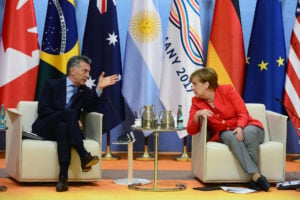
AW: Argentina needs to have a good relationship with everyone and that is what is happening. The G20 was a perfect example of that. We have already signed many agreements with China and started exporting new products such as blueberries. We would not make all of these commercial efforts if there was no support from the political side. The priority has not changed. China is still important.
DC: How interested are Chinese investors in Argentina?
AW: Argentina has investment opportunities in all sectors, all with different needs. In infrastructure, China is very present and is an important player. Similarly in energy, as is the case of the Vaca Muerta oil field and in renewable energies. We have been on several trips and have also received Chinese delegations and their interest is growing.
DC: Can a free trade agreement be concluded between Argentina and China?
AW: It is not a priority at the moment. The most important thing is to start exporting new products. As part of the Mercosur bloc, Argentina is currently negotiating a free trade agreement with Europe and that requires a lot of effort. First, we will work on that agreement, while we seek to carry out our agenda with China in terms of phytosanitary authorisation [meeting import requirements for plants].
DC: Argentina is one of the countries in Latin America that has not yet signed China’s Belt and Road Initiative. Will this happen soon?
AW: We should sign it at some point. It’s what China is waiting for. It is a long-term plan that China has for its relationship with the world and, if Argentina joins, it would send China a good message. It would allow the formalisation of the commercial relationship between the two countries, which is increasingly strong.


![Amne Machin, a sacred mountain on the Tibetan plateau, which is changing far quicker than the world realises [image by: Joshua Cohen]](https://dialogue.earth/content/uploads/2019/02/The-Tibetan-plateau-is-changing-far-quicker-than-the-world-realises-300x225.jpg)
![Only a little grass and a few animals grazing near the Deosai National Park [image by: Amar Guriro]](https://dialogue.earth/content/uploads/2018/09/16-B-300x200.jpg)