With reserves of some 244 million tonnes, lithium deposits discovered by the Canadian company Bacanora in the northeastern Mexican state of Sonora are the world’s largest, containing significantly more than the second-placed Thacker Pass site in the US state of Nevada (178 million tonnes), Mexico’s under secretary of mining Francisco Quiroga claimed in December.
Lithium is an central component in rechargeable batteries used in smartphones and electronic vehicles (EVs), making it critical for the global energy transition. Ganfeng Lithium, China’s largest lithium compounds producer and supplier to Tesla, has already agreed to a joint venture Bacanora to develop the mine in Sonora, which will be Mexico’s first lithium mine.
Did you know...?
As well as electric vehicle and smartphone batteries, lithium is used to manufacture heat-resistant glass and ceramics, industrial greases, and in treatments for bipolar disorder and depression
Chinese companies keen to corner the global EV market, which the Paris-based International Energy Agency estimates will reach 44 million vehicles by 2030.
“Lithium is the new oil”, Víctor Manuel Toledo, Mexico’s Environment Secretary said on announcing the Sonora discovery.
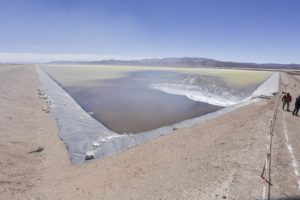
While the metal holds clean energy potential, it comes with pitfalls. The exploitation of lithium, requires huge quantities of water and can have serious consequences for the environment. Its extraction and industrialisation has also ignited vigorous national debates about resource ownership and management in countries including Chile and Bolivia.
Mexico has the added complication of its lithium mine sitting in a region controlled by criminal organisations, which the government has failed to control.
Extraction of the deposits in Sonora’s Bacadéhuachi municipality, which the Bavispe river runs through, are expected to commence in 2022.
China hones in on Mexico’s lithium
“Ganfeng has investments in resources all over the world – China, Australia, Argentina, Ireland and now Mexico,” Joe Lowry, a lithium market expert, told Diálogo Chino. He noted that the company is unable to invest in lithium in the US due to regulations on foreign control of strategic resources.
China currently dominates the EV supply chain, producing close to two-thirds of the world’s lithium-ion batteries. The US produces scarcely 5%. China also controls most of the world’s lithium processing facilities, according to data from Benchmark Minerals Intelligence.
75%
of the world's lithium lies in the salty brine deserts of northern Chile and Argentina, and southern Bolivia
Toledo said that the Mexican government is looking to begin manufacturing EVs in state-owned factories. Sonora Economy Secretary Jorge Vidal also said that his government had met with Ganfeng to discuss building a battery factory alongside the mine.
Quiroga said the Bacadéhuachi mine will bring “progress and wellbeing” to Sonora, a state with high rates of corruption and violence.
Security and sustainability concerns
Lowry said the mine’s location is “at best ‘challenging’” from a security perspective. “There are certainly much better places [than Sonora] to invest in a lithium project,” he added.
The mine is situated in an area affected by organised crime, just 98 kilometres from where gunmen suspected of belonging to a drug cartel massacred nine women and children of dual US and Mexican nationality on November 4 last year. According to Reuters, Coparmex–an influential Mexican business organisation, warned that violence is causing investors to lose confidence in the economy.
On November 11, armed robbers stole gold and silver in transit from a Sonoran mine in an incident that served as “an unwelcome reminder of the security risks faced by miners in Mexico,” business news website BN Americas wrote recently.
Furthermore, global lithium prices are volatile, and Mexico’s mining sector in particular has struggled to attract investment for over a decade.
Water Shortages and Chemical Spills
Sonora is already facing a desertification crisis and is ranked as having ‘Extremely High Baseline Water Stress’, according to the World Resources Institute. This means the population is already using more than 80% of their available water supply.
It’s a resource that we could be taking advantage of here in Mexico, both as an export and as a source of cleaner energy
Ricardo Durazo, coordinator of environmental campaign group Fridays for Future in Sonoran state capital Hermosillo, told Diálogo Chino that water supply is a critical environmental issue in the state. The discovery of the lithium deposits is “a double-edged sword” he said.
“Just as lithium is indispensable for the creation and development of renewable energies, it is also a mineral that is particularly polluting” he said.
There lithium extraction process has an inherent risk of contamination. In Tibet in 2016, where lithium has been mined since the 1960s, initially for use in industrial greases and anti-depressants, a toxic chemical leak from the Ganzizhou Rongda Lithium mine killed fish and cattle that local farming communities depended on.
Hydrochloric acid is used in lithium processing to filter waste products from the brine, rock or clay. This has generated conflict with communities living near mines in Argentina and Chile, where it has polluted local water sources. Lithium extraction can also affect soil and air quality.
“I think it’s a resource that we could be taking advantage of here in Mexico, both as an export and as a source of cleaner energy,” said Durazo. “But it will depend on the politicians, the authorities and the mining companies to implement environmental protection standards.”


![An old woman holds the fruit of the initiative in her hands [image by: Manoj Genani]](https://dialogue.earth/content/uploads/2020/02/An-old-women-holding-some-fruits-in-hand-e1582525645492-300x200.jpg)
![The women of Rahul Nagar live in concern of the impact of the river eating up the lands [image by: Manoj Singh]](https://dialogue.earth/content/uploads/2020/02/नदी-की-कटान-से-प्रभावित-राहुल-नगर-की-महिलाएं-300x225.jpg)