A new battery factory, light rail vehicle scheme, growing electric bus fleet, and pursuit of leadership in solar panel production – China’s BYD (Build Your Dreams) has big plans for Brazil in 2020.
In a further sign of BYD’s ambitions, São Paulo governor João Doria expects the company to buy Ford’s old São Bernardo do Campo factory, a long-held symbol of Brazil’s automotive industry, which closed in October 2019.
BYD had no comment on the transaction. But the acquisition of the plant would be the icing on the cake for the company’s recent advances, achieved despite a recession for Brazil’s domestic automotive industry, and sends a strong signal about the demands for a fossil fuel-free transport future.

Brazil has the sixth-highest greenhouse gas emissions worldwide and transport is responsible for a little over 10%, according to NGO Observatório do Clima.
Brazilian lawmakers are now pushing for more stringent legislation to encourage electric vehicle use. In São Paulo, the 2018 Climate Law established a goal of zero pollutants from transport in the state capital within 20 years. And on February 2019 the Senate Constitution and Justice Committee approved a plan to halt sales of petrol and diesel vehicles from 2030 – an important step towards becoming national legislation.
“Everyone believes that from 2020 this market will grow and be well-established in Brazil,” said Adalberto Maluf, BYD Brazil’s director for marketing, sustainability, and new business.
BYD’s race for leadership
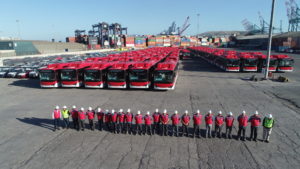
BYD is looking to diversity its activities in Brazil but got a foothold through the manufacture of electric bus chassis, which it produces at a factory in Campinas, São Paulo state. Maluf is expecting an upturn in demand for electric buses that could make up for Brazil’s lacklustre rollout so far.
BYD Brazil by numbers:
- BYD currently has 50 buses in Brazil
- They are spread across 8 cities: São Paulo, Bauru, Santos, Campinas (all SP state); Brasília; Volta Redonda (RJ); and Curitiba and Maringá (Paraná)
- Each electric bus saves 9 tonnes of CO2 per month from going into the atmosphere
- There are 36 electric BYD trash collection trucks in 3 cities: Indaiatuba (SP), Salto (SP), and Rio de Janeiro (RJ)
- Each of these trucks mitigates the release of 14 tonnes of CO2 per month
- Brazil had BYD solar panels with a combined installed capacity 1 GW by mid-2019, approximately one-third of the country's total
In 2019, BYD sold 450 buses to Colombia and 300 to the Czech Republic. Only 50 went to Brazil after two important bid processes were suspended by the courts because of insufficient financial feasibility studies, and other technical issues.
“In 2020, Brazil is expected to get its programme off the ground and have the largest fleet of electrical buses in Latin America,” Maluf said. “São Paulo is likely to become the largest market.”
According to Maluf, São Paulo’s public transport authority SPTrans estimates that 7000 electric buses will be on the streets in ten years.
The company also expects to expand the fleet in Campinas, which is in the process acquiring 339. In the north-eastern city of Salvador the company expects to sell another 300 electric buses.
BYD diversifies
Salvador is also the setting for a novel BYD project. In February 2019, the company won the bid to build a 22-kilometre urban monorail.
The Chinese company will undertake the project – its biggest in Brazil – in a public-private partnership worth 1.5 billion Reais (US$316 million) alongside the Bahia state government, which expects to complete the project by the end of 2021.
Another niche BYD Brazil has identified is electric trucks, imported from its parent company. It has sold a few dozen heavy trash compacting trucks to three Brazilian cities, including Rio de Janeiro, in what is becoming a competitive field. In December 2019, Volkswagen invested 110 million Reais (US$23 million) in its plant in Resende (also in Rio) to produce electric trucks.
Beyond its core transport enterprises, this month BYD will also open a new factory in Amazonas state capital Manaus that will produce electric batteries to store energy generated by solar panels.
“We want to establish ourselves in the energy storage sector,” Maluf said.
High electricity prices, rates that depend on the cost of generation, and network instability in some parts of Brazil have led some consumers (mainly larger ones) to seek new energy sources. One option for consumers is producing and using energy with solar panels.
This year, BYD hopes to double its solar panel production and lead sales nationwide, surpassing Canadian Solar. BYD’s Brazilian subsidiary already has a photovoltaic panel factory in Campinas, São Paulo state.
Cleaner, but no nationwide infrastructure
For Boris Feldman, an engineer and journalist who has been covering the automotive industry for thirty years, BYD is entering a market with little or no competition.
“There are almost no companies selling electric trucks, and no others manufacturing completely electric buses,” he says.
Feldman believes that BYD’s strategy of concentrating on electric buses and trucks for urban use is the right choice. A lack of charging stations and high taxes prevent private vehicles being a viable alternative, he says.
“This initiative by BYD is the only way that I can see electric vehicles working out in Brazil today – only circulating in city traffic, running all day long, parked and charging at night,” he says.
It’s bad for Brazil to be so far from technological development, without developing the domestic sector
Suzana Kahn, deputy director of Coppe, an engineering research institute at the Federal University of Rio de Janeiro, sees the growth of a company that produces zero emissions vehicles as a positive development.
According to the World Health Organisation, 51,000 people die each year in Brazil as a result of diseases caused by air pollution. The ten most polluted cities are in the state of São Paulo, where the automotive industry is concentrated.
But Kahn also has concerns about Brazil’s own industry: “It’s bad for Brazil to be so far from technological development, without developing the domestic sector, without generating jobs.”
Maluf agrees and says that while Brazil has missed opportunities to develop its industry, partnerships with BYD could yet be fruitful. The company has invested 5 million Reais (US$1 million) in photovoltaic research at the University of Campinas (UNICAMP). The project resulted in the first double-sided solar panel produced by BYD.
“The fact that Brazil has large reserves of very high-quality mineral lithium, plus biofuels, may harness the development of hybrid flex cars,” observes Maluf.
“Now it also depends on government action.”


![The Mahakali river at the India-Nepal border, downstream of the Sharada barrage [Image by: Joydeep Gupta]](https://dialogue.earth/content/uploads/2020/03/Mahakali_Sharada_barrage_JG-300x225.jpg)