Despite expectations of greater development, the lithium sector in Argentina and Chile is being slowed by the coronavirus. Projects under development have been halted by the mandatory quarantine, while significant investments have already been cancelled.
Argentina, Chile and Bolivia are part of the so-called “lithium triangle” of South America, a region with some of the world’s highest concentrations of the metal. It is central to the expansion of electric vehicles, the demand for which is expected to increase in the coming years.
110,000
tonnes less of lithium will be produced this year due to the coronavirus epidemic
Due to the quarantine measures, lithium production is expected to drop globally by 110,000 tonnes this year, representing a loss of US$960 million, according to English consultancy Roskill. In Argentina, production is expected to drop 35%, and in Chile by 20%.
On top of live projects slowing down, planned investments have been delayed or cancelled, in several cases by Chinese companies. China is the world’s leading consumer of lithium, primarily for battery manufacturing.
While Chile is a mining country with extensive development and exports of US$40,000 million per year in minerals, Argentina still has an incipient mining development – with exports of US$3.7 billion. The government is seeking further development and hopes that lithium will do just that.
“Lithium production is highly vulnerable to the kinds of disruptions a pandemic like coronavirus can cause,” said Emily Hersh, an economist specialising in the lithium market. “Quarantine is going to affect the industry generally.”
Argentina hits the breaks
Argentina has been under strict quarantine since the end of March to curb the spread of the virus. Although mining is one of the activities exempt from quarantine, land and air transportation have been slowed throughout the country, so workers cannot move.
“Producing companies have made efforts to restart their exports. But demand is very low. Everything is slowing down,“ said Alberto Carlocchia, president of the Argentine Chamber of Mining. “The main mining projects are working at less than 50% of their capacity.”
Lithium is extracted mainly in the provinces of Jujuy, Catamarca and Salta in the north of the country. There are currently two operating salt flats: Olaroz in Jujuy and Hombre Muerto in Catamarca. Mineral exports were US$250 million in 2019.
The Caucharí-Olaroz project, which is owned equally by the Canadian company Lithium Americas and the Chinese company Ganfeng Lithium, was halted in March due to delays in the delivery of equipment due to arrive from China. The mine is now expected to be ready in 2021 rather than by the end of this year.
“We are evaluating the impact of Covid-19 on the development program, including discussions with all suppliers and freight brokers on the delivery schedule, to assess the impact on the schedule and develop mitigation strategies,” the company said.
In Catamarca, the US company Livent Corporation, which controls the Fenix project in Catamarca, already in operation, decided to “place its capacity expansion plans under review”. Livent expects lower ore demand and lower prices.
Similarly, the French company Eramet also decided to cancel a US$600 million project to extract lithium in the Centenario-Ratones salt flat in the province of Salta. Eramet had already invested US$140 million but because of the coronavirus and the economic issues in Argentina, which is close to a new default, it stopped its plans.
“Companies do not know what the future of the sector will be in Argentina,” said Julio Ríos Gómez, a geologist and former president of the Argentine Geological Service.
Similar concerns in Chile
Chile is the second-largest producer of lithium in the world, after Australia. The country owns around 22% of the world’s lithium reserves. Last year, its production amounted to 16,000 tonnes, all derived from the salt flats in the Atacama desert.
Currently, only two companies that extract lithium there: the American firm Albemarle and the Chilean company Sociedad Quimica y Minera de Chile (SQM). In 2018, the Chinese group Tianqi Lithium, one of the world’s largest lithium producers, bought 24% of SQM’s shares for $4 billion.
SQM production in Chile remains largely stable but the company said that falling demand for the mineral could force it to adjust its plans for this year. SQM planned to invest US$330 million to expand its production but the project is now under review.
Since the sale of the shares in SQM, lithium prices have dropped 70% and the expectation is not good for this year. Tianqi expects a loss of $131.7 million in the first half of the year, after having already lost $848 million in 2019, according to its financial results.
“As we continue to evaluate the changing global economic environment and the impacts it could have on the growth of demand for the businesses we sell in, we may find it wise to delay or modify our spending plan for this year,” said Alberto Salas, chairman of the SQM board.
Mining minister Baldo Prokurica has urged miners to cut staff numbers on the ground and minimize the transfer of workers. Companies have extended shifts to 14 days from the usual 7 to reduce exposure from the moves, and they keep workers in quarantine upon their return.
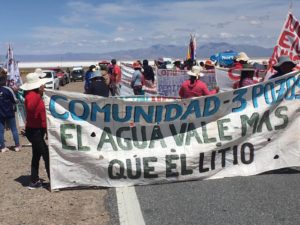
Chile registered a 38.5% drop in the value of its lithium exports in the first quarter, according to customs data. Indigenous leaders in the Atacama region have asked companies to shut down their operations to prevent the virus from spreading. However, this has not yet happened.

![Indians wearing protective masks stand with their luggage in queue outside a railway station [image: Alamy]](https://dialogue.earth/content/uploads/2020/05/indians-protective-masks-300x200.jpg)