2019 was a record year for the shrimp industry in Ecuador in terms of sales to China. With 767 million pounds exported, a trade worth US$1.9 billion, China quickly became a major market.
This year, China has again proven to be an essential buyer of Ecuador’s shrimp, but for a different reason. Aquaculture suffered a severe economic blow as a result of disruptions in global trade due to Covid-19, and Ecuador was particularly hard hit by the pandemic.
Although sales to China fell dramatically at the beginning of the year, they are recovering and, in fact, recorded a historic US$95 million jump in exports in April, according to figures from the National Chamber of Aquaculture (CNA). This has allowed shrimp farmers to mitigate the blow of the US$60 million drop in sales to the US and Europe.
Ecuador’s shrimp and Covid-19
Ecuador was one of the first countries in Latin America to suffer the most serious consequences of the disease caused by the new coronavirus. It has recorded more than 40,000 confirmed cases and, at the time of writing, there have been over 5,000 deaths with confirmed or suspected links to Covid-19, according to the health ministry.
As the country fell ill, its economy was also dramatically affected.
“So far, we have been impacted by lost commercial profit totalling some US$12 billion in Ecuador. Obviously, the sectors most affected are tourism, commerce and industry, along with the agricultural and export sectors,” minister of foreign trade Iván Ontaneda said in an interview with Dialogo Chino.
The shrimp sector, Ecuador’s second largest export after oil, has largely managed to keep its operations active from the time that the health emergency was declared. But there has been notable impact.
The quarantining that was mandated in all the cantons at the beginning damaged the logistics chain
In Esmeraldas, one of the provinces on the Pacific coast which produces shrimp, owners of shrimp farming pools are trying to mitigate the crisis without cutting jobs.
“With low prices, you must reap pounds per acre at lower costs, while hoping for a miracle, so let us see what happens. In any case, the situation is quite difficult,” said Marcos Tello, president of the Shrimp Farmers of Northern Esmeraldas (Aprocane), who represents some 30 producers with farms totalling 700 hectares.
In addition to the drop in sales, the supply chain has been affected, especially those who supply larvae from the province of Santa Elena.
50%
the estimated drop in shrimp larvae production in Ecuador since the covid-19 outbreak
“It’s obvious what is happening. We can already see the shortage of larvae. I estimate that production of larvae has decreased by 50%,” warns Tello, adding that the wait for orders has taken up to 15 days, leading to fluctuations in production.
The scarcity of supplies, such as balanced feed for shrimp, was felt most accutely in March when Ecuador declared the emergency, just before the pandemic peaked. “The quarantining that was mandated in all the cantons at the beginning damaged the logistics chain to our shrimp farms,” said Monica Mora, a producer in the Jambelí area of El Oro in the south of the country.
“We have taken a 30% price cut,” Mora laments, saying both whole or headless shrimp have been affected by abundant supply and reduced markets. Mora is calling on the authorities to regulate the price of inputs.
Since September last year, the sector has been left struggling to recover from a move by Chinese buyers to suspend imports, after indicating that some shipments might be contaminated with white spot syndrome (WWS).
This led to a slowdown in exports, which fell further when the Covid-19 virus paralysed China in December. In total, the value of Ecuadorean shrimp sales to China fell from US$271 million in November 2019 to $157 million in December. There were rebounds to $169 million in January this and $182 million in February. But in March, there was yet another $160 million setback.
The Chinese market re-opens
In April, sales to China rebounded strongly as the country appeared to control the outbreak of Covid-19. Production resumed and, more importantly for Ecuador, so did domestic food consumption.
“Why is there this demand for Ecuadorian shrimp? First the size, then the taste, and lastly the benefits of eating this food,” said Gustavo Cáceres, president of the Ecuadorian-Chinese Chamber of Commerce. “In China there is currently a middle class of 600 million people. This middle class is the sector of the population with the purchasing power that allows them to buy imported products.”
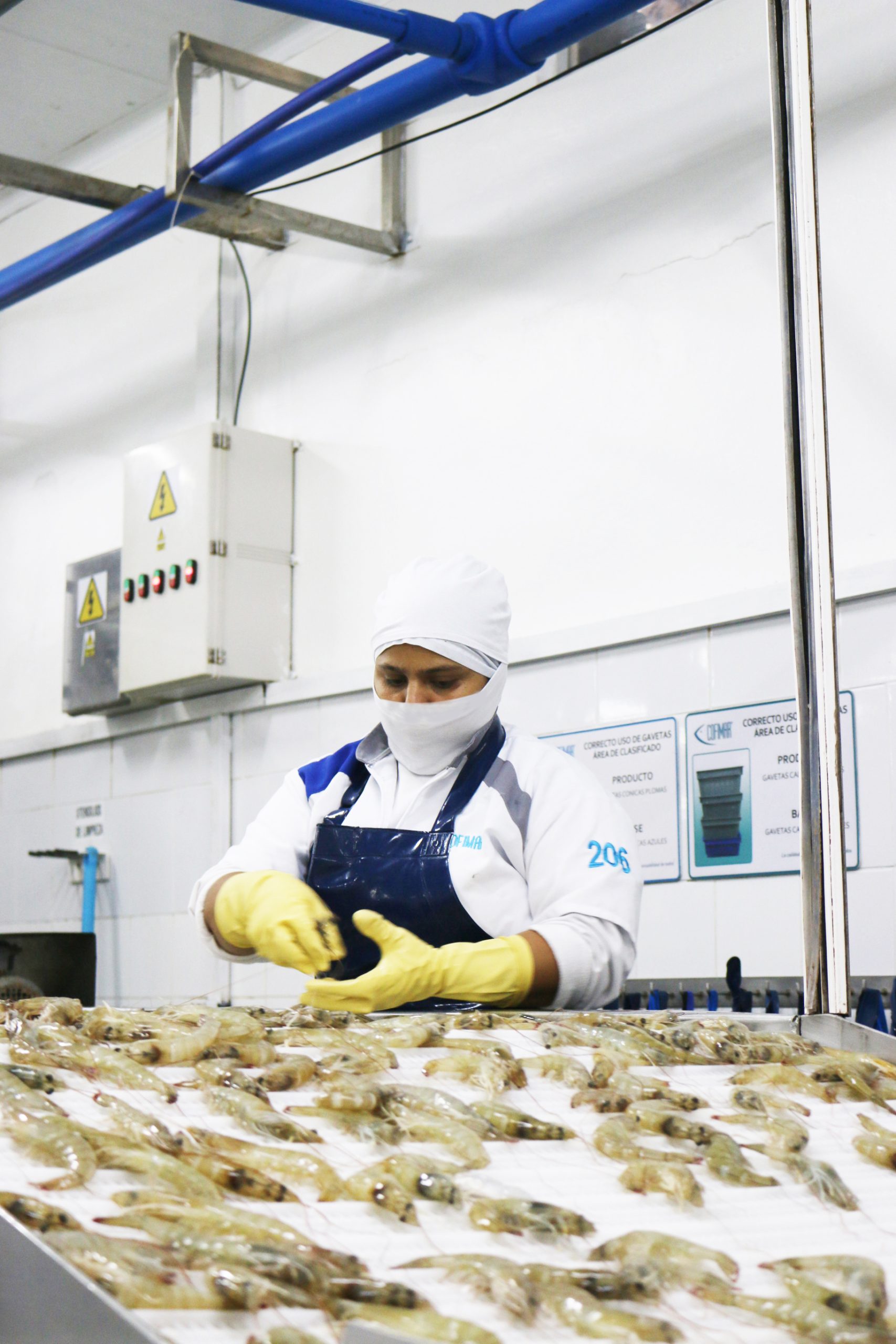
In total, April’s sales to China amounted to US$255 million for 104 million pounds in exports, a figure described by specialist seafood trade website Undercurrent News as a record.
However, José Antonio Camposano, president of the Ecuadorian National Chamber of Aquaculture (CNA), is cautious about the economic impact on the sector.
“We had a month of somewhat higher sales in China due to the closure of other destinations because of the Covid-19 outbreak, but we cannot call it a record or recovery in 2020. The industry is still operating at 90%,” he told Dialogo Chino.
Despite the crisis, Camposano said 261,000 direct and indirect jobs have been preserved in the production chain and temporary staff have even been hired to cover the work of those who need to take a break to restore health: “their jobs will be there when they return,” he said, adding that masks and other biosafety clothing have become administrative and field staff’s uniform.
Camposano estimates that the shrimp sector is likely to lose 10-15% of sales compared to 2019. That drop is attributed to the temporary closure of hotels and restaurants, which account for almost 50% of shrimp sales in importing countries.
At this time, one of the industry’s main concerns is the fall in exports to the US and European markets. In January, Ecuador sold 18 million pounds of shrimp to the US, equivalent to US$45 million. In April, it sold less than half that amount for US$20 million. It was similar in Europe: in January, 20 million pounds reaped US$54 million, while lower sales of 11 million pounds were worth US$29 million.
“The government has been asked to immediately implement a ‘drawback’ (tariff reimbursement scheme) and to open credit lines to provide liquidity to the productive and exporting sectors, which are dealing with an abnormal situation (…),” Camposano said. “Currently, importers have certain inventories that they do not have to return, and therefore, do not require the volumes that they normally request.”
Iván Ontaneda said that for the rest of 2020, the shrimp sector must try to maintain the volume of exports after living through the most difficult months of the health emergency, preserving current markets, and possibly securing new buyers.
“The advantage is that there will always be a demand for food and there will always be opportunities that arise because of the crisis,” Ontaneda said, adding that Ecuador aims to sell other food products to China beyond shrimp and is planning to simplify tax procedures and credit lines to facilitate trade.