“No to bitcoin”, “We don’t want bitcoin!” Unanimous cries were heard in the streets of El Salvador’s capital San Salvador as it became the first country in the world to adopt Bitcoin as legal tender. But with most El Salvadorans confused as to how to use it, the Bitcoin Law has implications for President Nayib Bukele’s popularity, as well as the country’s energy supply.
On September 7, around a thousand people marched to the Legislative Assembly protesting at the introduction of the cryptocurrency and Bukele’s decision to amend the constitution to allow presidential re-election.
As a group of Salvadorans try to jump the barricades and get past riot police to the Assembly, a few kilometers away on Gran Vía – one of the most popular shopping centers in the country, I’m in a queue ready to use the bitcoin ATM for the first time. Two people in front of me turn their bitcoins into dollars and withdraw the money. The process looks simple enough.
Did you know…?
China used to be home to over 65% of bitcoin mining
With the same ease, I try to buy my first bitcoins and fail. After five frustrating minutes of pressing buttons and calling a friend, a young woman explains how to buy them and tells me with confidence that she has been using them for years. In an impromptu lesson, she explains that bitcoin is a digital currency, that it is volatile, but just as its value can drop it can also increase, yielding profits.
Bitcoin is a decentralised currency, meaning there is no authority or control body responsible for issuance and registration of its movements. There is a system to store and use them, called an electronic wallet, which can be used from computers or mobile devices with the bitcoin app.
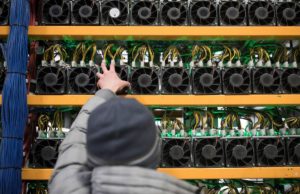
However, the cryptocurrency’s volatility is not its only drawback. The process of bitcoin ‘mining’ – running computers around the clock to generate unique numerical codes that constitute one ‘coin’ – is extremely energy intensive. So much so, that countries including China have banned bitcoin. El Salvador is set to devote one entire geothermal plant to bitcoin mining.
“If you want to talk more about Bitcoin, here is my card,” the woman offers back at the machine before leaving. I’ve learned that if there’s one thing bitcoin fans like more than bitcoin, it’s talking about bitcoin.
China bans Bitcoin as El Salvador moves ahead
El Salvador’s move to legalise Bitcoin comes a few months after China banned it. China’s crackdown, according to the Committee for Development and Financial Stability of the State Council, stemmed from the fear that cryptocurrencies alter the economic order and “resolutely prevent the transmission of individual risks to society in general”.
I have instructed the president of LaGeo, our public geothermal energy company to put in place a plan that offers facilities for mining Bitcoin with energy that comes from our volcanoes
Formerly home to more that 65% of mines, China was the world’s top cryptocurrency market. Its secure energy supply encouraged miners. But environmental activists have criticised the unsustainability of the currency’s energy demands.
Bukele said that geothermal energy will generate electricity for cryptocurrency mining, and urged state-owned renewable geothermal energy company LaGeo to build new facilities to power mines.
“I have instructed the president of LaGeo, our public geothermal energy company to put in place a plan that offers facilities for mining Bitcoin with energy that comes from our volcanoes: Cheap, 100% clean and with zero emissions. This will evolve fast!” he said.
El Salvador has two geothermal plants: Ahuachapán, 103 kilometers west of San Salvador, that has an installed capacity of 95 megawatts (MW), and Berlin, a 109MW-plant 106 kilometers east of the capital. Together they meet the needs of 1.5 million of El Salvador’s 6.5 million citizens.
If bitcoin were mined in El Salvador, it would cause an excessive increase in the demand for electricity and the country would be forced to import more
But according to Álvaro Trigueros, director of the Department of Economic Studies at the Salvadoran Foundation for Economic and Social Development (FUSADES), there are risks involved in devoting energy to bitcoin in a nation already dependent on energy imports.
“Given that the country is not self-sufficient, if bitcoin were mined in El Salvador, it would cause an excessive increase in the demand for electricity and the country would be forced to import more,” he said.
Volatility
Carlos Martínez Cruz, a professor of Electrical Engineering at the University of El Salvador said that handing over a geothermal power plant to the bitcoin industry is dangerous because it is a financial market sector based on speculation.
So how volatile is bitcoin exactly?
I review my transaction in the ATM. My US$25 is now $23 because of the commission. It is converted into 0.00039341 Satoshis or Sats, the name of the fraction of the bitcoin. One bitcoin is currently worth US$7,500, so it has to be denominated in small fractions. In a matter of 10 minutes my $23 has become $21.92. It turns out today is one of the worst days to buy bitcoins because its value fell by 17%. That cost me $1.08 and it cost the government too, which bought 550 bitcoins the day before, over half a million dollars in losses. All in a matter of hours.
“One of the fears is that people start receiving their salary in bitcoins. That is subject to fluctuations because, as you can see, they deposit $300 on payday, when you go to the bank the next day it may drop to $280 and with $20 a family can eat for a week,” said Óscar Salguero, a software engineer states.
Did you know…?
Bitcoin is a decentralised currency, meaning there is no authority or control body responsible for issuance and registration of its movements
To safeguard against fluctuations, the Bitcoin Law proposes a trust at the Development Bank of El Salvador (Bandesal) with reserves of US$150 million. It will function as a convertibility box to support bitcoin transactions in real time. This, in theory, will protect against the much feared volatility of bitcoin in the market. But for economist Rommel Rodriguez, this is not a solution.
“If people start to make many remittances in bitcoins, it implies the entry of this cryptocurrency into the economy and not the entry of dollars,” he said, adding; “The provision of dollars in El Salvador depends on whether they enter the country and if bitcoins begin to enter, there is doubt about how the bitcoin trust is going to provide these dollars,” he explains.
Buying a packet of gum
I leave the ATM with the firm intention of spending what is now US$19.80. But on a tour of the centre of Antiguo Cuscatlán, I visit 30 shops and find that spending my cryptocurrency is impossible.
One of the fears is that people start receiving their salary in bitcoins. That is subject to fluctuations because, as you can see, they deposit $300 on payday, when you go to the bank the next day it may drop to $280
Just as I am about to give up, I ask in one last store if I can use bitcoins there. Luis Benítez, a young man, gets up from his chair confused and replies doubtfully “mmmm, yes I think so”.
After 10 minutes struggling with the application and a couple of error messages, I manage to buy a pack of gum. With the losses from the fall of bitcoin and the cost of the, gum, I ended up spending $3 dollars. It should have cost $0.50 cents.
A survey published by the University Institute of Public Opinion (Iudop) suggests that Bukele’s bitcoin gamble caused his approval rate to drop from 8.7% to 7.6% in just three months. The survey also indicates that 9 out of 10 Salvadorans still do not have a clear idea about what bitcoin is. 67% of the population believes that the law should be repealed. Despite this, it is legally mandated people receive bitcoin as payment. For now, with respect to value, the energy equation and simply how to use it, Salvadorans are left with more questions than answers.