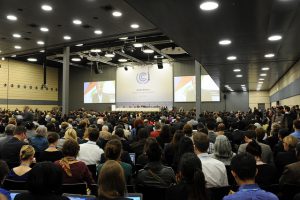
UN climate talks this week are the last major opportunity to refine a negotiating text ahead of the Paris climate summit, but the opening gambits from major emitters suggest a much-needed willingness to compromise remains elusive.
The gap remains wide between fully-industrialised and developing countries on major issues such as who should take the burden of emissions cuts, how to scale up climate finance and the legal status of a future Paris agreement. Without breakthroughs on these critical issues, a weak deal will likely be agreed at the end of the year, making it highly unlikely that the world will have a good chance of restricting a rise in average global temperatures to 2C.
In its last report, the Intergovernmental Panel on Climate Change had underlined that the 2C goal would require a peaking of global emissions in the next decade and a very steep decline after that, an outcome dependent on much deeper cuts than those proposed so far.
This week’s talks got off to an inauspicious start, as South Africa, the country which chairs the G-77+China negotiating bloc of developing countries, requesting that that rich nations commit to cuts before 2020, a timeframe that predates the likely scope of any potential deal struck in the French capital.
China, which is also a member of the BASIC group of large developing economies, said rich countries should deliver on several fundamental elements of a future deal post-2020, including climate finance and technology transfer, rather than just on emissions cuts.
For many, the depth of emissions cuts, also known as mitigation, remains a major worry. National climate plans submitted by 57 countries (including the 28 member states of the EU) so far have fallen well short of what is required to meet a 2C threshold, while the quality of disclosure has varied widely, says a comparative study published on Tuesday by the World Resources Institute (WRI).
Despite concerns about the scale of emissions cuts, the UN is confident that the climate plans submitted so far can form the building blocks of an agreement that will lock both rich and poor and countries into emissions reductions that can be scaled up in the future.
“On their own, the Intended Nationally Determined Contributions (INDCs) received before Paris are not going to keep us below a 2C rise this century. But they underline a sharp and positive departure from business as usual and will form the essential foundation to reach that ultimate goal if governments agree to clearly ramp up ambition over time,” UN climate chief Christiana Figueres said at the start of this week’s talks.
But the draft agreement spans 83 pages, peppered with square brackets, which is the UN’s way of indicating areas of disagreement. This has heightened concern among rich countries that technical negotiations are lagging behind high-level political discussions.
Finance
Finance remains one of the main obstacles to progress in other areas of the talks, despite attempts by the French hosts of the December summit to inject momentum with the presentation of several proposals on how to funnel climate cash to developing countries.
Poor nations are sceptical that the 2009 pledge by Hillary Clinton – then the US Secretary of State – of US$100 billion a year of climate finance by 2020 will be met.
Rich countries have always said that private financing will play a large part, but developing countries are insisting that a much bigger share of climate cash should be delivered by governments into funds such as the Green Climate Fund, and be clearly additional to existing overseas aid.
“Accounting tricks alone and political declarations will not solve the bigger climate finance issue.” Alix Mazounie of Reseau Action Climat France, echoing growing anger among activists and the world’s poorest countries that rich countries are trying to wriggle free from previous commitments on funding low carbon energy and adaptation to a changing climate.
Lawsuits
Frustrated by the lack of progress in the UN negotiations, some of the countries most vulnerable to the impacts of climate change – especially the small island states that are threatened as sea levels rise – have resolved to sue firms that mine or use coal, the fuel blamed most for global warming.
But rich countries at Bonn continue to oppose a compensation clause for loss and damage caused by climate change impacts. They fear a flood of litigation if such a measure was included in a Paris agreement.
The talks come as commodities prices languish at multi-year lows, raising hopes on one hand that the resources industry will rein in future investment and acknowledge that tighter regulation of fossil fuels will render their reserves and assets increasingly uneconomic.
But on the other, some fear that low prices for oil and coal will slow the transition to renewable energy.