![<p>Flood damage along the Bhagirathi river in Uttarkashi in the Himalayas [Image by: Pushkar Rawat]</p>](https://dialogue.earth/content/uploads/2021/02/Uttarkashi_June2013_Flood_damage_Image_Pushkar_Rawat-1024x768.jpg)

Disasters such as the recent flash flood that hit the Himalayan state of Uttarakhand underscore the dangers of climate change combined with poorly planned infrastructure, experts have warned.
Climate change has accelerated the melting of snow in the Himalayas in recent decades, creating unprecedented vulnerabilities that scientists have yet to fully understand. But as more studies gather information on natural and climate induced variabilities, there is hope countries and communities will be better equipped in the face of disasters as well as slow environmental changes.
Climate change impacts in the Himalayan region
Snow plays a significant role in water availability and in turn people’s livelihoods. In the Himalayan region alone, 129 million farmers depend on snow and glacier melt for irrigation. A deficit of snow also impacts water availability, ecosystems and hydropower generation. But the phenomenon known as snow drought, or relative reduction of the snow cover year on year, is still poorly studied.
In a paper published in 2020, researchers at the University of California, Irvine monitored the intensity and duration of snow drought globally from 1980 to 2018 and found that snow droughts were more prevalent and intense across parts of the US, Russia and Europe, whereas the Hindu Kush and Central Asia, greater Himalayas, and parts of South America experienced a recent decrease in snow drought duration.
Himalayas showed a decrease in the average duration of snow drought from 1980 to 2018
“The study underlines the importance of snow in supporting livelihoods for over 800 million people who depend on snow and ice melt,” said Aditi Mukherji, principal researcher at the International Water Management Institute (IWMI).
“There’s already a lot of evidence that these glacier-dependent irrigation systems are facing challenges due to earlier snow melt, or seasonal changes in timing and volume of snow fall.”
How much did it snow?
“Assessing snow has potential both for drought monitoring and even flood warning,” said Amir AghaKouchak, lead author of the study and professor of civil and environmental engineering at Irvine. “If there is below average snow, there may be problems with water availability. If there is a lot of snow, there is a chance of rapid melting resulting in flood.”
To assess snow drought, the authors use a parameter called Snow Water Equivalent (SWE), which is the amount of water obtained if the snow cover melted all at once. They used satellite data measuring SWE from October 1980 to September 2018 and combined them with snow cover imaging to identify vulnerable areas to study further. Snowy areas in Western United States (WUS), Eastern Russia, Europe, the Hindu Kush and Central Asia, extratropical Andes, greater Himalayas and Patagonia were chosen based on the study’s criteria.
The researchers compared snow drought intensity and duration during the first and second halves of the years 1980 to 2018. The analysis revealed that snow droughts across the Western United States, Eastern Russia, and Europe experienced varying degrees of growth, while the Hindu Kush and Central Asia, Andes, greater Himalayas, and Patagonia showed a decrease in the average duration of snow drought.
A decrease in snow drought duration indicates shorter snow drought periods. But this may not always be a good thing as several factors such as temperature and fragile environments can affect snow storage.
Better knowledge of the local water system’s variability can help design more resilient infrastructureAditi Mukherji, International Water Management Institute
Raghu Murtugudde, professor of atmospheric and oceanic science at the University of Maryland (who was not involved in the study) said that the study is good because it analyses the data taking into account both natural and human-made stressors. “The complications are of course in the multitude of factors that can contribute to snow droughts in different regions, especially for the Himalayas which are so far away from the oceans.”
Climate change & incidences of snowmelt in Himalayas
He added that while it is good news that the snow drought duration had decreased in the Hindu Kush Himalayas, it is critical to know why this is happening. If this change is due to weather patterns originating from the Atlantic or the Mediterranean, it could alter monsoon patterns.
Mukherji said that it is difficult to conclusively state that the Himalayan region is experiencing lower snow scarcity compared to previous years, since observational data is subject to large uncertainties.
But even with limitations, a better knowledge of the local water system’s variability can help design more resilient infrastructure.
For example, “if we know that due to climate change incidences of snowmelt floods or similar water induced disasters will increase, it is better to think of alternatives to hydropower, knowing how fragile the Himalaya region already is,” Mukherji said.
Kangkanika Neog, an independent researcher working on water governance, said, “It is essential to note that the vulnerability of the Himalayas is exacerbated by various factors, not limited to snow droughts.” One of the pressing issues policymakers need to address in the Himalayas, she added, “is to include climate smart design in any area, be it agriculture, water or economy.” For example, she said, “farmers should be prioritised when it comes to provision of a data-based management system, including and not limited to smart irrigation advisories.”
AghaKouchak’s previous work has shown that even a one degree change in temperature can significantly change snow distribution. “In places like the Himalayas, where the sensitivity to temperature change is significant, rapid snowmelt is a very critical issue,” he said. “Even in the context of an overall decrease in snow drought, that can turn into massive flood.”
![Upendra Prasad Singh, the Union Secretary for Water Resources [image courtesy: Jal Shakti Ministry]](https://dialogue.earth/content/uploads/2019/07/UP_Singh_Photo_Jal-Shakti-Ministry-1-300x164.jpg)
![Rishi Ganga, Dhauli Ganga flood [image courtesy: Uttarakhand information department]](https://dialogue.earth/content/uploads/2021/02/dhouliganga-flood-pic-credt-information-department-300x162.jpg)
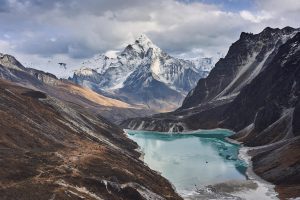
![The Shishper glacier moved forward 2 km in 2018-19 [image by: Karim Dad]](https://dialogue.earth/content/uploads/2020/06/Shishper-glacier-300x225.jpeg)