As Himalayan communities grow increasingly vulnerable to the impacts of rising temperatures, schools in Nepal are struggling to prepare young people for a future shaped by climate change, teachers and experts tell The Third Pole.
In December 2019, climate education was included for the first time in Nepal’s education goals, in the national curriculum developed and published by the education ministry’s Curriculum Development Center (CDC). Translated into English, the relevant goal sets out “to prepare citizens [to be] capable of reducing possible risks and managing disasters, while being aware of climate change, natural and manmade disasters.”
More than three years later, however, multiple education experts and schoolteachers from across Nepal tell The Third Pole that access to educational resources on climate change remains limited.
Lack of resources for climate education
Rama Devi Kafle Aryal is a teacher at Shree Adharbhut Bidhalaya, a primary school in the city of Bharatpur, around 180km south-west of Kathmandu. Aryal, who teaches a range of subjects including social studies, says the government has not provided “proper guidance” or educational resources on climate change and other environmental issues.
Shree Adharbhut Bidhalaya school is close to Chitwan National Park, where conservation successes have brought benefits but also problems for local people, especially indigenous groups. Over 80% of the school’s students come from the indigenous Kumal community.
“A lesson on climate change is included in Social Studies, but [it only] briefly mentions general information,” Aryal says. “We don’t have more resources or training to make teaching effective. We sometimes try to teach [about climate change] by searching for information on YouTube or in other books.”
Teachers further north in Solukhumbu district, where Mount Everest base camp is located, tell The Third Pole that they too struggle to communicate with students about the problems that rising temperatures are creating in the mountains.
“Maybe it is because we are far from the capital city Kathmandu we have not received much attention,” says Ngawang Dorjee Baing, principal of Khumjung Secondary School in Solukhumbu district. “I don’t remember getting any direct programme from the government on climate education.”
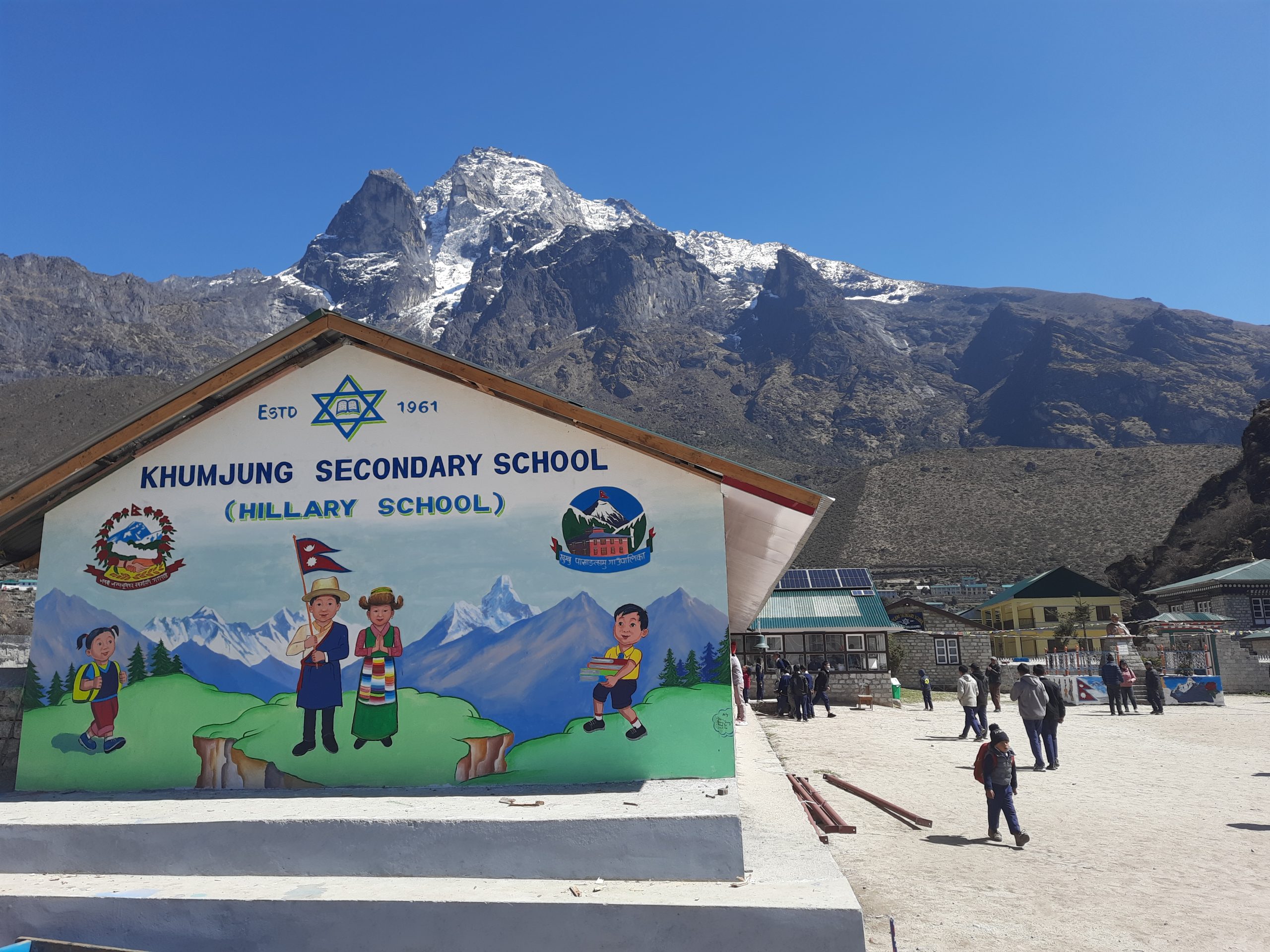
“Government officials and experts are eager to talk about mountains in our region to explain the intensity of climate change at a national and international level. But there is no serious interest in talking about it to children here, who deserve to know more about impacts and adaptation,” says Baing.
Children in classes 7 and 8 (ages 12 to 13) are given dedicated lessons on climate change through Nepal’s state-set curriculum. After that, however, for the remainder of their schooling, which concludes at age 17 in class 12, the state curriculum does not stipulate specific books to be used for climate change studies.
‘Textbooks are not everything’
A representative of the Curriculum Development Center says it has “carefully considered and designed” the current syllabus to address climate change, the environment and natural resource management.
“Textbooks are not everything,” says Babu Ram Dhungana, an information officer at the CDC. “It is a teacher’s responsibility to find relevant material and information to give students current information.”
600,000
The approximate number of children between the ages of 10 and 15 currently enrolled in classes 5 to 10 in Nepal.
Baing, principal of the school in the Himalayas, says the information gap is filled to some extent by non-profit organisations like the Sagarmatha Pollution Control Committee (SPCC) and the Himalayan Trust Nepal, who train teachers on how to communicate with students on the subject of climate change.
According to Kapindra Rai, a programme officer at SPCC, the committee works with students and teachers to improve their understanding of environmental conservation. “Students are active and always eager to know more about what is going on in their area and how they can contribute. But collaboration is limited because of limited resources,” says Rai.
Dhungana, the CDC’s information officer, disagrees that there is not enough material to help teachers with education around climate change. “There is a teacher’s guide and there is also a training package for teachers,” says Dhungana. “The source materials are sufficient. And course lessons on climate change are also enough.”
Teachers like Aryal, however, say they are often left to search for material on YouTube to use in their classrooms.
Many students in the dark on climate change
When The Third Pole spoke directly with students, their responses raised questions about the coverage climate change gets under the current curriculum.
13-year-old Ojasvi Shakya, a class 8 student at the United School in Lalitpur, is keen to learn about environmental issues. “We need fresh air to breathe and clean water to drink – that’s why we all have a responsibility to conserve the environment,” she says. But Shakya has heard little about climate change in the classroom. “We haven’t learned about that topic, but we do want to know more.”
27.8% aged under 14
Of Nepal’s total population of about 30 million, 27.8% are aged 14 or under
A 2020 study by UNICEF, which surveyed almost 26,000 respondents between the ages of 15 and 24 across eight South Asian countries, found significant gaps in climate education. The study found that 1 in 10 respondents in Pakistan, India, Afghanistan and Sri Lanka said they “never” learn about climate change in school. The highest proportion of respondents that could “explain climate change and global warming” was in Bangladesh, at 50%, whereas the lowest was in Pakistan, at 27%. In the case of Nepal, only 34% of 4,197 students reported that they could explain climate change and global warming.
“We have compulsory subjects [like] math, English and so on,” says Sanjeevani Yonzon Shrestha, a conservation and education activist based in Kathmandu. “But subjects which deal with life on this earth have a very weak presence in our schools.”
Yonzon’s organisation, Wildlife Conservation Nepal (WCN), runs an environmental education programme called Nepal Prakriti Pathshala (Nepal Nature School) which works with over 1,000 schools in Nepal and has conducted about 150 teacher training sessions, with the aim of encouraging responsible natural resource use in the country.
We don’t think a compulsory book on environment and climate change is necessaryHemraj Khatiwada, head of social studies at Nepal’s Curriculum Development Center
She points out that before the new curriculum came into effect, there was a compulsory subject titled Environment, Population, and Health (EPH) for classes 9 and 10 (ages 14 and 15), but this is no longer available. In 2020-21, the CDC instead introduced Environmental Science as an optional subject for classes 9 to 12 (ages 14 and 15).
Hemraj Khatiwada, subject head of social studies at the CDC, tells The Third Pole: “Even though we don’t have a dedicated subject, climate change is covered in a different way in books like science and even in English. We don’t think a compulsory book on environment and climate change is necessary. If students want to study, there is an optional subject.”
Buddi Sagar Poudel, who leads the Climate Change Management Division (the only government agency dedicated to climate change) at Nepal’s Ministry of Forest and Environment says: “I accept that there is little discussion about education. There is some weakness in coordination, where we thought the concerned ministry will handle it, and they thought we will oversee it.”
Localising climate education in Nepal
“We need more on climate and environmental education because it is one of the most sustainable investments in the future,” says activist Snjeevani Yonzon Shrestha. “We can do more than we are doing now, and for that we have to use local resources and provide training that is better suited to where the educators are teaching.”
Yonzon advocates for “place-based learning”, in which students learn from exploring their surroundings and environment, to communicate the bigger picture to Nepal’s students. This approach was taken at the Kopila Valley School in Surkhet, which was started in 2010 by philanthropist and educator Maggie Doyne. “We allow our students to go out and explore nature and they try to make sense [of it]. Our teachers assist them,” says Doyne.
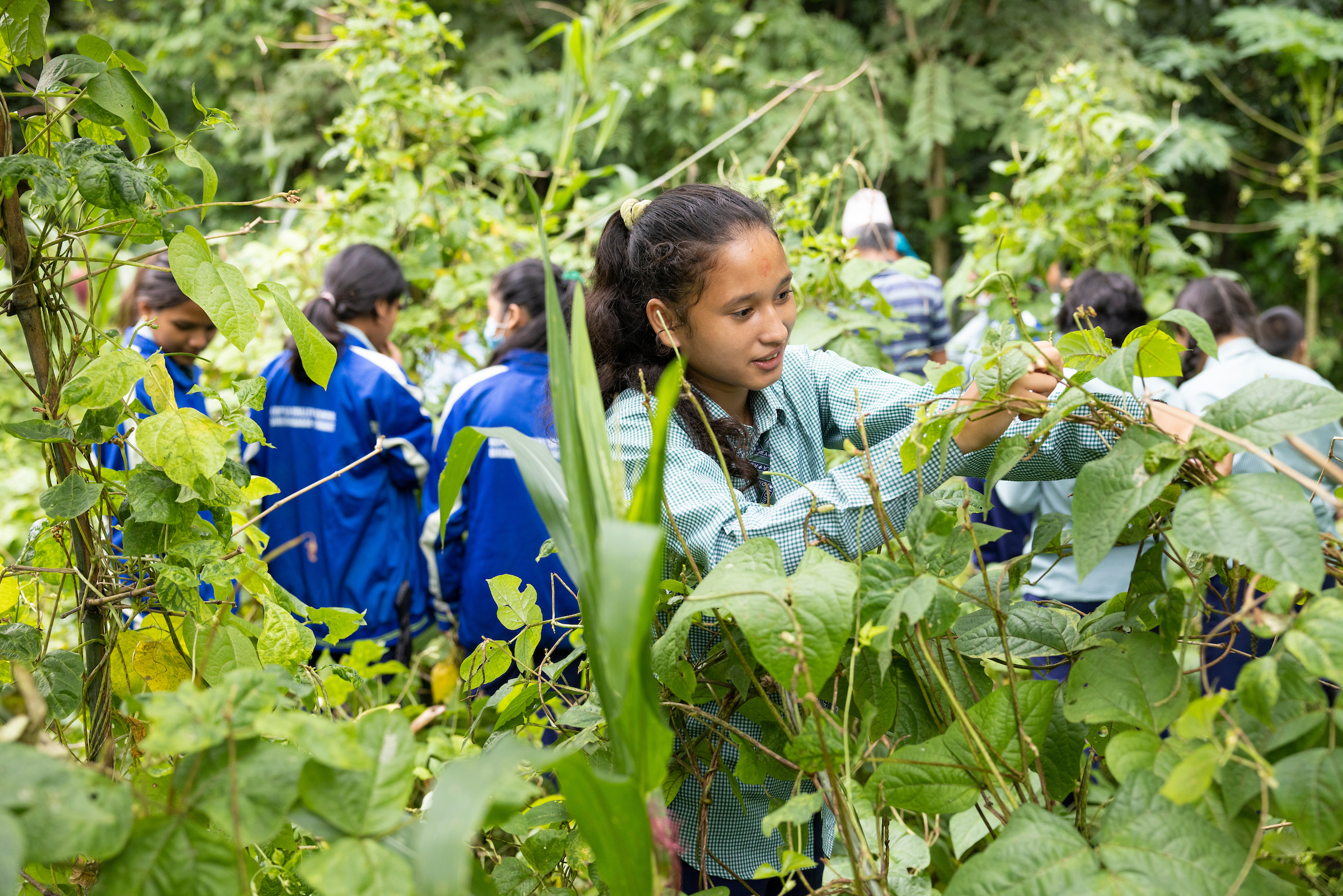
Doyne agrees that the state-set curriculum lags behind when it comes to addressing the urgent need for environmental education in Nepal.
“If we really want our children to grow up with a sense of responsibility towards the nature they are living in, we can teach by letting them explore the surrounding environment,” she says.
“Introduction to environmental issues through fear is what almost all education systems are doing – [children] are growing up hating nature,” Doyne argues. “As an adult, we can show how we interact with nature and how we can appreciate it. It will inspire them and help them to love nature, so they can protect it in the future.”