Changes in transport use due to the Covid-19 pandemic and national recovery plans are an opportunity for governments and businesses in Latin America and the Caribbean to accelerate the transition to electric mobility, according to a recent report by the United Nations Environment Programme (UNEP).
The report is UNEP’s annual review of the state of the sector, which, according to its authors, is gaining momentum as users opt for cleaner means of transport. This is coupled with more ambitious climate commitments from governments that specifically include the transport sector.
“2020 was a disruptive year for transport in the region. If countries and companies know how to take advantage of the context, the transformations we see today can open the way to fully sustainable mobility with a clean energy matrix,” said Gustavo Máñez, UNEP’s Regional Climate Change Coordinator for Latin America.
80%
Of Latin America's population lives in urban areas
Transport is the main, and fastest growing, source of energy-related greenhouse gas emissions in Latin America, accounting for one-third of total emissions. Nearly 80% of the region’s population lives in urban areas and by 2050 that figure could rise to 90%, according to UN figures.
Still, the region has a critical window of opportunity to electrify its transport sector. Latin America has one of the cleanest electricity grids in the world, with 60% of installed capacity coming from renewable energy, mainly hydropower but with expanding solar and wind. It also has the fastest growing car fleet in the world.
“Latin America and the Caribbean has the opportunity, and the potential, to drastically reduce transport emissions and improve urban air quality with electric mobility based on a clean energy mix,” said UNEP Director Piedad Martin in the foreword to the report.
Progress on electric transport in the region
According to the report, 27 of the 33 countries in Latin America and the Caribbean have prioritised transport as a central element in reaching their emission-reduction targets under the Paris Agreement. However, countries in the region do not have short- or medium-term targets for ending the sale of combustion vehicles.
National efforts to formulate electric mobility strategies grew last year. Argentina, Ecuador, El Salvador, Guatemala, Honduras, Mexico, Nicaragua and Paraguay are in the process of developing their plans. While Chile, Colombia, Costa Rica, Dominican Republic, Panama had already published national policies in previous years.
“It is a clear sign that all governments in the region are on this path and take into account the importance of decarbonisation of the sector,” said Jone Orbea, leader of UNEP’s electric mobility programme. “Regulations have been built and governance structures have been generated that facilitate electric mobility.”
Urban public transport remains a priority in mobility plans in the region, which has the highest bus use per capita of any of the world’s regions. However, reduced ridership caused by the Covid-19 pandemic changed the use of some public transport.
The cities with the greatest progress in bus electrification were Bogotá, with the acquisition of 406 buses, and Mexico City, which added 193 trolleybuses. If current trends continue, 5,000 electric buses per year will be newly deployed in the region from 2025, the UN estimates.
It is a clear sign that all governments in the region are on this path and take into account the importance of decarbonisation of the sector
The private electric vehicle market also grew in 2020 in Latin America. In Costa Rica, registration of electric cars grew 77% in 2020 and registration of motorbikes increased 36%. In Peru, imports of electric motorbikes increased 220% year-on-year, according to the report.
The report also highlights that countries in the region have innovated in developing business models that circumvent the high upfront costs of electrification and reduce the associated financial risks. However, these are not easily replicable and it is necessary to integrate solutions that reduce the financial risk.
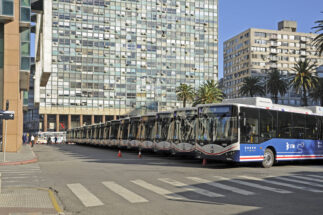
“Bogotá purchased electric buses through a public tender, which represents a trend reversal. While Montevideo transferred subsidies earmarked for internal combustion buses for the electrification of urban public transport,” said Fabricio Pietrobelli, UNEP’s expert on electric mobility.
Latin America’s green recovery
The economic crisis resulting from Covid-19 has left Latin American countries struggling. The region’s GDP fell by 7.7% in 2020 and is not expected to return to pre-pandemic levels until 2024, according to the UN Economic Commission for Latin America and the Caribbean (ECLAC).
Against this backdrop, the authors of the new UNEP report argue that it is crucial that transport spending and investment is directed towards cleaner long-term solutions as part of post-Covid-19 economic recovery plans. This must include rethinking fossil fuel subsidies, which remain high in many Latin American countries.
“Electric mobility can be the engine of Latin America’s post-pandemic economic recovery. In Mexico and Brazil there are millions of jobs related to vehicle manufacturing and assembly, so there is great potential to manufacture our own electric vehicles and charging facilities,” said Máñez.
Latin America’s automotive industry has been slow to transition to electric units, and most of the goods in the region are imported. Similarly, the availability of charging infrastructure is limited to imports. This is why a repurposing of the region’s industries could bring numerous opportunities.
Last year, the Chinese company BYD inaugurated its third factory in Brazil, located in the Manaus Industrial Pole (PIM), where it assembles batteries. Together with Brazilian company Marcopolo, BYD produced the first articulated electric bus chassis that was 100% made in Brazil. Marcopolo has a plant in Colombia, which will soon assemble electric buses.
The decarbonisation of Latin America’s economy, including transport, would eliminate 7.5 million jobs but at the same time generate 22.5 million new jobs in sectors such as construction, manufacturing and renewable energy, according to a report by the Inter-American Development Bank and the International Labour Organisation.
However, achieving this will not be easy. Latin America is investing too little in a green recovery from the pandemic, with only 2.2% of the region’s stimulus funds spent on environmentally sustainable projects in 2020. The percentage is significantly lower than the global average of 19%.
“As the region’s economies decide where investments will go in the face of pandemic recovery, the sustainable transport sector and its integration with renewable energy offers the opportunity to generate employment and industrial sector development,” said Horst Pilger of the EU’s Euroclima programme.