President Alberto Fernández’s trip to China in February heralded the accession of Argentina to the Belt and Road Initiative (BRI), and confirmed a series of energy investments that could boost its energy transition – but also facilitate fossil fuel development.
Argentina has had limited or no access to international financial markets for years, a situation that is likely to endure, owing to its high level of sovereign debt. The nation did, however, recently agree a debt restructuring deal with its main creditor, the International Monetary Fund. Meanwhile, China’s interest as an investor in Argentina is growing, with the signed memorandum of understanding (MoU) on the BRI specifically mentioning the energy transition.
13%
The current share of renewable energies in Argentina's energy mix. The country is aiming to reach 20% by 2025.
Worldwide, nearly 40% of China’s foreign investment under the framework of the BRI has gone to the energy sector, according to researchers at Fudan University. Though China currently generates more than a quarter of global carbon dioxide emissions, it has ambitious domestic decarbonisation plans, and with greater overseas investments in renewables, it could accelerate a global energy reconfiguration.
“At [2020’s] UN General Assembly, President Xi Jinping said that [China] will reach carbon neutrality by 2060,” said Néstor Restivo, a historian who specialises in the Argentina–China relationship. In 2021, he added, “no project involving coal anywhere in the world received BRI funding.” Xi also pledged at 2021’s UN assembly to pursue greater support for renewables worldwide.
Alberto Fernández’s government estimates that to meet its climate commitment of a 26% reduction in greenhouse gases by 2030, it will need to incorporate between 8.7 and 11.8 gigawatts (GW) of renewable power by 2030. This will require investments of between US$422 million and $751 million annually. Argentina also has a target of achieving a 20% share of renewables in the energy mix by 2025. It’s currently around 13%.
“China has an overwhelming presence as a supplier of renewable energy inputs. With attractive financing behind it, it will continue to grow strongly in the local [Argentina] market. It has been doing so in Brazil, Colombia, Ecuador, Peru and Chile,” said Gustavo Castagnino, director of corporate affairs and sustainability at Genneia, Argentina’s leading wind energy company.
China in Argentina’s energy sector
China is already a major player in the renewable energy sector in Argentina, in the supply of technology, the construction and operation of wind and solar farms, and the sale of equipment. China produces about a third of the world’s wind turbines, around 80% of solar panels and two thirds of lithium batteries.
Chinese company Goldwind, the second largest global manufacturer of wind turbines, owns the 250-megawatt (MW) Loma Blanca wind farm in the southern province of Chubut, and the 96 MW plant in Miramar, Buenos Aires province. PowerChina, a state-owned construction and engineering company, built the plants.
With attractive financing behind it, China will continue to grow strongly in the Argentine renewables market
PowerChina also built and operates the Cauchari solar park, the largest in the country, with an installed capacity of 315 MW, which was contracted by JEMSE, a provincial state-run energy company in Jujuy province. The Chinese firm also built the Cafayate Solar Park project (101 MW), contracted by Canadian Solar, and the Diaguitas (2.4 MW) and Tamberías (3.6 MW) solar parks in San Juan province. It is also working on 65 MW of solar projects in Córdoba.
In wind, Chinese company Envision Energy has won contracts to develop the 10 MW García del Río farm in Bahía Blanca, in the south of Buenos Aires province, and the 50 MW Vientos del Secano wind farm in Villarino, Buenos Aires. Envision is also involved in the construction of the 125 MW Los Meandros wind farm in the southwestern province of Neuquén, although the project is currently in doubt due to difficulties in accessing finance.
According to researcher Juliana González Jáuregui in a report for the Carnegie Endowment for International Peace, in 2016 and 2017, Chinese firms won 29% of the total number of projects awarded through the RenovAR programme, Argentina’s regulatory framework that has sought to boost investment in the renewables sector. They acquired 19% of the megawatts tendered for wind energy and 45% for solar.
New renewables projects
The closer relationship Argentina has developed with China since Fernández came to power in 2019 has laid the groundwork for unlocking new Chinese investment. This political relationship informs business decisions made by Chinese companies and facilitates bilateral financing mechanisms.
The two countries identified ten infrastructure works to be financed by China in the Strategic Dialogue for Economic Cooperation and Coordination, a roadmap for bilateral development cooperation. It includes a number of energy projects, the most advanced of which is the construction of hydroelectric plants on the Santa Cruz River in Patagonia, which will add 1,300 MW of power to the national electricity system.
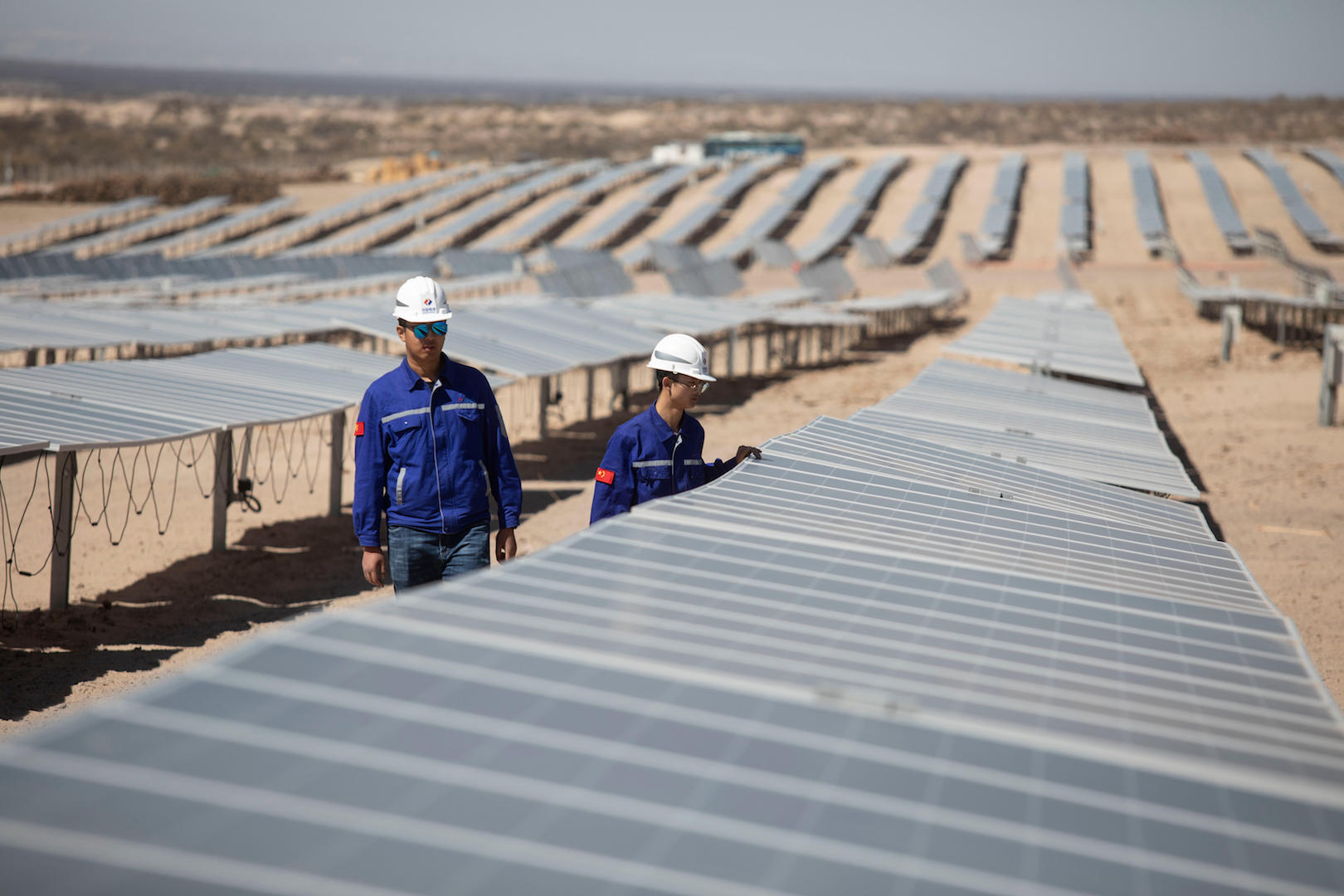
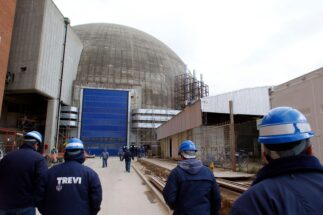
New infrastructure projects also include: the country’s fourth nuclear power plant, a US$8 billion project to add a further 1,200 MW, which will use a Chinese reactor; the 200 MW expansion of the Cauchari solar park for $200 million; and the Cerro Arauco solar park for another 200 MW.
But that is not all. Chinese companies are also interested in the El Escorial wind farm in Chubut and in electricity transmission infrastructure in Buenos Aires. There is also the Potrero del Clavillo–El Naranjal hydroelectric project in Catamarca province, for which the government has already signed a memorandum of understanding with PowerChina.
Chinese company Ganfeng Lithium, which is developing the Mariana lithium production project in Salar de Llullailaco, Salta province, has contracted PowerChina to build a 30 MW solar farm to supply its own energy. Ganfeng Lithium also owns 51% of the Caucharí-Olaroz project, which is expected to start producing lithium in 2022. In addition, PowerChina has pipeline projects to supply 24 MW of energy to French company Eramet’s lithium plant and 6 MW to the Australian firm Orocobre in Catamarca (6 MW).
“We have important projects in operation and also to be developed in the short term in Argentina,” said Tu Shuiping, president of the PowerChina in Argentina. “The incorporation of the country into the New Silk Road is a favourable condition.”
Fossil fuel investments
China is also an important player in the fossil fuel sector in Argentina and, despite its pledge to cut overseas coal investment, there are also new non-renewables projects in the pipeline.
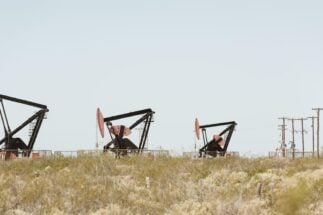
Since 2010, China National Offshore Oil Corporation (CNOOC) has been a shareholder in the Pan American Energy Group (PAE), the largest privately owned oil company in the country. PAE is the second largest operator in the Vaca Muerta unconventional oil and gas field, in terms of area awarded in its concessions.
Also in 2010, Chinese firm Sinopec acquired US-based Occidental Petroleum’s Argentinian assets, which represented the country’s fifth largest oil company. However, in 2021, the national firm Compañía General de Combustibles (CGC) bought this Argentina arm of Sinopec, before the Chinese firm ceased operating in the country.
China could also finance a new pipeline that the government plans to build to transport an increased capacity of shale gas from Vaca Muerta to the provinces of Buenos Aires and Santa Fe, along with a connection to southern Brazil. Chinese entities are also interested in the installation of the Manuel Belgrano II combined cycle power plant, which would contribute 810 MW of power to the electricity system.
The potential
Beyond good political ties with China, Argentina’s financial restrictions and the Asian country’s interest in growing its equipment sales and energy companies’ presence, the renewables market in Argentina faces a series of challenges ahead, especially with a number of previous projects remaining in a legal limbo.
In 2018, the country entered an exchange rate crisis that changed the financial landscape and led to the suspension of several investments that had been awarded during the Mauricio Macri administration. Many of projects were not decommissioned by companies, in order to avoid paying fines for non-compliance. While initiatives are underway from the national government to clear this, there has been no final resolution
At the same time, expanding the country’s renewable energy matrix would require investments from the Alberto Fernández administration or private companies on further high-voltage transmission lines, as the current ones are already at their maximum capacity. Solar and wind resources are primarily located in the north and south of the country, away from its most populous cities.
Argentina has excellent wind resources, growth potential, and laws and regulations that support the development of clean energy
Sources from the Ministry of Economy told Diálogo Chino that China’s attractiveness as a development partner lies in its financial capacity, but that there are differences between foreign direct investment – in which the private company assumes the risk of the project – and a sovereign loan, in which the risk is transferred to the Argentine state. As such, only part of the foreign currency ends up in the country, while another portion stays in China to buy equipment.
Marcelo Kloster, president of the Argentine state-owned energy company IMPSA, stressed that the incorporation of the nation’s industry into the energy value chain is another, long-standing issue. The government is seeking to support national industries so that they can play a greater role. China is reportedly “more open than before” to the idea, Kloster said.
Ling Peitian, general manager of Goldwind Argentina, said that investing in Argentina carries extra risk compared to other South American countries due to its legal and regulatory volatility, foreign exchange restrictions and limited electricity transmission capacity. Yet, this does not detract from the “very high attractiveness” of the market, Ling told Diálogo Chino.
“There are excellent wind resources, growth potential, and laws and regulations that support the development of clean energy. Furthermore, investments now fall under the BRI, China’s international economic cooperation initiative, which Argentina has joined,” Ling added.
Editor’s note. This article was updated on March 16 to add information about the MoU between Argentina and China.