Argentina’s energy network has not been upgraded in years and has not met surging demand. This increased under the last administration owing partly to policy choices. Electricity was heavily subsidised, discouraging “rational and efficient” energy use and causing shortages, according to new energy minister Juan José Aranguren. Lifting the subsidy led to a spike in prices, leading to demand for more affordable electricity.
One might think that in the midst of these energy shortages, the new Kirchner and Cepernic dams, which are expected to be completed in 2018 and add 5% to Argentina’s energy capacity, would be warmly welcomed. Not so. Some 2,500 kilometres from Buenos Aires, the country’s principal demand centre, the Kirchner-Cepernic complex is not ideally located, as government information concedes. Moreover, there are at least a dozen other projects on the table with a higher economic, social and environmental viability rating. So why are they going ahead?
The promise of Chinese finance is an important factor.
After two failed bidding processes for the project in 2007 and 2012, Santa Cruz’s provincial water law was amended in 2013 to allow private capital to harness hydropower. In a third round of bidding that year, the contract was finally awarded to Represas Patagonia S.A. (Patagonia Dams Corporation), a consortium made up of China Gezhouba Group Company Limited, Electroingeniería (Electro Engineering) and Hidrocuyo S.A. (Hidrocuyo Corporation). The bidding process was characterised by a lack of transparency.
Gezhouba has a blemished record at home. In May 2015, the World Bank Group disqualified the company and its subsidiaries from bidding for projects for a period of 18 months due to its poor conduct in three projects in China relating to water conservation, earthquake recovery and flood management co-financed by the Bank of China. Furthermore, in June 2016, a contract for the transportation of drinking water was cancelled after the company overstated the scope of the job and failed to provide prior technical studies.
Along with China Development Bank (CDB) and the Industrial and Commercial Bank of China Limited (ICBC), Bank of China will provide the US$4.7 billion in finance required for the Kirchner and Cepernic dams (see chart).
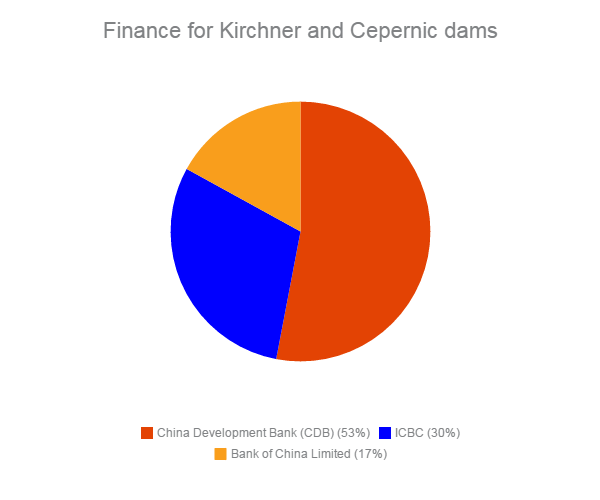
The loan carries a LIBOR rate (London Interbank Offered Rate – the rate of interest at which leading London banks would charge if lending to other banks) of 3.8% for 15 years, with a grace period of five and half years coinciding with the project’s construction. This means credit will be cancelled out as work progresses. It is estimated that 76% of the credit will be sent to the country by means of certificates of work progress, while the balance remains in Chinese accounts in order to pay for agents, machinery and other capital goods suppliers. The financing agreement and any resulting extra contractual obligations will be governed by English law.
Environmental impacts
The Kirchner and Cepernic hydroelectric complex will affect the course of the Santa Cruz river, Argentina’s last glacial river which flows freely from the Andes Mountains to the Atlantic Ocean. It will not only impact the fauna and flora that depend on it, but also the Monte León National Park and the Perito Moreno National Park, which contains the Upsala and Perito Moreno Glaciers – one of the largest reserves of fresh water in the world outside the polar regions. The site is also a UNESCO World Heritage Site and the development is in manifest contravention of Argentina’s Glacier Protection Act (Law No. 26,639) and the National Parks Law (No. 22,351).
The environmental impact assessment (EIA) for the dams was seriously flawed. It prevents the implementation of a comprehensive analysis of the impacts of the project, which should be fundamental to the granting of an environmental licence to operate. This is in breach of the minimum requirements established by the Argentina’s General Law on the Environment. The situation has resulted in two lawsuits being filed to the nation’s Supreme Court, which ordered the current government to present reports on the contents of the controversial EIA.
In terms of the economic viability of 30 projects on the table, the Kirchner and Cepernic dams were ranked 23rd and 25th respectively, according to an energy ministry report.
Stronger China ties
Since 2012, Argentina has strengthened its political and economic ties with China. This year, a joint declaration was signed which provided the initial stimulus to frame agreements linked to energy, transport and agriculture. The negotiations started a conversation on funding the 1,511-kilometre Belgrano Cargas Railroad, which will be funded by CDB and ICBC.
In 2014 Sino-Argentine bilateral relations were elevated to the status of “strategic integral alliance”. This happened at a time when the Argentine government, in the midst of a dispute over repayments to international creditors over its 2002 default, found it extremely difficult to access financial markets. This put strong pressure on Central Bank reserves which, again, placed the country at risk of default. The deal with China consisted of 18 agreements including a currency swap aimed at bolstering foreign exchange reserves.
The close bilateral relationship was reiterated in early 2015 with the signing of new agreements, in addition to Argentina giving the green light to begin construction of the dams following the disbursement of a two million-dollar loan disbursement, even though no EIA had been concluded.
Faced with the possible cancellation of the project, CDB sent a letter to the Treasury – by now under the control of a new government – and to Gezhouba, reminding it of the terms of the US$4.7 billion loan. CDB pointed out the connection with the US$2 billion loan for the Belgrano Cargas train line. This includes a clause, known as a cross-default, which would cut the line of credit to a project financed by CDB in the event that another one of its supported projects were abandoned.
If the dam project defaults on repayments, financing for the railway and a total of US$6.8 billion in finance for our country would also be in jeopardy. The environmental concerns over the dams are drowned out by fears over the larger streams of finance their cancellation would obstruct.