After more than a year of legal conflicts, the government of Mauricio Macri will seek to recommence construction of two controversial hydroelectric dams in Patagonia, projects widely challenged by environmental, but necessary to unlock more finance from China to Argentina.
The Néstor Kirchner and Jorge Cepernic dams on the Santa Cruz River will require investment of US$4.7 billion, of which Chinese banks will provide 85%. Chinese company Gezhouba and Argentine firms Electroingenería and Hidrocuyo will execute the project. Its progress is a necessary condition for the development of other projects by China in Argentina.
“If we had no commitment to China, we probably would not have progressed at this speed,” said Juan José Aranguren, minister of energy and mining.
Sergio Bergman, Argentina’s environment minister, was unequivocal on the role of loan conditions in the project advancing, saying contracts with China “influence the State”.
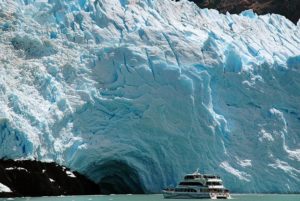
The project was awarded in 2013 and construction began in 2015, mired in controversy. Environmental organisations warn of the environmental damage that dams could cause, including affecting the biodiversity of the area and the Upsala, Spegazzini and Perito Moreno glaciers, which UNESCO has declared a World Heritage Site.
“The project is continuing only because there is an international commitment to be fulfilled. China imposes conditions that force the government to proceed with construction. Archaeological sites will be badly affected as will be the hooded grebe [macá tobiano], a bird [unique to the area] that is at risk of extinction”, Andrés Napoli, executive director of the Environment and Natural Resources Foundation (FARN) told Diálogo Chino.
On taking office, the Mauricio Macri-led government halted the development of the dams, ordered a new analysis of their feasibility and changes to the project. The power the dams would generate was scaled back from 1,740 to 1,310 megawatts (MW); the number of turbines was reduced from 11 to 8; the height of the dams was lowered to avoid negative impacts and an additional high voltage line was constructed.
However, the project was soon became paralysed. The Supreme Court accepted a complaint from environmental organisations that the project lacked a proper environmental impact assessment and ordered the government to carry out a new study and conduct a public hearing. Both these stages have now been completed. The Macri administration now hopes to relaunch the project as soon as September.
“There is no turning back regarding the work. The government needs the funds and the jobs it will generate in the face of financial strangleholds. The project should have been better thought out when it was initially conceived. With these stoppages and changes the State is behaving like an amateur,” said Gustavo Girado, a researcher specialising in contemporary Chinese studies at the National University of Lanús (UNLA).
No common ground
The recent public hearing threw up seemingly irreconcilable differences of opinion on the dams. Some see a paradise of biodiversity under threat, others see energy opportunities and a contribution to the reduction of carbon emissions as an alternative to thermoelectric energy sources.
Enrique Viale, president of the Argentine Association of Environmental Lawyers and a candidate for a seat in the house of deputies in congressional elections later this year, told Diálogo Chino:
“The dams have environmental, economic and institutional inconsistencies. With the same money, solar and wind projects could be carried out yielding 70% more energy. The public hearing was a farce as the government has already decided to undertake the work. But we are going to continue to fight.”
Changes in the project do not guarantee there will be no serious environmental impact, according to a coalition of environmental NGOs. The same is true of the new environmental impact study, which was criticised in part due to the fact it contains no analysis of the impact of the power lines.
The government and energy specialists see the hydroelectric plants as the lynchpin of a more diversified matrix, which they say requires continuous energy generation and an increased share of renewable energy. Almost 90% of Argentina’s energy matrix today depends on non-renewable sources, particularly gas and oil, according to the International Energy Agency.
“The [hydroelectric] project is extremely important for the Argentine energy system. It allows for the addition of the energy we need. The dams have financing, with initial works already having taken place, and it must go forward. We do not see inconveniences or circumstances that would require stoppages, but the opposite,” said Oscar Navarro, a member of the Argentine Committee of Large Dams.
Pablo Chelmicki, an engineer with the Argentine Chamber of Engineering Consultants stressed the same point, reiterating the need to achieve a cleaner energy matrix in Argentina. He also ruled out any kind of environmental impact from dams that cannot be mitigated. “We have a very polluting energy system and the dams would be a starting point to help to change it,” he said.
The Ministries of Environment and Energy admitted that the project will have impacts, and announced a US$400 million mitigation and compensation plan. They will create new protected areas comprising 337,000 hectares and monitoring centres for the glaciers.
Close links
Argentina has a “comprehensive strategic alliance” with China, a diplomatic status enjoyed by few countries. More than 20 treaties were signed to develop cultural, technological, energy and economic projects.
While China has guaranteed funding for key energy and transportation works such as dams and nuclear power plants, Argentina authorised the award of works without a prior bidding process and opened the door for Chinese labour. The relationship between both countries is long-standing, but was initially questioned by Macri due to the type and lack of transparency around the contracts.
Progress on the construction of the dams is a key step in unlocking and pushing forward other projects for which Argentina needs financing from China. These include renovating the fleet of trains and the network of the state-owned Belgrano Cargas line in the central northern province of Santa Fe, in addition to the construction of two nuclear power plants. That message was reiterated to Macri on his trip to China in May.
The trade relationship between the two countries has been described as “asymmetrical” or unequal and this is acknowledged by both governments. Argentina has an annual trade deficit with China of around US$5 billion. More than 95% of Argentina’s exports to China are primary resources.
“At this point, there is no other way out, but for the project to move forward. Argentina demands more and more electricity, and needs this project. If it succeeds in moving ahead, China will immediately provide financing for nuclear power plants and solar and wind projects. Completion of the dams frees up other projects that are now frozen,” said Ernesto Taboada, executive director of the Argentina-China Chamber of Commerce.