The shift to renewable energy is often described as a political and economic challenge; a struggle to mobilise substantial investments and overcome vested interests that profit from a fossil-fuel economy. But there’s another challenge that receives far less attention: do we have enough land and water to accommodate the production of renewable energy?
Bio-energy, hydropower, wind, solar and geothermal all require substantial land and water resources. And these are limited. A closer look at the different ways of capturing renewable energy and the amount of water and land they require reveals which energy scenarios are more feasible in the long run.
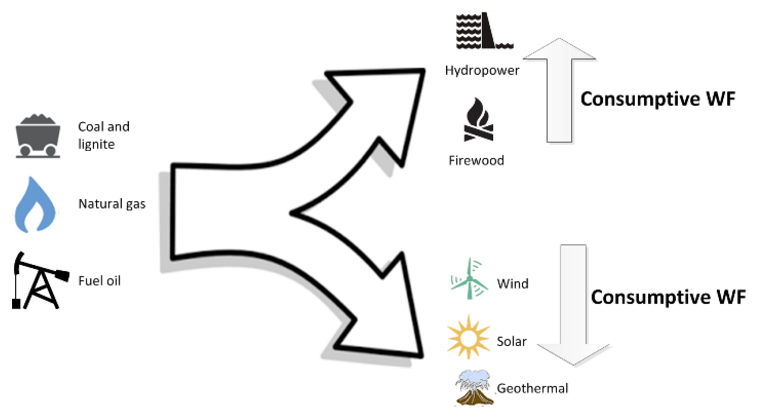
Change in water footprint from fossil energy to renewable sources
Source: ayhoekstra.nl
Biofuels
Our reliance on fossil fuels as the primary source of energy has led us to worry about “energy scarcity” as a major risk to economic development and national security. Renewable energy would seem to resolve this problem because incoming solar radiation alone is already so far beyond what we need.
In fact, solar radiation, together with the energy captured from wind, water flows, biomass and the internal heat of the earth, seem to offer an inexhaustible source of energy. Unfortunately, this is a misunderstanding. The case of bio-energy can illustrate why.
Producing biomass to turn into biofuels requires natural resources, including fertile land, water and energy. However, with current energy-intensive agricultural practices we sometimes need to input about the same amount of energy as will be produced in the form of biofuel. Even if there was a substantial net gain in energy, we would still need vast amounts of land and water resources. We estimated that if first-generation bio-ethanol replaced 10% of the fossil fuel used in global transport, world water demand would increase by about 6-7%.
While most of our water consumption still goes into producing our food, energy production could become a larger water consumer in future if we replace fossil fuels with biofuels at substantial scale. Using next-generation biofuels based on non-food crops, waste or algae may improve things, but the conclusion is similar: producing biofuels at the same volumes as we consume fossil fuels will require more land and water than are sustainably available. Even today we have land and water footprints beyond maximum sustainable levels.
Energy scarcity will thus be replaced by land and water scarcity.
Hydropower
Hydropower accounts for about 16% of the world’s electricity supply and is generally seen as a clean form of energy. This does not mean that we can simply increase hydroelectric capacity though, because dams can heavily impact riparian ecosystems and societies.
Building new dams is often difficult because the creation of reservoirs inundates land that is usually in use for other purposes. When China’s Three Gorges Dam was built, over one million people were displaced. Hydropower is also a large water consumer because the creation of reservoirs results in additional evaporation, affecting downstream water availability for other purposes.
There are other forms of hydroelectric generation that don’t require enormous dams. They rely on river flow, ocean currents or from the freshwater-saltwater gradient in deltas. But these are small scale only – at least from a global perspective – and because of the low concentration of this sort of energy, it is expensive to concentrate it.
Solar, wind and geothermal
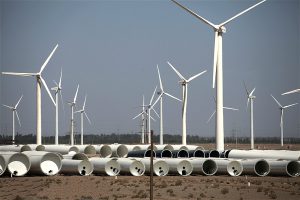
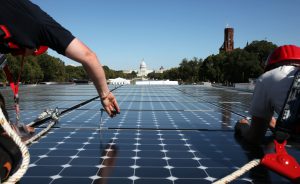
Per unit of energy, the water footprint of photovoltaic (PV) and wind energy is ten to a hundred times smaller than that of fossil fuels and nuclear, while the water footprint of hydroelectricity and bio-energy is a hundred to a thousand times larger. Electricity from concentrated solar power has a water footprint similar to fossil fuels, while geothermal can have a footprint that is similar to ten times smaller.
So from a water scarcity perspective it really matters whether we shift from fossil energy to bio and hydro or to solar, wind and geothermal energy. So-called “green” energy scenarios are based on substantial growth of bio and hydro in the mix, which means that the water footprint of the energy sector will grow sky-high if we follow such scenarios.
To be truly green, energy scenarios must lead to a declining water footprint and so should be primarily based on solar, wind and geothermal energy.
The transition to electricity
Of course, the land footprint matters, too. Solar energy is more efficient than biomass because PV panels and concentrated solar power systems are more efficient in capturing incoming solar radiation than photosynthesis, and so generate more energy per square metre. The major argument for photosynthesis though is that it results in storable bioenergy that can be turned into energy-dense biofuels, whereas PV results in non-storable electricity. Concentrated solar power systems can store energy by use of thermal energy storage, but the final product is still electricity, not fuel.
Since substantial growth of bioenergy – beyond using waste streams of organic material – is not a sustainable answer to shifting away from fossil fuels, we have to accept that the future energy economy is going to be based increasingly on electricity. This implies electric transport. It also means electric heating, at least where surplus heat from industrial processes or geothermal energy doesn’t offer a solution.
Such a shift creates new challenges: how to store energy and how to design electrical grids that can handle the large variability of both electricity demand and supply.
Solar and wind power, and earth’s heat offer us possibilities to become more energy self-sufficient at much smaller scales than we are used to in our globalised fossil fuel economy. As we transition away from fossil fuels let’s hope that we are smart enough to invest in solutions that are truly sustainable, unlike biofuels that have been so much at the centre of government policies. Decarbonising our economy can be combined with lowering our water footprint.