A decision to approve oil exploration off the coast of Brazil weeks before the country hosted the COP30 climate conference signals the country’s intention to increasingly target the international market, despite criticism from environmentalists.
At the close of the conference in Belém, Brazil committed to continuing to pursue a plan to eliminate fossil fuels from global economies. However, activists have claimed that its decision to award the exploration licence to state-owned Petrobras threatens the country’s position as a climate leader, suggesting that it intends to expand its oil frontiers.
Brazilian crude oil exports have grown 132% in the last decade, reaching almost 90 million tonnes in 2024, according to foreign trade data. During this period, China dominated demand: alone, it imported more Brazilian oil than all the other countries in the top 10 combined, according to an analysis by Dialogue Earth.
In October, Ibama, the federal environmental licensing agency, awarded the licence to explore for oil in Block 59, an area off Brazil’s northern coast, just weeks before COP30 opened. The approval process has dragged on for several years due to concerns about the environmental impact of exploration in the Foz do Amazonas basin, at the mouth of the Amazon River and one of the most biodiverse regions in the country.
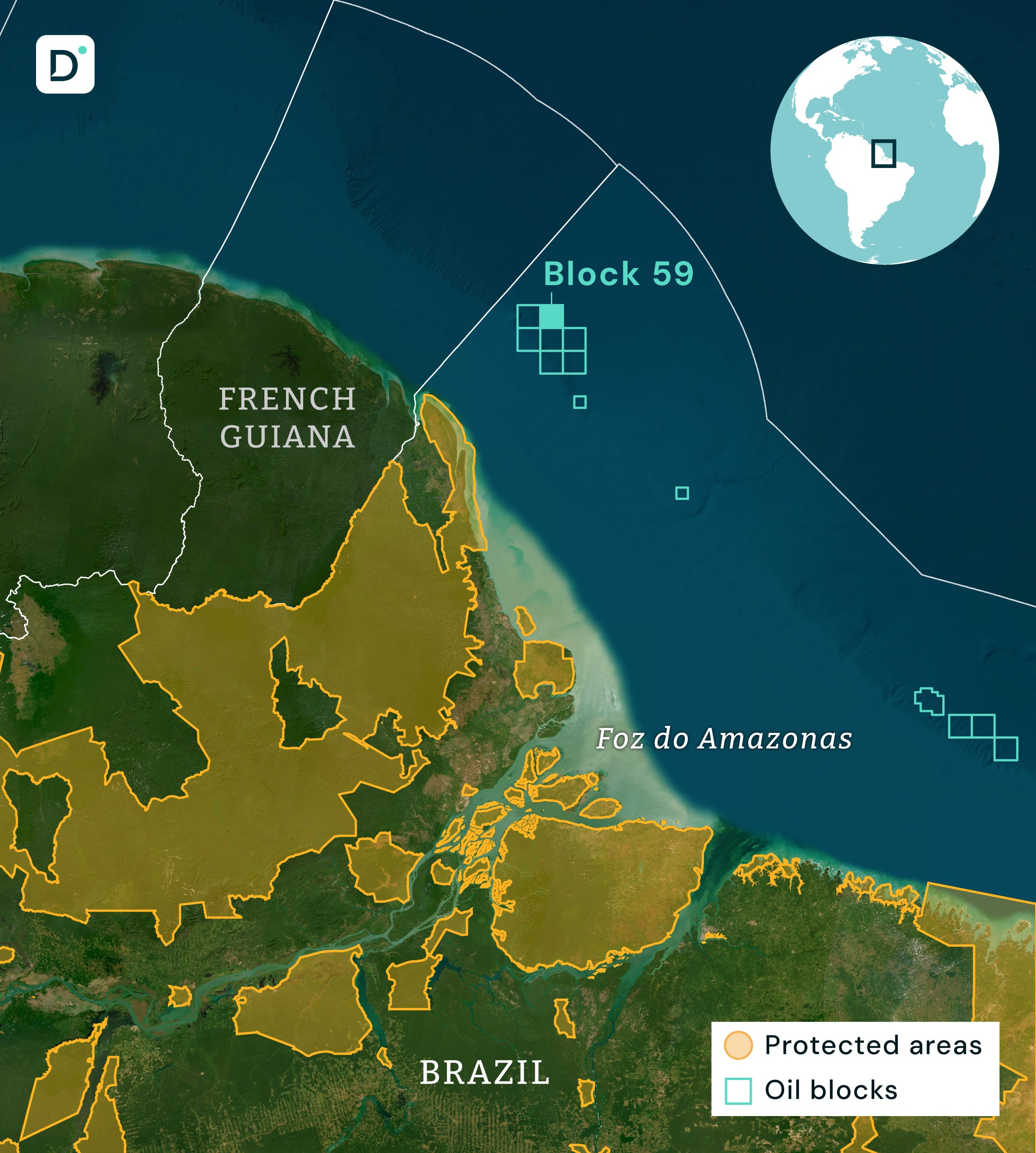
The licence authorises the drilling of an offshore well in Block 59 to assess the presence of oil. If there are commercially viable reserves, Petrobras would have to apply for a new licence to begin production. If none are found, new authorisations would be required for additional drilling. However, the company included three other potential wells in its original application.
According to Petrobras CEO Magda Chambriard, its work should unlock the sector’s progress towards a “new global energy frontier” and could expedite licensing for other wells. The area is close to the region where major oil discoveries in neighbouring Guyana have been reshaping the country’s economy over the past decade.
Government officials say exploration is necessary to ensure Brazil’s energy sovereignty, but some observers see it as a signal to foreign investors that oil expansion will continue, even in the face of the country’s campaign to slow down the use of fossil fuels.
“This expansion is much more focused on the foreign market than on achieving self-sufficiency in production,” said Mahatma Ramos, technical director of the Institute for Strategic Studies on Oil, Natural Gas and Biofuels (Ineep), a research entity linked to the Single Federation of Oil Workers, a union.
Days after it was approved, eight Brazilian civil society organisations, including environmental network the Climate Observatory, took legal action alleging illegalities and technical flaws in the licensing process. The organisations claimed the process had failed to consult local communities, had used outdated data on the threats to biodiversity, and failed to assess its climate impacts. Both the Ministry of the Environment and Climate Change, to which Ibama is linked, and Petrobras stated that the awarding of the licence is the result of a rigorous, five-year environmental analysis. The company has complied with all the established requirements, the organisations said.
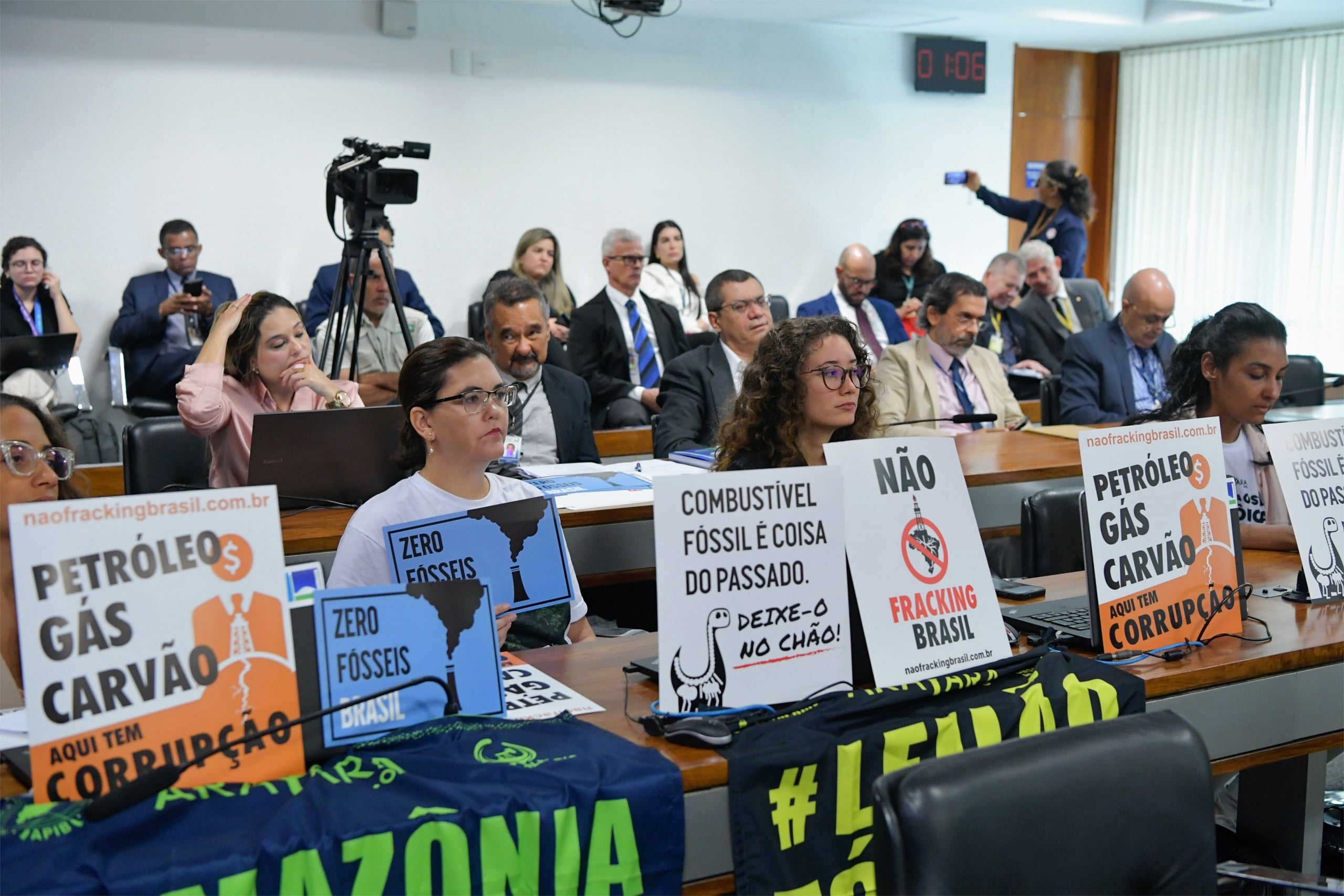
Ibama has also imposed 28 conditions on Petrobras’ activities in the area, including conducting a further oil spill simulation during the drilling of Block 59, the results of which should be published within a year.
“In the oil spill simulation carried out in August, Petrobras used outdated modelling from 2013, even though modelling from 2024 was already available,” said Suely Araújo, public policy coordinator at the Climate Observatory and former president of Ibama. “If Ibama itself considers that there is a need for a new model, it should not have granted this licence.”
Oil for the international market
Petrobras has claimed that if Brazil maintains its current demand for oil and does not incorporate new reserves, the country “could lose self-sufficiency” and would need to import more oil, as early as the beginning of the next decade. Brazil’s crude oil production has now passed more than 4 million barrels a day, technically sufficient to cover domestic consumption, though the country lacks the refinery capacity to process all of this, relying on imports to cover some demand for oil products. However, analysis by the news website InfoAmazonia suggests that this scenario would only materialise if the country failed to meet its climate target of reducing carbon emissions.
A report by the International Institute for Sustainable Development highlighted that 85% of Petrobras’ projects would be economically unviable in a scenario aligned with the goal of limiting global warming to 1.5C compared to pre-industrial levels, as established by the Paris Agreement.
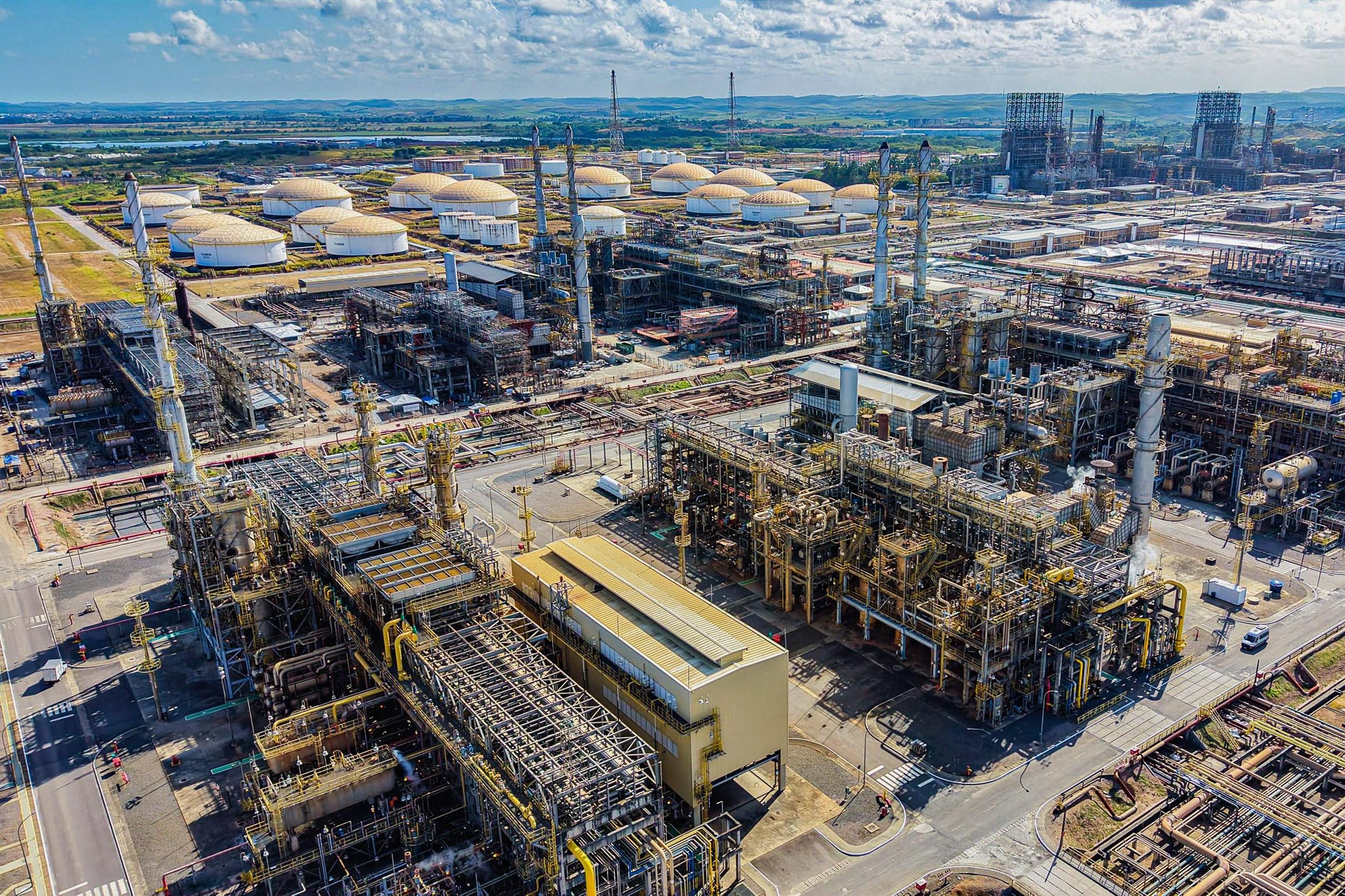
In 2024, the year with the second-highest production ever recorded, Brazil exported 52% of all oil extracted. Some of those exports are refined abroad and then re-imported, but according to Ramos, the recent expansion of Brazilian production is not focused on meeting domestic demand.
“Brazil has greatly expanded its crude oil production, which has allowed it to become an important country in the export market,” said Ramos.
Brazil already ranks sixth among the world’s largest oil producers, and exploration of the equatorial margin – which includes the Foz do Amazonas – could propel the country to fourth place in the next decade, analysts say.
At the same time, foreign companies are ramping up investment in Brazilian oil production. At a July auction, 19 blocks near the mouth of the Amazon River were awarded, all with the participation of foreign companies, including local subsidiaries of the American companies Chevron – responsible for one of the largest oil spills in the history of the Ecuadorian Amazon – and ExxonMobil, the main operator in Guyana, as well as the Chinese company CNPC.
This will lead to more oil money flowing out of the country, Ramos said. “Much of the technology, employment and income generated from this exploration will not remain in Brazilian territory,” he said.
Some experts believe that companies are failing to account for the risk of the post-2030 fall in demand for oil projected by the International Energy Agency. Even if commercially viable oil reserves are found in Foz do Amazonas, the earliest production would begin is in seven years.
“The world is at a point where the new frontiers of the fossil fuel industry are advancing into increasingly difficult-to-access deposits,” said Andrés Gómez, Latin America coordinator for the Fossil Fuel Non-Proliferation Treaty Initiative. “This means that large investments will be made that will not necessarily bring economic returns, and there is a high risk that companies will end up with stranded assets.”
Exploration in these hard-to-reach areas of the Foz do Amazonas basin would be costly. In its strategic plan, Petrobras said it plans to invest USD 3.1 billion in the equatorial margin by 2028, drilling 16 wells in deep and ultra-deep waters.
Oil: an economic and political asset
Activists claim Ibama’s decision to award the licence was made after pressure from high-ranking allies of Brazilian president Luiz Inácio Lula da Silva. The timing of the decision, on the eve of Brazil hosting COP30, was also criticised, with activists branding it a blow to Brazil’s climate leadership.
Ibama president Rodrigo Agostinho said the decision was not made as a result of political pressure and that it would have been “hypocritical” to wait until after the conference to award the licence.
Despite being a voice in favour of ending the use of fossil fuels in Belém, Lula’s administration has allocated 100 billion reais (USD 18.8 billion) more in budgets towards oil and natural gas than the government of his more vocally pro-extraction predecessor, Jair Bolsonaro.
The dispute highlights the contradiction between phasing out oil and gas and the economic realities the country faces. Lula has stated that “no country is ready” to give up oil. This year, Brazil accepted an invitation, first made in 2023, to join OPEC+, a group that brings together allies of the Organisation of Petroleum Exporting Countries.
Clarissa Lins, founding partner of Catavento, a strategy and sustainability consultancy, said that Brazil’s move is guided primarily by economic interests, not energy security.
“It is very difficult to ask a country considered by the World Bank to be middle-income to give up this economic resource,” she said. “The oil produced here is highly competitive, and the industry has a relevance that cannot be ignored.”
The issue is likely to crop up in next year’s presidential election. “President Lula still strongly associates oil with development,” said Ilan Zugman, director for Latin America and the Caribbean at the environmental organisation 350.org. “In his quest for re-election, he is likely to bring up this issue when talking about jobs, income generation and improving quality of life.”
Petrobras ‘discreet’ at COP30
Despite its manoeuvres in the weeks leading up to the conference, Petrobras was described as playing a “discreet” role at COP30 – despite a record number of fossil fuel lobbyists and representatives attending. Petrobras only sent second-tier employees to the event. “Petrobras has clear influence within the government, with direct access to President Lula and other relevant politicians, but during COP, they behaved very discreetly,” said Zugman.

Petrobras told Dialogue Earth that it “was present at COP30, as it has been at recent editions, because it recognises the opportunity to discuss sustainable models”.
It held two events in Brazil’s official pavilion, in the restricted area where negotiations take place. One of them coincided with the Climate March, which brought around 70,000 people to the streets of Belém demanding, among other things, that there be no oil exploration in the Amazon. One expert said this alignment was a “tactical choice”. “The event took place just as organised civil society was occupying the streets, focusing media attention,” said Renata Prata, environmental analyst at the Arayara International Institute.