


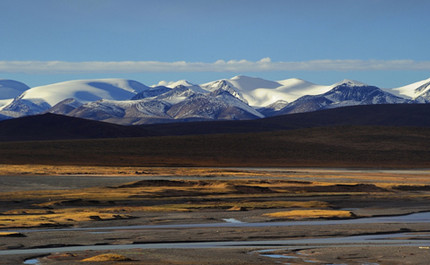
In his new book, Spoiling Tibet: China and Resource Nationalism on the Roof of the World, Gabriel Lafitte analyses the extent and scale of China’s mineral exploitation in Tibet.
Here he talks to thethirdpole.net about the global environmental significance of the Tibetan Plateau and the impact of mining on the region’s rivers and countries downstream.
The Third Pole: What’s so special about the Tibetan Plateau?
Gabriel Laffite: Can I answer that obliquely with another question? Why did it take centuries of industrial burning of fossil fuels before anyone thought it might affect climate? Even now, after the painstakingly precise reports of the Inter-governmental Panel on Climate Change (IPCC) there are still plenty who doubt human fuel consumption is capable of affecting the planetary climate.
The IPCC was set up by the UN in 1988, at a time when the interconnectedness of all regional climate systems, and their vulnerability to change due to rising levels of carbon dioxide, was scientifically evident.
Science works by reducing complexity to a few variables that can be controlled, observed, manipulated. Only after the experiments can complex reality be rebuilt.
The interconnectedness of all phenomena is not news to Tibetans, who, for thousands of years, sustainably managed a plateau the size of western Europe, with the light touch of a mobile civilisation. On a great plateau with no fences, wild and domestic herds mixed freely, with room for all, biodiversity conservation accomplished by doing nothing, beyond routine reminders by Buddhist lamas that hunting is bad karma. The Tibetans knew their land was rich in minerals, but mined sparingly, so as to not disturb the earth gods. They knew their many rivers continued, far past the high plateau, in all directions watering abundant populations downriver.
In today’s language, they provided environmental services, by doing nothing, other than moving on with their herds to avoid overgrazing any one spot. They knew the climate was highly unpredictable, with sudden snowstorms and hailstorms possible in summer, blizzards and intense cold snaps at just the time the yaks and sheep are moving up to their alpine meadows in spring, or down again to winter pasture in autumn. Adaptability, a capacity to live off uncertainty, flexibility of pasture management and risk management were among the skills that made the Tibetan Plateau humanly habitable. At the extraordinary altitude of the planet’s great island in the sky, Tibetans could watch the jet stream divert southwards round the plateau in winter and around the northern edges of the plateau in summer. Tibetans knew, from daily experience, what science has come to call the teleconnections linking all climate systems into a planetary circulation.
But why put this intimate, embodied knowledge of energy flows, atmospheric circulation, and the water cycle in the past tense? The knowledge of interdependence is still there, even if the plateau is compulsorily fenced, and the wild herds of antelope endangered. The knowledge of grasses, seasons, winds and risks is still in use, in the remaining areas of the plateau where grazing is still permitted, and mobility can still be practiced. The purity of rivers and lakes is still protected by customs that warn against angering the capricious water spirits.
TTP: Aren’t you being a bit of a romantic, making too much of ways of seeing that today’s world has no room for?
GL: There is nothing particularly romantic or mystical about such premodern, implicit understandings. Buddhists may call it the working of karma, but say that simply means common sense, applicable to anyone, of cause and effect.
TTP: Surely, given the size of the Tibetan Plateau, a few mines aren’t going to matter too much.
GL: Today all of the environmental services Tibetans protected are threatened. Extensive land use is giving way to the inexorable logic of intensification, concentrating capital, technology and labour in enclaves designated for resource extraction, feedlot animal production or tourist gratification; leaving huge areas largely depopulated, surplus to the requirement of modernity.
Mining is rapidly turning the Tibetan Plateau from a cost centre, swallowing huge sums for infrastructure construction, into a profit centre focused on the 80 million tonnes of extractable copper, and 2000 tonnes of gold proven by Chinese geological teams. That hardly puts Tibet in the same class as Chile, the world’s top copper producer, yet China’s new mines are set to operate in Tibet for decades, benefiting greatly from state investment in the roads, railways, communications, hydro dams, pipelines and urban infrastructure needed for profitable extraction enclaves to eclipse the old extensive ways.
At today’s gold and copper prices –neither of them even close to their recent peaks- the sale of Tibetan copper will generate revenues of US$617 billion for China’s state owned mining corporations, of which only half need be spent as the cost of production, and gold a further US$106 billion.
Tibet will be transformed as a result. The copper/gold deposits also contain silver, and usually lead and zinc, or molybdenum, all in demand and extractable at the same time. Meanwhile the world’s factory is on the move, from China’s coastal belt to far inland, taking advantage of lower labour costs, plentiful hydroelectricity from the hydro dam cascades on the rivers plunging from the Tibetan Plateau, less environmental law enforcement, and proximity to fresh Tibetan sources of raw materials. Chongqing and Chengdu have boomed as manufacturing hubs attracting the biggest global corporations to build new factories. It may not be long before your next smartphone or tablet is powered by lithium from Tibet.
TTP: You’re focussing on the big new mines, but isn’t mining in Tibet an older story?
GL: The mining of Tibet is not new, but the intensity, scale and capital invested are very different to the picture a decade or two ago, when mining was on the surface, usually by poor immigrant men from the lowlands using mercury and cyanide to extract flakes of alluvial gold from stream beds. Often the mining was financed by local governments keen to make money by assembling giant dredges to chew through river beds for placer gold, destroying pasture and river bank, fish and bird breeding spots, without noticing.
Tibetans have had decades of destructive gold rushes swarming over the land they once took pride in protecting, powerless to resist, their protests quickly labelled as criminally splittist, a threat to the existence of China. That means they are forbidden to form NGOs, or to speak publicly. There is no organised environment movement in Tibet, even though Tibetans care deeply, because it is politically impossible. At this time, Tibetans need others to speak up. Too many Tibetan environmentalists are in jail.
TTP: Does mining impact people downstream from Tibet?
GL: Geologically, Tibet is a young land, still rising. The rock is often loose, vulnerable to earthquakes and landslides blocking rivers, then giving way in sudden outbursts. Rock from deep within the earth is close to the surface in Tibet and that includes the arsenic that afflicts much of Bangladeshi well water.
Toxic heavy metals naturally occur in Tibetan rivers, so mining, which generates huge waste dumps close to major rivers, must be able to keep tailings waste dams from leaching into the river below – forever. Given the flagrant violations of environmental regulations Tibetans have witnessed, there’s little reason to believe the new miners will ensure the safety of their wastes for decades and centuries after mining has exhausted the ore deposits.
The Himalayas are not the natural barrier wall Indians may imagine. Rivers cut through them, monsoon clouds float through, and people have always crossed. South Asia will be affected in many ways, as mining spreads across Tibet, especially in the many areas being depopulated by the grazing ban policy, supposedly to grow more grass, which in practice lets in more miners, without any locals left to resist.
India is used to thinking of itself as upstream of Pakistan and Bangladesh, but India is downstream of Tibet, and is awakening to the strong connection between hydrodamming of Tibetan rivers and mining, which is a major user of hydropower for ore concentrators and smelters. India is learning the discomforts of being downstream, yet also ambitious to capture the hydropower potential of those trans-Himalayan rivers.

TTP: Has mining spoiled Tibet?
GL: Not yet, but that’s the way things are rapidly heading. The small scale mining of recent decades was environmentally very destructive, but had little economic impact. The new large scale intensive mines now about to go into full operation, at Shetongmon, Gyama and Yulong, will generate so much wealth for the state-owned corporations that own the mines, they have the potential to integrate Tibet into the global economy, into the commodity value chains that make the cars and computers that will be exported, and bought by people around the world. The new mines establish long-term enclaves of high profitability that attract new waves of immigrants, all further intensifying land use.
The land of Tibet cannot sustain intensive use. The Tibetan Plateau can accommodate extensive land use, mobile pastoralism that moves on well before overgrazing and land degradation start. Because of the long and intensely cold winter, once degradation starts to destroy the hardy native vegetation, it is extremely hard to stop. Because of accelerating degradation, social exclusion of nomads from their pastures, temporary grazing bans becoming irreversible, the loss of land tenure and food security in Tibet, all that will be left will be a depopulated, desertifying grassland, with pockets of intensive production centred on cities, mines and the highways that connect them. That’s an alarming prospect, not only for Tibet, but for all the billion people across Asia who daily drink Tibetan water.
Gabriel Laffite is author of Spoiling Tibet: China and Resource Nationalism on the Roof of the World, published by Zed Books 2013.