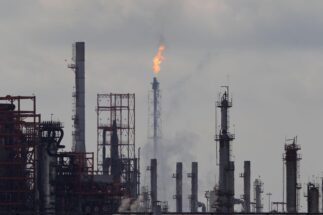
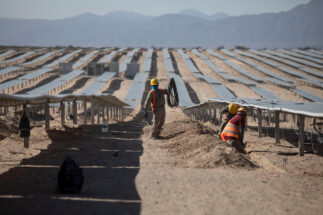
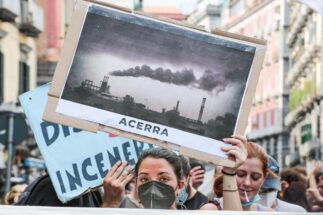
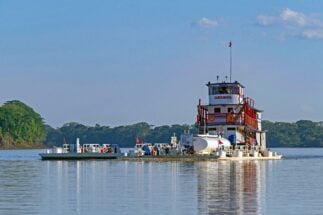
Despite its emissions reduction targets, Argentina is doubling down on hydrocarbon production. In addition to increasing fossil fuel subsidies, the government is moving forward on the expansion of a pipeline system to transport gas from the Vaca Muerta fields.
“We can become an energy exporter. We have the resources, as Vaca Muerta is the world’s second largest gas reserve, a key fuel in the framework of the energy transition”, president Alberto Fernández said at the opening of the current sessions of Argentina’s congress in March.
However, environmental organisations claim that such plans are incompatible with commitments to reduce emissions, and that the money earmarked for fossil fuels could be used to finance the energy transition by promoting renewables.
Vaca Muerta at the centre
Vaca Muerta is Argentina’s main formation of unconventional hydrocarbons – those requiring extraction using methods other than traditional drilling – and occupies an area of 36,000 km2 across several provinces. It ranks fourth globally in the size of its unconventional oil reserves and second in unconventional gas, according to estimates from the US Energy Agency.
55%
Natural gas accounts for 55% of Argentina's primary energy
The main oil and gas concessions are in the hands of state-owned energy company YPF, and Pan American Energy and ExxonMobil of the United States.
According to data from Argentina’s Energy Secretariat, natural gas accounts for 55% of the nation’s primary energy. In 2019, 37% of gas went to thermal power plants to generate electricity, 30% went to industry, 23% to residential consumption and the rest to compressed natural gas and commercial sector demand.
Between 2010 and 2014, gas production decreased due to a lack of tariff incentives, at a time of decline in conventional wells. Since then, there has been a gradual recovery that can be explained by advances at Vaca Muerta, which already represents half of the country’s gas production.
Gas production is currently advancing thanks to subsidies from the national government, including the gas plan for 2020–2024, which sets a fixed price per barrel that is not subject to international variations. Recently, the government presented a bill extending the benefits of the gas plan for 20 years.
Energy secretary Darío Martínez said that without support for the sector, gas production would have fallen by 8% this year and imports would have increased by US$1.15 billion.
New gas pipelines
Argentina has privatised its natural gas transport system, with the service provided by two companies: Transportadora de Gas del Norte (TGN), with a network of 6,806 kilometres of pipelines, and Transportadora de Gas del Sur (TGS), with 9,231 kilometres of pipelines.
In 2019, the government of former president Mauricio Macri took the first steps to put the construction of a new gas pipeline connecting Vaca Muerta with consumption centres out to tender. However, the economic crisis postponed the process and the new administration cancelled the call for tenders.
On taking office, the Fernández government considered it convenient to first prioritise the repowering of the current Central West Gas Pipeline, as well as the construction of a new section between La Mora, Mendoza province, and Tío Pujio in Córdoba. The total cost would have been some US$900 million but with the advantage that the work could be tendered in parts.
The new pipeline would open up the possibility of substituting imports and increasing exports through contracts with Brazil, as it currently faces a delicate energy situation
However, plans changed, and the 2019 proposal for the new gas pipeline, which costs US$ 1.2 billion, was taken up again. It would initially expand capacity by 19 million cubic metres per day (m3/d) with a potential to reach 40 million m3/d with power additions.
“The new pipeline would open up the possibility of substituting imports and even [increasing] exports through contracts with Brazil, which is facing a delicate energy situation and needs to strengthen its electricity system that is based mainly on hydroelectric energy,” explains Victor Bronstein, director of the Centre for Energy, Politics and Society Studies.
The expansion of the system also increases the supply of gas to the Bahía Blanca petrochemical hub, in the southwest of Buenos Aires province, and offers an alternative to imports of natural gas from Bolivia, which are already decreasing. In 2020, Bolivia exported 14 million m3/d to Argentina, though it is estimated that no more than 12 million m3/d will be sent in 2021.
According to government estimates, the pipelines would save about US$1 billion a year in winter due to lower imports. With limited natural gas exports leaving Argentina for the time being, the pipeline will also significantly reduce its use in summer months.
For oil companies and service firms investing in Vaca Muerta, the pipeline is key because it eliminates logistical risk. According to government sources, it is estimated that in winter at least 82 million m3/d are drawn from the Neuquén basin, out of a total capacity amounting to about 90 million m3/d.
“Gas production has increased a lot and there is no transport capacity,” summarised Pablo González, the president of YPF.
Financing
The total amount of the gas pipeline works that would begin in 2022 is US$1.3 billion. The Energy Secretariat details that there is US$125 million available from the reallocation of 2020 funds, and that it wants to add some US$550 million from the proceeds of the tax on large fortunes.
Even so, almost half of the money for the upgrades is still missing. Without full funding, the government says, the tender will not be opened. To complement this, a financial trust fund could be created, made up of the oil companies themselves.
Another option being considered is to obtain financing from China. The government signed a memorandum of understanding with a consortium of Chinese companies, headed by PowerChina, for the construction of the pipeline. The technical and financial proposal is underway, but the political agreement between president Alberto Fernández and Xi Jinping is still pending.
The timeline of China’s investment seems to be slower than the government’s needs. Moreover, this option usually comes with conditions regarding the provision of equipment from China, which could lead to conflicts with national industry.
Against the grain
Argentina continues to bet on fossil fuels despite the fact that the International Energy Agency (IEA) calculates that for the world economy to reach 2050 with net-zero emissions, there should be no more investment in hydrocarbons.
“Moving forward with the exploitation of Vaca Muerta goes against the commitments made on climate change,” says María Marta Di Paola, director of research at the Environment and Natural Resources Foundation (FARN).
A FARN study warns that in 2019, subsidies to oil companies increased greenhouse gas emissions by 26 million tonnes of CO2 equivalent, which represents 7% of Argentina’s total emissions.
Moving forward with the exploitation of Vaca Muerta goes against the commitments made on climate change
Argentina has pledged to reduce its greenhouse gas emissions by 19% by 2030 compared to the 2007 peak, according to its nationally determined contribution (NDC) submitted to the Paris Agreement. The country states that it will use natural gas as a transition fuel.
Indigenous communities living in Vaca Muerta have filed an injunction against the government of Neuquén, warning that there are constant tremors as a result of extraction processes, and that people have already lost their homes. In addition, there is a risk of hazardous substances spilling into the groundwater and rivers in the area.
Laura Forni, a researcher at the Stockholm Environment Institute, explains that wastewater from gas production is injected underground or stored in ponds on the surface.
“Both the injected fluids and the water that naturally exists in shale formations contain carcinogens and other pollutants. Therefore, the water produced after extraction poses health and environmental risks,” she adds.
Infrastructure or stranded assets?
For Julián Rojo, an energy analyst at the Mosconi Institute, there are no feasibility studies in economic, environmental or financial terms to justify the new pipeline. “We don’t know how much demand will expand, nor the export horizon,” he added.
Marcos Rebasa, an analyst at the Scalabrini Ortíz Energy Institute, argues that expanding gas production in Vaca Muerta means consolidating a more expensive price, because it is done to the detriment of other conventional basins, whose production costs are lower but are currently relegated in priority.
Moreover, the speed required to change the energy production model to avoid the most worrying climate forecasts entails financial risks associated with stranded assets – natural resources and physical capital that are not fully exploited.
According to the Inter-American Development Bank, the fossil fuel sector is the most affected by this situation, which will also impact transport, ports, buildings and mining.
Countries with large hydrocarbon reserves, such as Argentina, have a higher opportunity cost and are more at risk of facing stranded assets. A recent report by the Argentine Chamber of Renewable Energies (CADER) suggests that Argentina should only expand its natural gas infrastructure if it can be made suitable for operation with green hydrogen to avoid stranded assets.
“The government is investing in stranded assets,” warns María Marta di Paola of FARN. “These infrastructure projects will not recoup their costs because of the speed at which the energy transition is taking place.”