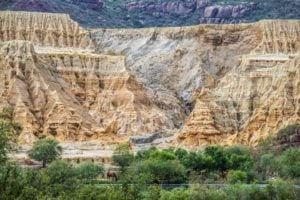
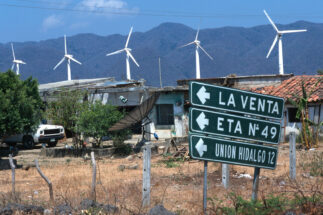
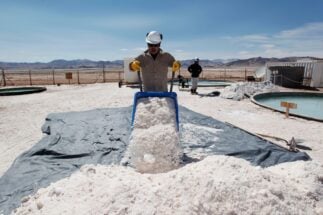
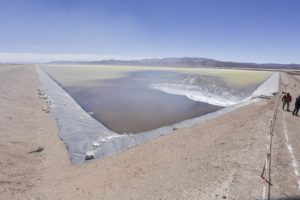
In 2018, the UK-listed company Bacanora Lithium announced the discovery of lithium deposits at Bacadéhuachi, in the northern Mexican province of Sonora, declaring to have found 243.8 million tonnes of the mineral – making it the largest reserve in the world.
It had been speculated that Mexico would soon take its place among the most important nations in the industry, alongside the “lithium triangle” of Bolivia, Argentina and Chile. But in October 2020, the then Secretary of Economy of Mexico, Graciela Márquez, denied the claim that the country was home to the world’s largest lithium reserve.
“It is very important – and I want to emphasise this – when this estimate of the lithium deposit was made, all the clay was taken into account, but those tonnes of clay are not lithium,” Márquez said, during an appearance in the Mexican senate.
Nationalisation amid the chaos
Amid the confusion and over-estimates on the amounts of lithium in the country, President López Obrador has opened a debate on nationalisation. On 1 October, he presented an electricity reform to congress that proposes the modification of three articles in the constitution, and would prohibit giving up further concessions for lithium exploitation.
“Lithium is a strategic mineral that must remain under the control of the nation,” the president said in a press conference. Lithium matters a lot to those who act as hegemonies. We cannot leave this strategic mineral to the market,” he added.
Lithium is a strategic mineral that must remain under the control of the nation, we cannot leave it to the market
The Secretary of Energy, Rocío Nahle, confirmed the creation of a state company that will exploit the mineral, but so far no further details have been given.
But López Obrador’s decision to restrict private investment in lithium mining in Mexico, and his seeking of advice from Bolivia – a country that has chosen to keep foreign investment away – worries experts and businessmen.
Concerns and violations
Carlos Aguirre, an academic in the Universidad Iberoamericana’s business studies department, explains that Bolivia has a state-owned lithium-producing company and its legislative system is not too different to those of Chile and Argentina, though these countries allow investment or participation from private companies. This has positioned Chile and Argentina as the main lithium producers in the world – unlike Bolivia, despite the nation having the largest reserves.
According to Aguirre, private investment must be allowed in order to develop successful lithium production in Mexico. He believes that the country should adopt a model of concessions, surveillance and control over what investors can do.
75%
Chinese mining company Ganfeng Lithium has the rights to as much as three-quarters of the lithium extracted at Sonora Lithium
There are currently eight concessions granted by previous governments for the possible extraction of lithium. Although López Obrador maintains that these will be respected, for that to happen companies must prove to the Federal Electricity Commission and the Ministry of Energy that they have already started the exploration process and meet the requirements to start production. The president has remained firm in rejecting new concessions, even if his reform is not approved.
So far, the most advanced project is Sonora Lithium, the concessions to which are co-owned by Bacanora Lithium and the Chinese company Ganfeng Lithium, which recently invested further in the project to become the majority partner.
Ganfeng now has the right to 50 percent of the lithium carbonate that is extracted in phase one, and 75 percent that is extracted in the second phase, according to a report titled “Lithium: the new commercial dispute fuelled by the false green market”. Ganfeng is the world’s largest lithium producer and supplier to the American electric car maker Tesla.
Another concern raised by the president’s announcement is that his reforms directly contradict the new United States-Mexico-Canada Agreement (UMSCA) free trade agreement. The American Chamber of Commerce of Mexico (AmCham) and a group of 40 US congressmen argue that private companies in the energy sector would be excluded under the new reform.
On 3 November, the US Ambassador to Mexico, Ken Salazar, met with Mexican officials to express the same concern. On the same day, Mexico’s parliamentary leaders and legislators announced that the approval of López Obrador’s electricity reform will be postponed to April 2022.
The lithium dilemma
This metal, often dubbed “white gold”, plays an important role in the energy transition, given its use in batteries for electric cars. For this reason, its demand has increased in recent years, but for Yannick Deniau, a member of the GeoComunes collective and the Mexican Network of People Affected by Mining (REMA), the possibility of exploiting this mineral brings more negative than positive consequences for the territory.
Deniau, a trained geologist, points to environmental damage, displacement and disputes around existing mining operations in Mexico. “Mining is one of the main culprits for this crisis due to its consumption of water, the emission of CO2 and environmental degradation,” he says.
The activist highlights similar concerns around the Bacadéhuachi site, and particularly the overexploitation of water in Sonora, where extreme water stress has been recorded for more than a year. Since an open-pit mine is planned, he adds, this will result in devastation of the landscape and in mineral residues causing acid drainage that, when exposed to air and water, generates a chemical reaction that pollutes the soil and rivers.
The more economic interests and actors increase in an area, the more violence gets out of control
Finally, there is the notable issue of violence and the presence of organised crime in the state of Sonora, which increasingly threatens local communities and mining operations. “The more economic interests and actors increase in an area, the more the situation of violence gets out of control,” Deniau explains.
The Sonora project, he says, is very close to the so-called “Golden Triangle”, an area where a wave of violence and displaced people has been documented due to mining activity and the dispute over territory among organised crime groups.
“There is a correlation that when there are mining projects, the presence of organised crime and repression increases,” he says.
But a local outlet reported that the majority of people in Bacadéhuachi are expectant about the possibility of 200,000 jobs that Bacanora Lithium has promised, which could represent a better future for a community that is currently struggling to make ends meet.
Beyond possible extraction conditions and their impact, there is still a lot of uncertainty about the state of lithium in Mexico. According to a report, titled “Regulation of lithium: Proposals and international comparison”, carried out by the Mexican senate’s Belisario Domínguez Institute, the government still does not have precise figures on the production forecast in Mexico.
Despite the various concerns and uncertainties, work to move operations in Sonora forward is ongoing. Flor de María Harp, director of the Mexican Geological Survey (SGM), a government agency, announced that the organisation will invest 55.2 million pesos (US$2.52 million) for lithium exploration, in order to gain hard data on the amount of the mineral present, and thus confirm that its extraction is economically viable.