Exactly 24,638 Chilean cherries were placed side by side at Shanghai Port International Cruise Terminal on January 11, forming two giant representations of the ruby red fruit. It achieved a Guinness World Record for the longest line of fruit in the world.
As exports boom, producers are experimenting with varieties that meet China’s seasonal spikes in demand. Yet, there are concerns over the effects of scaling-up production on a country that is already suffering from water scarcity.
Expansion
In 2017, more than three million cherry crops were planted across the country, according to the 2018 Chilean plant nursery yearbook. This equated to almost 3,340 hectares, according to Jorge Valenzuela, president of the Chilean fruit producer federation (Fedefruta)
“We are currently expecting to reach a total surface of 36,600 hectares nationwide,” he added.
85%
das exportações de cereja chilena vão para a China
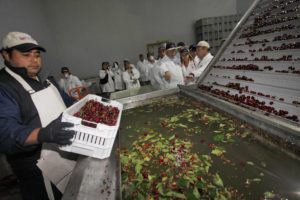
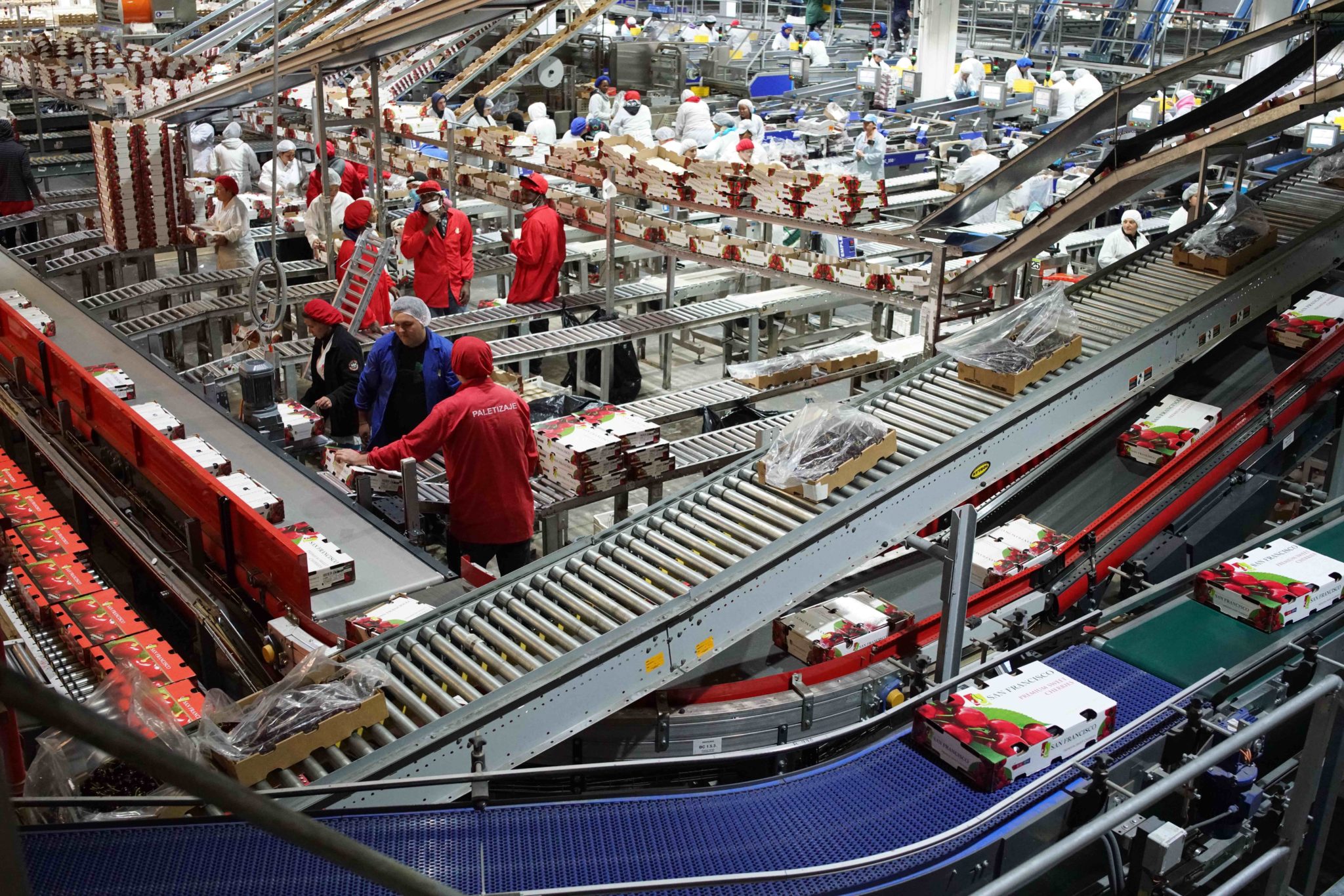
Chile has tripled its cherry production over the last ten years, according to the Office of Agricultural Studies and Policies (ODEPA). 85% of cherries goes to China and exports peak around Chinese new year.
“Red is a sign of prosperity,” says Felipe Borgoño, operations manager of Garces Fruit, Chile’s largest cherry producer. He said Chinese New Year coincides with production, achieving “a match with their cultural need to gift fruit”.
Valenzuela said: “This decade has seen a demanding Chinese consumer develop. With their purchasing power, they value quality and high standards, and that is where the Chilean cherry has a huge space.”
Demand has grown in part due to a nationwide marketing campaign under the slogan “Cherries from Chile”, which aims to bring the fruit to the attention to both online buyers and retailers.
Climate adaptation
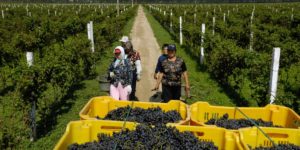
Producers have sought varieties for early (October to early November) and late harvest (late January to February), Borgoño said. “We have established the best patterns, which can be adapted to the conditions of the soil and the climate.”
In 2010, a genetic improvement program for cherries began in Chile.
Protecting ourselves from the weather is the main topic every year, so we try to get the latest technology
Marlene Ayala, a researcher from the Faculty of Agronomy of Chile’s Pontifical University (PUC), said climate change is creating new challenges. For example, in November 2018 there was a hailstorm nobody was prepared for.
“They were the size of golf balls,” she said of the storm that hit the central regions of O’Higgins, Maule and Ñuble, which lie just south of the capital Santiago. Some producers even lost whole trees.
Joaquín Zamora head of agricultural operations at Garces Fruit, said: “Protecting ourselves from the weather is the main topic every year, so we try to get the latest technology.”
The company uses propeller-powered heating to mitigate the effect of frost and plastic coverings to protect against humidity and rain. Solar radiation is another growing threat. Heatwaves are more frequent in summer and can even burn leaves and lead to physiological disorders.
However, Ayala said varieties that can withstand little cold could prosper in new environments.
“If we move to the south, we are looking for varieties that tolerate rain and low temperatures during ripening,” she said.
Elena Vidal, a researcher at the Integrative Biology Institute iBio, said: “Cherry crops need hours of accumulated cold temperatures in order for the flowers to blossom in spring.”
She said varieties of smaller trees, which require fewer agrochemicals are a possible solution.
Water problems
Water demand from avocado producers in Petorca in the Valparaíso region close to Santiago created competition with communities demanding it be used for direct human consumption. Following this, the cherry’s water use is now under the spotlight.
NGO Modatima has warned that cherries could cause the same problem, though this is not yet clear.
While each individual cherry tree may have less environmental impact than other fruits, intensive cultivation creates pressure on the environment
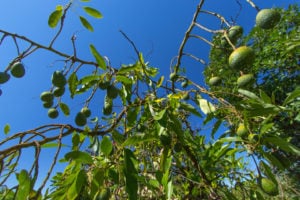
Elena Vidal said that unlike the cherry tree, the avocado is evergreen and so has higher year-round need for water. “This also entails a greater nutritional requirement in terms of fertilizers and pesticides,” she added.
For more than a year, the Aculeo lagoon, about 80 kilometres from the capital, has been dry. Cherry producers were among those accused of illegally extracting water from the area’s aquifers.
While each individual cherry tree may have less environmental impact than other fruits, intensive cultivation creates pressure on the environment, Vidal added.
According to Ayala, water consumption by cherry producers is mostly limited to the production period, which lasts about 70 days.
If cherry demand continues to increase, the rush to capitalise could lead to other issues. “The spread of monoculture could be a problem,” she warned, adding that the way the change is managed will be crucial.