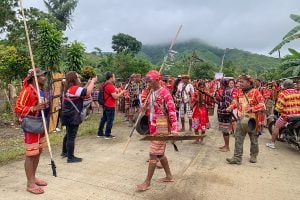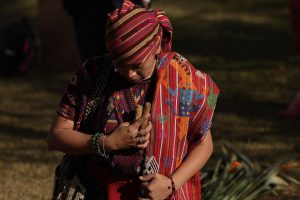
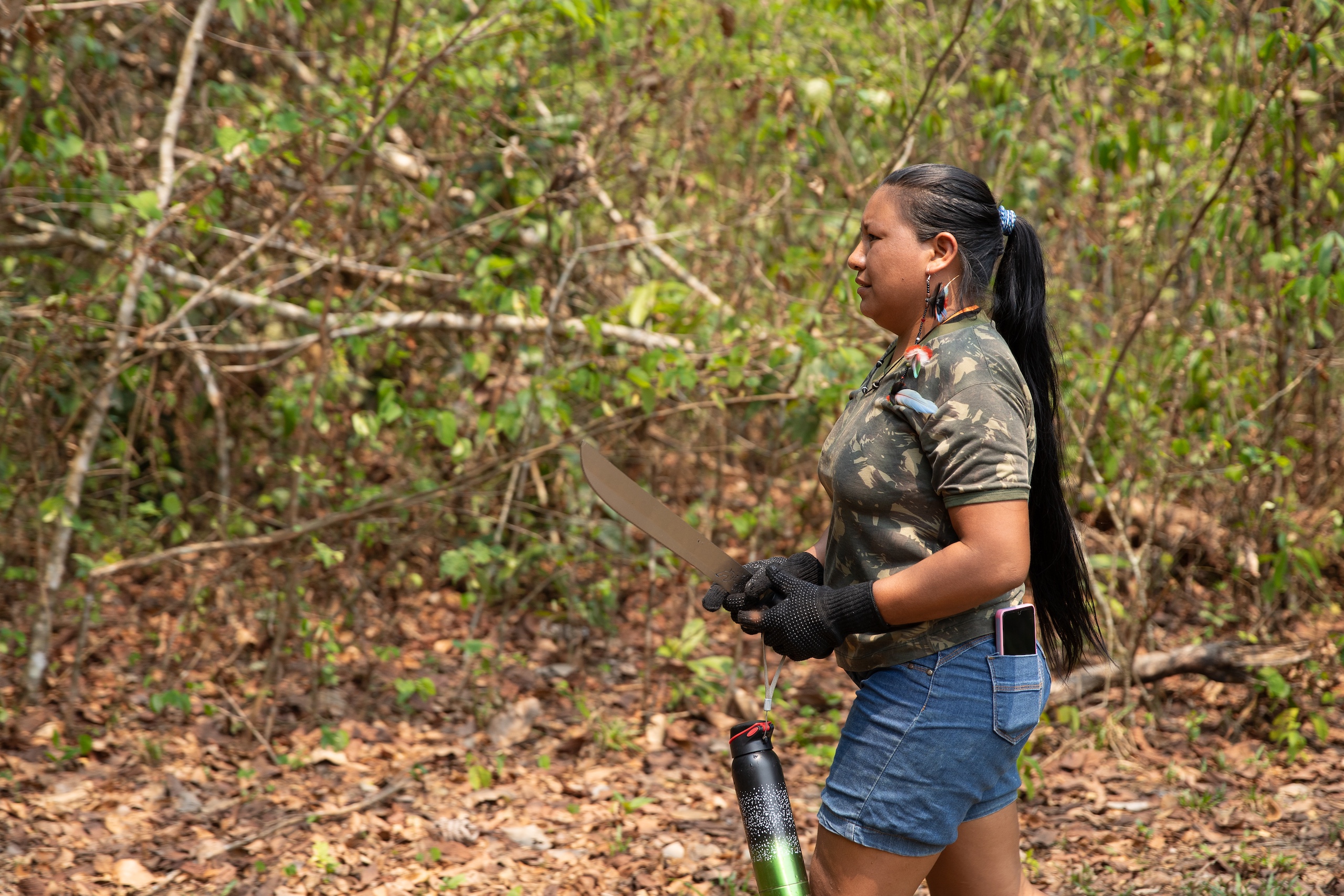
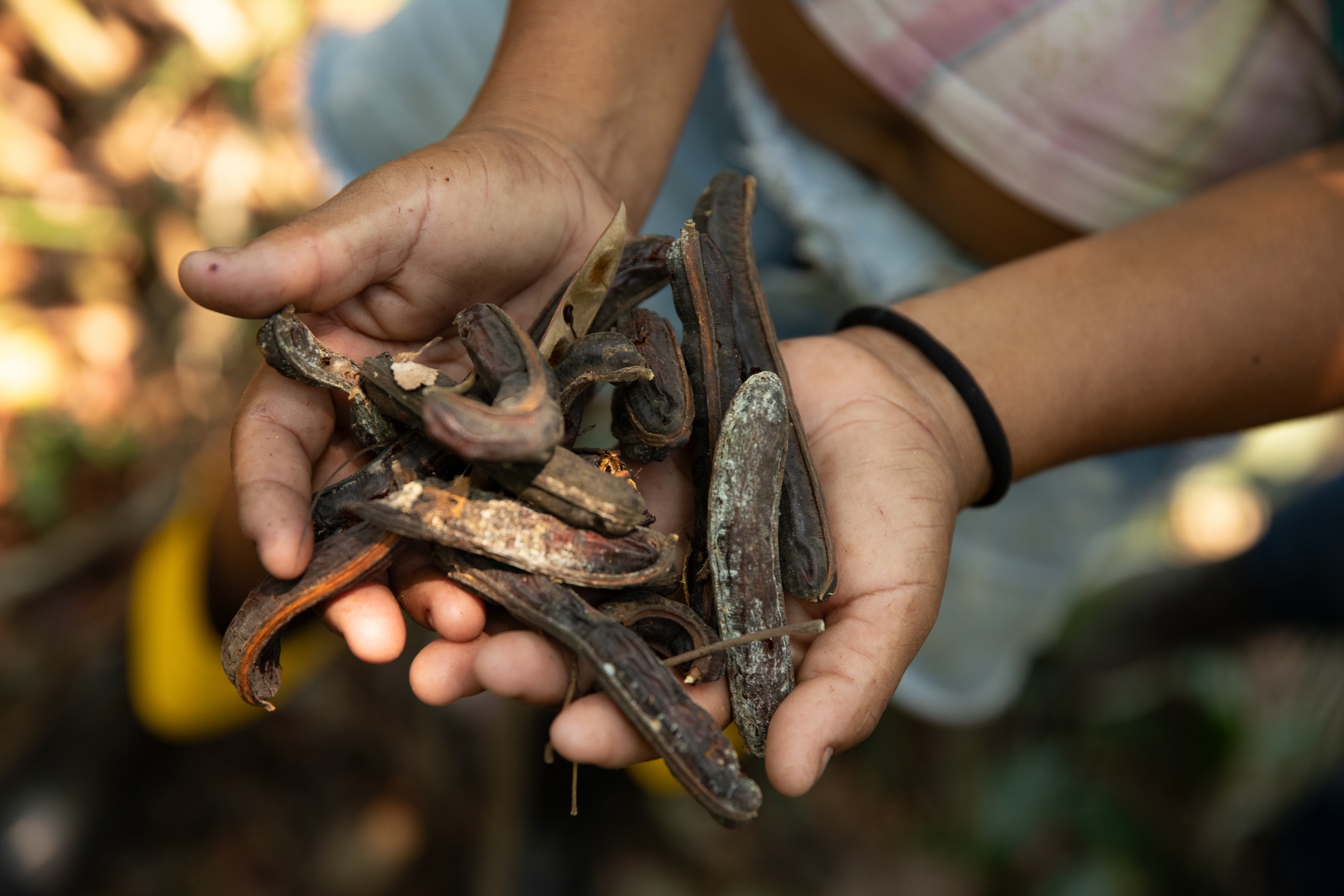
When she enters the Amazon rainforest on her territory, Rariane Suruí now sees it with new eyes. Its trees – the pinho-cuiabano, jatobá, tento-vermelho and cumaru – are more than a source of food, raw material for handicrafts and a pillar of spiritual life. They also produce the seeds that can help restore this threatened biome.
A year ago, Suruí and 30 other residents of the village of Apoena Meirelles, in the portion of the Sete de Setembro Indigenous land that lies within Mato Grosso state, joined the Amazon Bioeconomy Seed Network (Reseba).
When a new forest restoration project is commissioned, the Indigenous people set off on expeditions that can last up to two weeks. They usually collect seeds that have fallen on the ground or from lower trees near the village, but they often have to venture deep into the dense forest and even clear trails to find them. “I have gained new knowledge of the forest,” Suruí told Dialogue Earth.
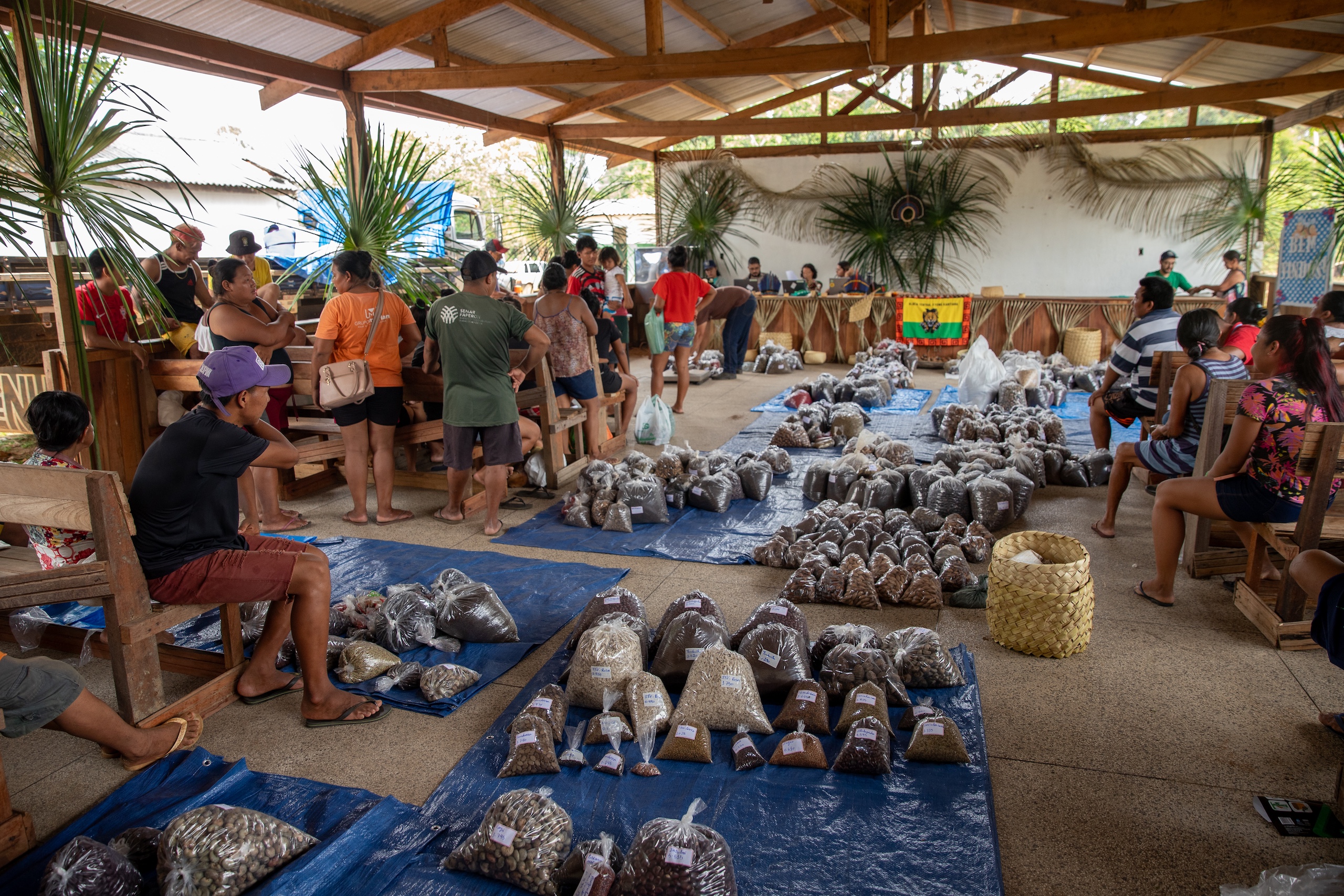
Created in 2021, Reseba brings together 620 seed collectors from Indigenous territories, quilombola communities (those formed by descendants of enslaved African people), extractive reserves (areas where local communities can exploit the rainforest in a sustainable manner) and family farmers in the neighbouring states of Rondônia and Mato Grosso. Since then, it has sold 84 tonnes, generating BRL 1.5 million (USD 280,000) in direct income, and supplied seeds for initiatives including the federal programme Sustainable Landscapes of the Amazon, which restored 500 hectares of rural land in Rondônia in 2024.
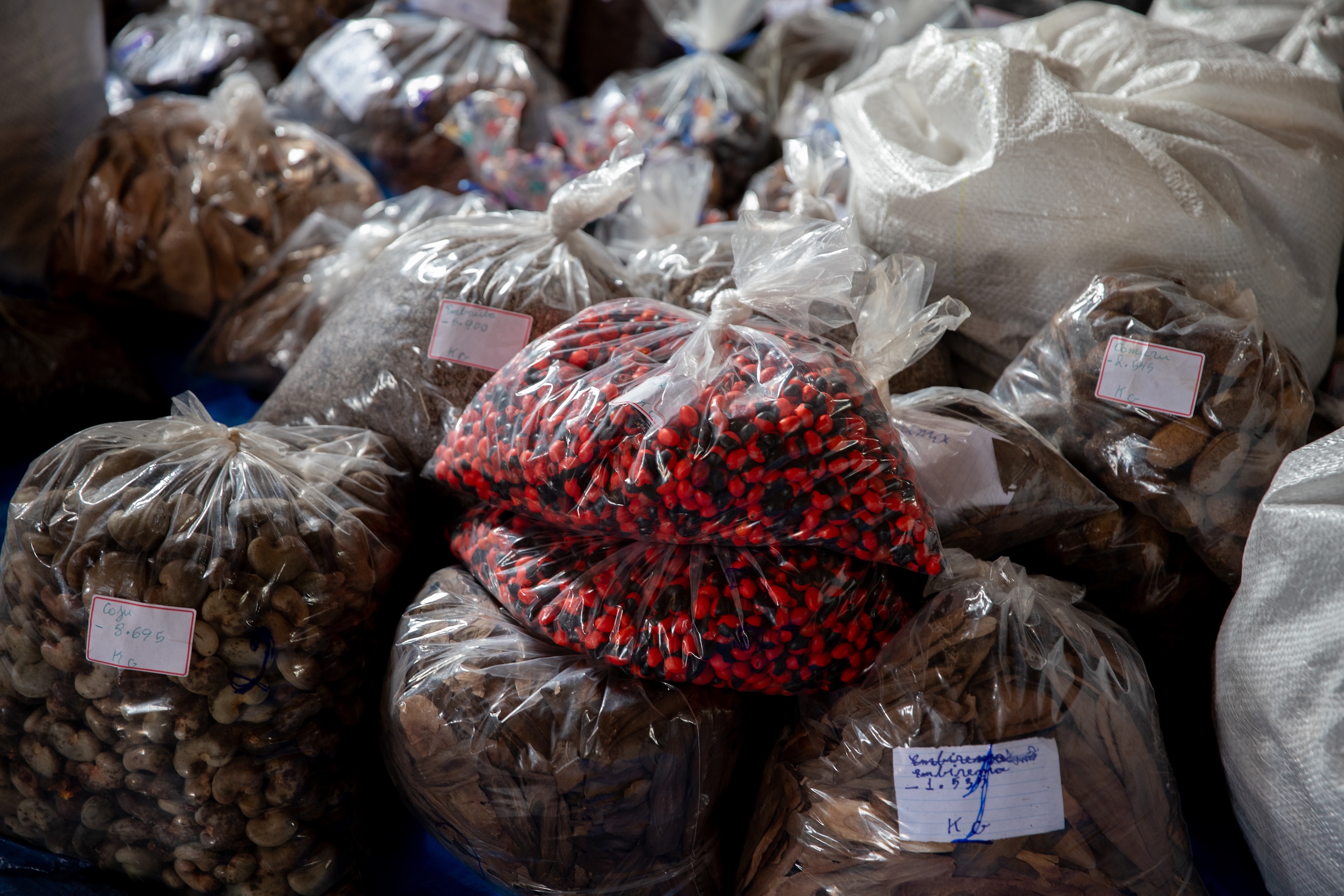
Initially focused on supporting restoration projects under the nonprofit organisation Ecoporé’s Sustainable Amazonian Forest Garden initiative, Reseba quickly established itself as one of the main networks of Redário, a national organisation that brings together 27 groups and around 2,500 collectors from across the country.
These networks are considered essential for Brazil to achieve its goal, established in its national commitments under the Paris Agreement, of restoring 12 million hectares of vegetation by 2030, said Danielle Celentano, an analyst at the Socio-Environmental Institute and one of the coordinators of Redário.
“Working with seeds brings about land conservation, the recovery of traditional knowledge, and the valorisation and professionalisation of young people and the elderly,” said Celentano.
She points out, however, that groups such as Reseba still face obstacles in terms of demand, governance and bureaucracy. Planaveg, a national plan for the recovery of native vegetation, which was relaunched in December 2024, seeks to overcome some of these challenges by placing community seed collection at the centre of its actions, according to the analyst. Planaveg had originally launched in 2017, before former President Jair Bolsonaro took office, but it received little attention during his administration. The current Lula government revived it, restarting discussions in 2023 and beginning implementation earlier this year.
Seed networks are guardians of socio-biodiversity and the first link in the restoration chainThiago Belote, director of forests at Brazil’s Ministry of the Environment and Climate Change
Developed by the government in collaboration with organisations, it aims to train Indigenous people, quilombolas and family farmers as technicians and collectors. It also aims to coordinate technical assistance policies and expand these groups’ access to credit and public funds.
Thiago Belote, director of forests at the Ministry of the Environment and Climate Change and the person responsible for implementing Planaveg, agrees that strengthening collection networks is essential to recover degraded areas in the country.
“Seed networks are guardians of socio-biodiversity and the first link in the restoration chain. So strengthening them is super-strategic,” Belote told Dialogue Earth.
Low demand for seeds
This boost is needed. As it stands, even the longest-standing group of collectors struggles to find a stable market. Created in 2007, the Xingu Seed Network brings together more than 700 members from Indigenous lands, rural settlements and urban areas in Mato Grosso. It has already contributed to restoring 11,000 hectares of the Amazon and Cerrado, generating BRL 8.5 million (USD 1.6 million) in direct income for collectors, according to executive director Bruna Ferreira.
But demand has never matched the production capacity. Dialogue Earth spoke to Ferreira in June, which is when orders are usually received. Demand is “very low, not even 40% of our potential”, she commented at the time. “We have several networks in all biomes with very high collection potential, but there is no clear demand for seeds for restoration.”
Marcelo Ferronato, president of Ecoporé, said that as it stands, interest in the forest replanting market is limited to a few export groups subject to stricter environmental requirements, and restoration start-ups linked to the carbon market.
According to Belote, from the environment ministry, the second iteration of Planaveg seeks to solve this problem and increase demand for restoration and, consequently, for seeds. It will do this by providing incentives for rural landowners to restore degraded areas.
Brazil’s goal of recovering 12 million hectares by 2030 will require up to 15,000 tonnes of seeds – a volume capable of generating 60,000 jobs and USD 146 million, according to a 2020 study.
By law, rural landowners are required to preserve a share of native vegetation, the extent of which varies by biome and region. Compliance is monitored by satellite and enforced by environmental agencies, though significant gaps remain. According to Belote, restoring vegetation on these properties alone would account for nine of the 12 million hectares that Brazil needs to restore by 2030.
Rodrigo Junqueira, executive secretary of the Socio-Environmental Institute (ISA), argues that Planaveg should go further. He advocates conditioning access to credit: restricting it for producers who degrade the land and violate the law, while expanding benefits for those who restore their land and comply with environmental regulations.
For now, the 2030 goal is far from being achieved. Since making the commitment in 2015, Brazil has restored just 700,000 hectares – 500,000 through compliance with legal obligations by rural landowners and business owners, and the rest through voluntary initiatives by civil society, the private sector and regional governments.
Voluntary participation by rural producers in restoration is still low, even in initiatives that do not entail direct costs for them. According to Belote, this is because many do not see immediate economic returns from the recovery of degraded areas. For him, the key is to invest in productive restoration – a model that combines forest restoration with income-generating activities, such as agroforestry systems, native species management and socio-biodiversity products.
Other initiatives are already doing this. The environment ministry’s Productive Forests programme recovers degraded areas in settlements and traditional communities in Pará with a view to increasing the production of healthy foods and socio-biodiversity products. Its Eco Invest project, meanwhile, hopes to raise BRL 31.4 billion (USD 5.8 billion) at auction to transform 1.4 million hectares of degraded land into sustainable production systems in various Brazilian biomes.
The federal government is also betting on natural regeneration to meet the Paris Agreement target. Planaveg’s technical team used geospatial data to identify 16 million hectares of secondary vegetation in the Amazon and another 8 million in the Cerrado – areas that began to recover on their own after being deforested or degraded.
However, these figures still need to be reviewed to assess whether these forests are indeed stable and capable of maintaining their ecological functions. According to Belote, landowners often allow the land to regenerate but return to using it within five years. “We want natural regeneration, but we want it to bring back ecosystem services,” he explained.
Governance barriers
The governance of seed networks, which involves technical training and logistics, is another bottleneck. Until recently, progress had been made independently. The Xingu Seed Network, for example, arranges meetings with new networks from different biomes to share experiences. “Each territory has its challenges and opportunities, but we talk about what is essential to have in a network structure,” said Bruna Ferreira.
This work evolved into the creation of Redário, which now offers support in training, seed quality control, and market access. The results are already apparent: of the 106.8 tonnes sold by the associated groups, 18.5 tonnes were negotiated through the network.
For Junqueira, who represented civil society in the development of Planaveg, the experience of cooperation between networks should serve as a model for future policies to support collectors.
The challenge of scaling up
To scale up the restoration chain – from seed collection to reforestation – the Alliance for the Restoration of the Amazon, a multidisciplinary group, has mapped 205 active sources of funding and policies. Among them is the Arc of Restoration, an initiative of the environment ministry in partnership with the BNDES (Brazilian Development Bank), which provides BRL 1 billion (USD 183.4 million) to recover, by 2030, 6 million hectares in the most deforested areas of the Amazon, to the east and south.
There are also international contributions. The Global Environmental Facility, for example, supports projects to create biodiversity corridors in private areas, payment for environmental services programmes and the strengthening of subnational public policies for restoration and implementation of environmental standards.
But Ferreira, from the Xingu Seed Network, pointed out that many restoration funding opportunities do not provide for staff salaries or investments in basic infrastructure, such as storage facilities. In addition, she noted that projects tend to prioritise Indigenous territories, conservation units and public areas – precisely those that are most preserved and also complex in terms of logistics and infrastructure – while the greatest potential for native vegetation recovery lies elsewhere, on private rural properties.
For Junqueira, the central challenge is to ensure that resources reach Indigenous peoples and traditional communities, such as seed networks, quickly, but without the bureaucracy and requirements that currently alienate these populations.
Despite the obstacles, Rariane Suruí believes that the meaning of her work is quite clear: to plant today what will sustain future generations. She said she feels privileged to be a seed collector.
“Keeping the forest standing is important for everyone: Indigenous and non-Indigenous people alike,” she said. “If I plant a tree, I know that I am doing good not only for myself, but for future generations.”