Latin American civil society groups have celebrated China’s acceptance of the vast majority of their human rights recommendations presented at a November 2018 United Nations review in Geneva, Switzerland, but say they will closely watch implementation.
At a March 15 UN Human Rights Council peer review session, known as the Universal Periodic Review (UPR), China accepted 284 of 346 recommendations to uphold rights where they had been violated by its extractives and infrastructure projects.
“We have to celebrate the fact that the recommendations were accepted,” said Sofía Jarrin, environment and indigenous peoples coordinator at Ecuador’s Centre for Economic and Social Rights (CDES). “This is a voluntary mechanism so they could easily reject them. We weren’t expecting much.”
CDES joined civil society groups from Argentina, Brazil, Bolivia and Peru in producing a report on violations in 18 projects managed by 15 Chinese mining, oil and hydropower projects. The report warned of a pattern of violations in all projects, including failure to adopt measures meeting China’s “extraterritorial obligations” to protect rights in host countries.
UN member states’ human rights records are examined every five years. This was China’s third review and had a special focus on its responsibilities overseas.
Environment focus
20
recommendations related to human rights and the environment
Around 20 recommendations at China’s review related to human rights and the environment, a record number compared to its two previous sessions.
China accepted one each from Ecuador and Peru, who called for measures to ensure that Chinese infrastructure projects are compatible with national human rights and environmental standards.
“The two recommendations were extremely useful to the UPR process,” said Paulina Garzón, head of the China-Latin America Sustainable Investments Initiative. She added that they also helped national governments “engage with communities affected by Chinese projects and take progressive positions on human rights and the environment”.
In addition to the South American countries’ recommendations, China accepted proposals from Palestine, Haiti, Fiji, the Democratic Republic of Congo and Kenya.
Kenya asked China consider the International Covenant on Economic, Social and Cultural Rights (ICESCR), UN human rights framework principles, and climate change when investing abroad.
Cautious welcome
Whilst the number of accepted recommendations gives cause for optimism, communities affected by Chinese projects say there is some way to go to ensure human rights are fully respected.
We can’t just wait for them to act on their own
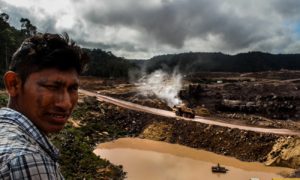
Adolfo Chávez, a representative of the Coordinator of Indigenous Organizations of the Amazon Basin (COICA), which reviewed the controversial El Mirador copper mine in Ecuador – the site of a fatal conflict with indigenous Shúar communities – along with four other projects executed by Chinese firms, said dialogue is sorely needed.
“It’s a first step. We’d now like to sit with Chinese representatives and work out a roadmap to improve and overcome the existing difficulties.”
COICA concluded that the five projects violated the rights of 455 indigenous groups in the Amazon basin since they were carried out without their prior consent. He said monitoring China’s rights record is vital.
“We can’t just wait for them to act on their own,” Chávez said.
Sarah Brooks, programme manager for Asia at the International Service for Human Rights (ISHR), agreed. “Activists in China and abroad should seek clarification, and monitor to ensure full and effective regulation of Chinese business,” she said.
Brooks said that despite accepting many recommendations, in all China rejected around 20%, having deemed them “politicised” and claimed some of the stronger recommendations are “already implemented”.
31
the number of UPR rights recommendations China said it had "already implemented"
At its first UPR in 2009, China accepted 42 recommendations and rejected 50. Five years later, it received a further 252 recommendations, accepting 204 and rejecting 48. Of those, China said 31 had already been implemented and eight were currently being implemented.
At the November 2018 session, the government pointed out that by April that year it had enacted 28 new laws related to human rights and had issued and implemented the country’s 2016 Human Rights Action Plan, the third of its kind.
Zhao Shukun, a human rights professor, wrote in an opinion piece about the UPR: “Instead of making empty promises, China believes in making gradual progress in human rights development, because that is what brings people concrete benefits”.
The article, which featured in the state-run China Daily, claimed China’s acceptance of 284 of the 346 suggestions in the review “speaks volumes” about the progress China has made on the human rights front.
However, according to Brooks, China has not reported on its ‘mid-term’ progress implementing rights recommendations on the previous two occasions.
“It is unlikely that the UPR recommendations can be used to improve practices of the Chinese government directly,” she said.