Justice

China and Colombia: building the peace?

SPECIAL SERIES: Will China's role in developing post-conflict Colombia help or undermine peace?
<p>The development of rural Colombia is a central focus of the peace deal with FARC, but what role for China? (image: <a href="https://www.flickr.com/photos/miljoverndepartementet/34512555363/in/album-72157682815036001/" target="_blank" rel="noopener">Norway Ministry of Climate and Environment </a>)</p>

The development of rural Colombia is a central focus of the peace deal with FARC, but what role for China? (image: Norway Ministry of Climate and Environment )

On 24 November 2016, the government of Colombia signed a peace accord with the guerrilla group the Revolutionary Armed Forces of Colombia (FARC), opening a new chapter after nearly 60 years of civil conflict.

The Colombian government has hailed the post-peace deal era as one of multiple opportunities for foreign traders and investors to stimulate economic activity in war-ravaged and previously inaccessible parts of the country.

As China begins to engage with resource-rich Colombia, will its investments help or undermine sustainable development?
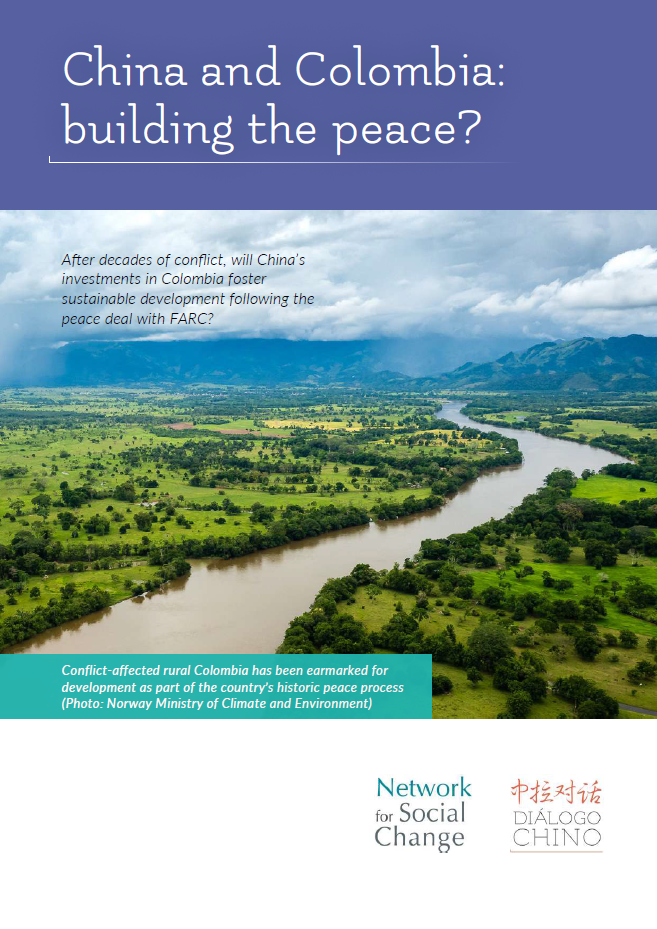
Click HERE to download our special series China and Colombia: building the peace? as a PDF

Elsewhere in Latin America, China has emerged as a major new trade partner, source of loans and contractor for infrastructure projects. The region’s resources – soya, copper, iron ore and oil – helped to fuel China’s rapid growth and to meet its food and energy security needs.

But the social and environmental risks endemic to resource extraction and, more recently, infrastructure building, have generated strong opposition from affected communities when projects have not been responsibly managed.

On the eve of the first anniversary of the signing of the historic peace deal, violence still ravages many parts of rural Colombia. The end of the western hemisphere’s longest-running war has opened the door to new conflicts over land ownership and natural resources.

On the eve of the first anniversary of signing of the peace deal with FARC, Diálogo Chino presents a special series of articles exploring China’s challenges in the promotion of peaceful and sustainable development in Colombia.

From biodiversity preservation on the Caribbean coast to community opposition to oil exploration in the Amazon, the articles in this series offer a timely snapshot of the critical China-Colombia relationship.

Cookies Settings

Dialogue Earth uses cookies to provide you with the best user experience possible. Cookie information is stored in your browser. It allows us to recognise you when you return to Dialogue Earth and helps us to understand which sections of the website you find useful.

Required Cookies

Required Cookies should be enabled at all times so that we can save your preferences for cookie settings.

Dialogue Earth - Dialogue Earth is an independent organisation dedicated to promoting a common understanding of the world's urgent environmental challenges. Read our privacy policy.

Cloudflare - Cloudflare is a service used for the purposes of increasing the security and performance of web sites and services. Read Cloudflare's privacy policy and terms of service.

Functional Cookies

Dialogue Earth uses several functional cookies to collect anonymous information such as the number of site visitors and the most popular pages. Keeping these cookies enabled helps us to improve our website.

Google Analytics - The Google Analytics cookies are used to gather anonymous information about how you use our websites. We use this information to improve our sites and report on the reach of our content. Read Google's privacy policy and terms of service.

Advertising Cookies

This website uses the following additional cookies:

Google Inc. - Google operates Google Ads, Display & Video 360, and Google Ad Manager. These services allow advertisers to plan, execute and analyze marketing programs with greater ease and efficiency, while enabling publishers to maximize their returns from online advertising. Note that you may see cookies placed by Google for advertising, including the opt out cookie, under the Google.com or DoubleClick.net domains.

Twitter - Twitter is a real-time information network that connects you to the latest stories, ideas, opinions and news about what you find interesting. Simply find the accounts you find compelling and follow the conversations.

Facebook Inc. - Facebook is an online social networking service. China Dialogue aims to help guide our readers to content that they are interested in, so they can continue to read more of what they enjoy. If you are a social media user, then we are able to do this through a pixel provided by Facebook, which allows Facebook to place cookies on your web browser. For example, when a Facebook user returns to Facebook from our site, Facebook can identify them as part of a group of China Dialogue readers, and deliver them marketing messages from us, i.e. more of our content on biodiversity. Data that can be obtained through this is limited to the URL of the pages that have been visited and the limited information a browser might pass on, such as its IP address. In addition to the cookie controls that we mentioned above, if you are a Facebook user you can opt out by following this link.

Linkedin - LinkedIn is a business- and employment-oriented social networking service that operates via websites and mobile apps.