


Lener Fonseca and Freddy Navas were the last two leaders of Nicaragua’s Rural Anti-Canal Movement who were not imprisoned or in exile. That is, until they were taken into custody from their safe houses in the capital Managua last week.
Both were kidnapped by paramilitaries, armed civilians serving the government, and transported to the El Chipote maximum security prison, opposition paper La Prensa reported. It is the same place Anastasio Somoza, Nicaragua’s dictator until 1979, detained his political opponents.
Protests in Nicaragua have already left nearly 400 dead, 4,000 wounded, 600 political prisoners and 50,000 displaced to Costa Rica, the US and other countries, according to the Nicaraguan Centre for Human Rights (Cenidh).
Disquiet erupted in April this year when the government announced changes to social security that cut retirees’ pensions by 5% and increased employers contributions. Since then, President Daniel Ortega’s government began a fierce purge of those who led protests against him.
The peasant movement, which opposes the controversial project to build a 270-kilometre shipping canal connecting the Pacific and Atlantic oceans, joined the resistance. The stalled US$50 billion project, spearheaded by Chinese entrepreneur Wang Jing, has the full support of the Nicaraguan government. The government claims the project will boost economic activity in the second poorest country in the Western hemisphere after Haiti.
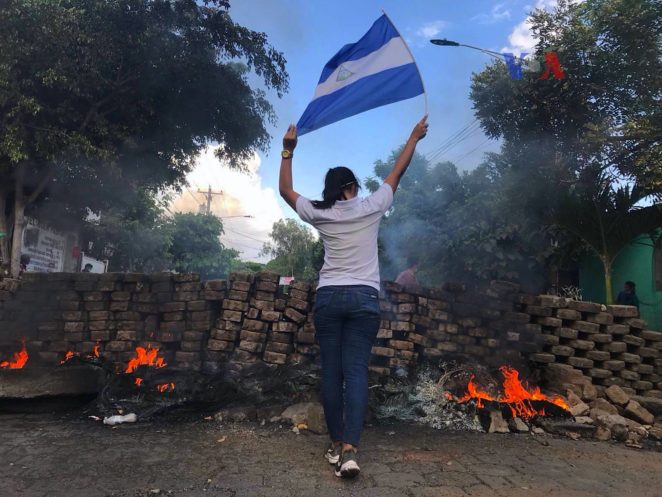
While students occupied three universities and anti-government protests kicked-off in the cities, rural communities barricaded main roads, paralysing the country. Initially focused on derailing the canal, they have come to demand Ortega’s departure.
Canal resistance
The rural anti-canal struggle began in July 2012 when deputies from the government’s Sandinista Front for National Liberation (FSLN) and allies approved Law 840, known as ‘the canal law’. It granted a 100-year concession to Wang, enabling him to expropriate land from rural communities where he deemed it convenient, according to lawyers’ interpretations.
Though the canal project has not advanced and no land has yet been taken, the law opened the door to the violation of human rights and lit the touch-paper for a revolution. Rural organisations organised more than 100 marches demanding law 840 be repealed. But none of the marches had much impact or roused solidarity in urban areas where the government maintained social programs.
“When the student demonstrations began, the peasants, with a strong anti-government sentiment, joined in,” said political analyst Eliseo Núñez. “And then protests escalated throughout the country.”
On April 18, a group of retirees went out to protest in the western city of León, a cultural centre and birthplace of the poet Rubén Darío and other renowned intellectuals. They were repressed by the government’s “shock forces”. Videos and photographs appeared on social media of 70-year-olds being dragged, beaten and intimidated.
The next day in Managua, a group of students from the Jesuit Central American University went out to protest and faced the same fate. They were beaten with baseball bats by government supporters as police special forces watched on. At dawn on April 20, other Managua universities rose up.
The first students died that day as the government cracked-down using excessive force. Though Ortega backtracked on the social security reforms a day later, protests had spread nationwide, demanding justice for those killed.
The uprising has cost the peasant movement dearly. Accused of terrorism, its main leaders are either imprisoned or in exile.
“The rural movement, which was the only one that had protested against the government since 2013 when the [National] Assembly approved the canal law, added to the protests initiated by the students that put the government on the ropes,” explained Núñez.
“In the 11 years of Ortega’s government, the only movement that confronted Ortega in the streets was the peasant movement,” Núñez added.
The uprising has cost the peasant movement dearly. Accused of terrorism, its main leaders are either imprisoned or in exile.
“Medardo Mairena (coordinator of the Rural Anti-Canal Movement) is being tortured in a maximum security cell and accused of being a terrorist,” according to defence attorney Julio Espinioza.
In addition to Mairena and other anti-canal leaders such as Pedro Mena, Víctor Díaz and Ronald Enríquez, Fonseca and Navas have been added to the list of those detained. Other emblematic figures of the peasant struggle like Francisca Ramírez, Henry Ruiz and environmental lawyer Mónica López Baltodano, are in exile in Costa Rica, working out how to continue the fight.
“The blow to the peasant movement and the students has been very tough,” says Núñez. “But they will come out stronger from all this.”
Resistance regroups
“We are getting organised to return,” rural leader Francisca Ramírez said in a video from Costa Rica.
When the Rural Anti-Canal Movement began, it did not have a broad political agenda. Nor did it demand Ortega’s removal.
However, during the protests the movement has toughened its stance: “We demand his departure, his resignation and early elections,” Mairena told Ortega on the only day he arrived at the ill-fated National Dialogue. Shortly after, negotiations broke down. The police stormed the barricades peasants had erected on roads and highways.
“The peasant struggle has changed tack to demand the departure of Ortega because we understand that the only way Law 840 can be repealed is with another government,” Núñez said.
President Ortega has declared the protests against him illegal and said they are a threat to the peace and security of the country. In his last public speech, he said: “They were financed by the US, by European organisations and NGOs in Nicaragua.”