An Ecuadorean environmental NGO has hit back at the government’s “arbitrary” and “illegitimate” order to shut it down following a complaint by Chinese mining company Explorocobres (EXSA) about its involvement in an ongoing social conflict.
Ecuador’s interior ministry requested on December 20 that the ministry of the environment dissolve 30-year-old Acción Ecológica (AE) for supporting the indigenous Shuar communities of Nankints in protests against a new mining camp in their territory in the South-eastern province of Morona Santiago.
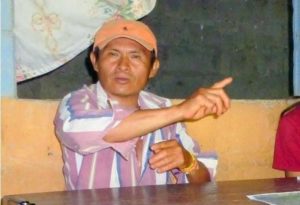
AE says the Shuar were not consulted on the construction of the camp and opposes the expansion of the extractive frontier in the Cordillera del Condor in the Ecuadorean Amazon owing to its impacts on sensitive ecosystems.
The government upheld the complaint, arguing that by mobilising opposition to EXSA’s operations, the NGO had ceased to follow the objectives for which it was created.
However, in a statement released on December 21, AE counters that their repeated warnings about human rights violations in Condillera del Condor “precisely” matched their statute.
“[We] promote the defense of the rights of nature with the aim of preserving a healthy environment and achieving the right to live well (buen vivir),” the statement read.
The rights of nature are written into Ecuador’s 2008 constitution. Article 71 says: “Every person, people, community or nationality can demand the recognition of the rights of nature before public institutions”.
The ministry’s request came after EXSA, a copper project jointly-owned by China’s Ecuacorriente and China Tongling Nonferrous Metals Inc., complained that AE’s social media posts had encouraged violent protests on November 21 and December 14.
Clashes claimed the life of one policeman and injured seven others. AE argues that if their pleas to Chinese banks to withdraw funding for the controversial projects in the region had been heeded, the death of the policeman could have been avoided.
Indigenous Shuar leader José Tendetza Antún was killed in 2015 after opposing the El Mirador copper project, also owned by Ecuacorriente.
Solidarity
The order to dissolve AE has provoked a strong response both at home and from international NGOs.
The Global Forest Coalition, an international coalition of 83 groups from 53 mainly Southern countries said: “We repudiate the extractivist violence of the Ecuadorian government and express our solidarity with the struggle of the Shuar people and with the defense of human rights carried out by Acción Ecológica.”
US-based Amazon Watch said: “The move is a clear reprisal to the group’s efforts to raise awareness about environmental and indigenous rights concerns over a planned mega-copper mine”.
Best-selling author Naomi Klein called the action to close down AE “shameful” in a tweet that included the hashtag #SOSAccionEcologica.
Meanwhile, the Confederation of Indigenous Nations of Ecuador (CONAIE) and the Confederation of Nations of the Ecuadorean Amazon has circulated a Change.org petition calling for the demilitarisation of Shuar indigenous territory.
Strategic partnership
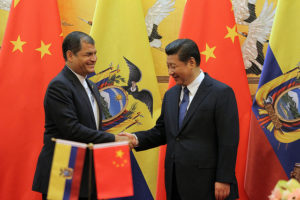
The AE controversy comes a month after Chinese president Xi Jinping visited Ecuador in advance of the APEC 2016 summit in Lima, Peru. During the visit China and Ecuador agreed to upgrade their relationship to that of a “Strategic Integral Partnership”.
The move followed a declaration by President Xi in 2014 which said cooperation between the two countries would be guided by an “inclusive and sustainable cooperation plan”.
Ecuador is indebted to China to the tune of some US$15 billion.
President Rafael Correa has cultivated a close relationship with Beijing since Ecuador was frozen out of international capital markets following a default on foreign debt in 2008.