In December 2024, El Salvador’s congress reversed an historic ruling on metal mining to reauthorise the activity in the country, seven years after it became the first nation in the world to explicitly ban it.
Gold mining has a particularly long and troubled history in the Central American country, dating back to the colonial era, and has had profound environmental consequences, such as river pollution caused by acid drainage from mines.
The new law states that only President Nayib Bukele’s government can authorise or carry out the mining, though it can do so through “institutions specifically created or designed for this activity, or through companies in which it has shareholdings”.
Since the law was approved, Vidalina Morales says she has experienced hellish nights. She tells how, after dark, strange vehicles have been driving around her community of Santa Marta, located in El Salvador’s inland department of Cabañas, an area that has been at the centre of mining conflicts. The endless barking of dogs, stirred by outsiders entering this rural area, has pierced the nighttime silence. Morales is one of the women activists who have been speaking out against mining in El Salvador for many years. She doesn’t know for sure who is in those vehicles, but her neighbours warn her to “be careful”.
Morales is president of the Economic and Social Development Association (Ades), an activist organisation through which she and her colleagues have been resisting a range of threats in Santa Marta for over 20 years. She suspects the police may be among those trying to intimidate her by driving through her community at night; Ades has been reporting police harassment in the community for months, something she says has intensified after the reauthorisation of mining.
The activist says that Ades never stopped its resistance, even after the entry of the mining ban in 2017. In 2023, five Ades members were arrested and charged with a crime that allegedly occurred during the Salvadoran Civil War (1980-1992). Ades is convinced this is a reprisal for their anti-mining struggle. The activists have chosen not to attend recent hearings because they believe there are no guarantees of a fair trial.
Other organisations have also expressed opposition to the new law reauthorising mining. In March, the Catholic Church submitted a petition with around 150,000 signatures to El Salvador’s legislative assembly calling for the law to be repealed. Social organisations submitted another 59,000 signatures and a constitutional complaint to the country’s supreme court.
All these activities, however, have failed to change the government’s decision or deter the mining industry. Meanwhile, companies have been discreetly registering themselves in the country, with the aim of exploiting minerals in the country – some even before the approval of the new law.
Veteran miners shows interest
The new metal mining law has attracted well-known figures into the sector, although no specific projects have yet been announced. Since December, at least three companies related to the metals trade have been registered in the Salvadoran Commercial Registry.
Among those is a company formed by two mining veterans with a controversial track record in Central America. Citalá Resources, which officially registered as a mining company on 27 February 2025, was founded by two lawyers from a firm specialising in foreign investment, but its board of directors reveals a more robust mining profile: Canadian Simon Ridgway serves as president and Venezuelan Pedro Rafael García Varela as vice president. Both are linked to the Canadian company Radius Gold, with nearly 30 years of experience in gold mining in Peru, Mexico, Guatemala and Honduras.
Ridgway and García Varela also founded Entre Mares de Guatemala, a company that participated in the country’s Cerro Blanco gold mine, and a subsidiary of Canada-based Bluestone Resources, and formerly of the now-defunct Canadian mining giant Goldcorp.
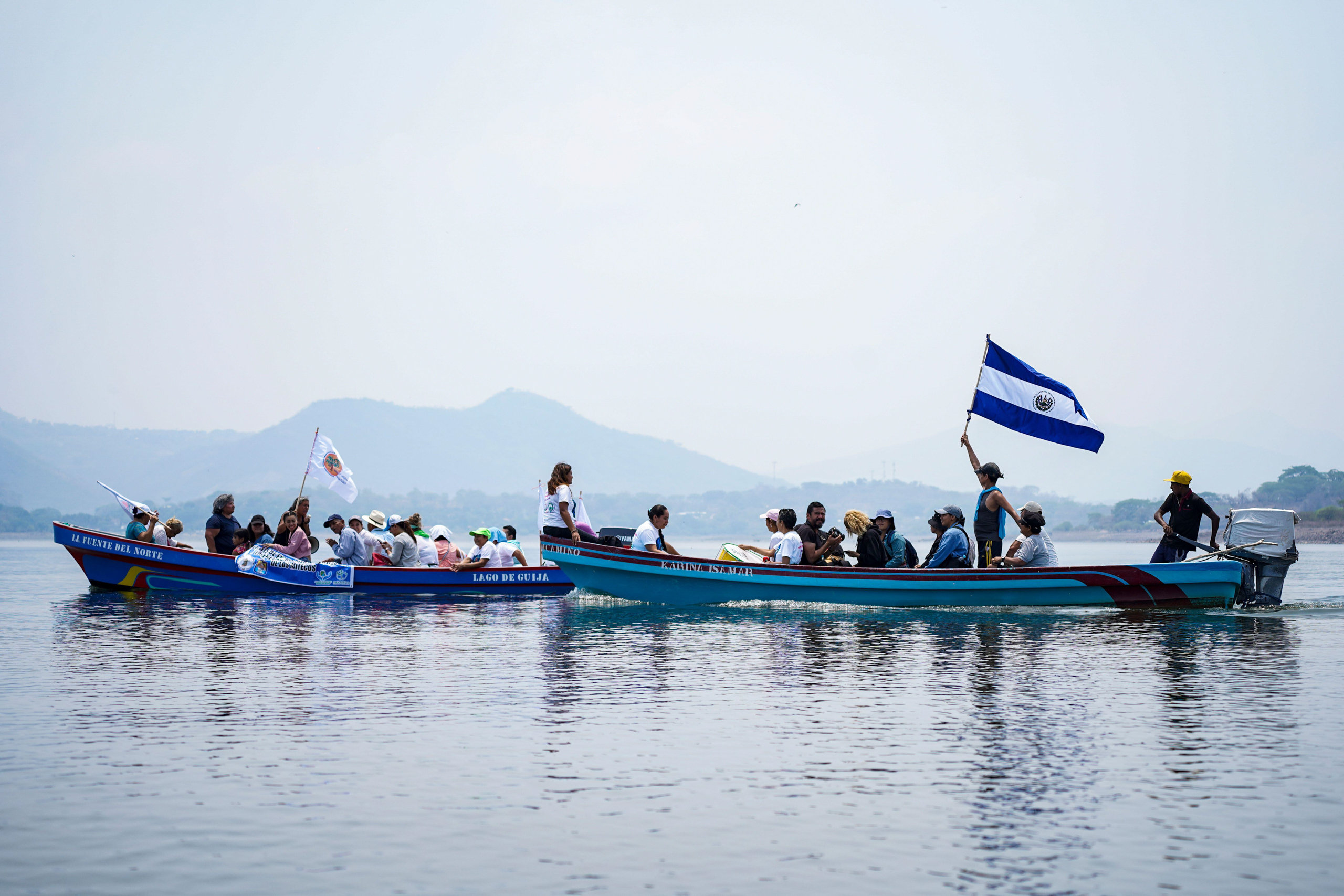
The Cerro Blanco project has been criticised for alleged mismanagement and risking the contamination of Lake Güija, which is shared with El Salvador and connected to the Lempa River, El Salvador’s main water source. Although the project’s mining permit was suspended in June 2024, the mine was later sold to fellow Canadian firm Aura Minerals as part of its acquisition of Bluestone. The new owner has since responded to accusations that it poses environmental threats, stating a “commitment to responsible and sustainable mining”.
Radius Gold also participated in the San Martín mine in Honduras, operated through the now-defunct Glamis Gold and Entre Mares de Honduras, also subsidiaries of Goldcorp. Although closed since 2009, the project is cited as an example of the negative impacts of open-pit mining: pollution, social conflicts and alleged human rights violations.
According to Property and Land Registry documents seen by Dialogue Earth, as of the end of April 2025, Citalá Resources had not registered any real estate in its name, but its articles of incorporation contemplate mergers and participation in “mixed economy” companies. This is relevant, given that El Salvador’s new mining law establishes that only the state can engage in metal mining, but also allows for such public-private partnerships.
The new legislation also offers tax benefits to foreign investors, including tax exemption periods of as much as 20 years.
In addition to Citalá, two other companies were created on 17 December 2024, six days before the law’s approval: Efatá and Mega Obras y Servicios. Both are affiliated with foreign entities – from Colombia and Venezuela – and were officially registered in January and February 2025. Their founding documents list them as mining support companies.
Resisting in hostile terrain
Despite the reversal of the ban, and the circling interest of new companies, experts have called into question the feasibility of new projects.
Andrés McKinley, an academic and researcher at the José Simeón Cañas Central American University (UCA) with decades of experience in metal mining and water resource management, believes that renewed mining projects in El Salvador are not viable.
“There isn’t enough water to meet people’s demands [….] water stress occurs when water availability reaches 1,700 cubic meters per person per year. And we’ve been there for a few years now,” says McKinley, referring to the water stress indicator developed and implemented since the 1970s.
That’s not the only thing that makes it unviable. According to McKinley, the prospecting studies carried out around 20 years ago by the Pacific Rim mining company showed that density of gold deposits in El Salvador barely reached 5-9 grams per tonne of earth: less than what is needed to forge a single ring.
In an X post in November announcing the law would be reversed, a month ahead of the final decision, Bukele claimed El Salvador possesses gold deposits with the “highest density per square kilometre on the planet”. This claim has been rejected by academics and other experts.
We understand that we need minerals, we need metals. But that doesn’t mean it should be done anywhere, under any circumstancesAndrés McKinley, José Simeón Cañas Central American University (UCA) researcher
In 2013, El Salvador’s then Mining Division of the Hydrocarbons and Mines Regulatory Directorate of the Ministry of Economy (MINEC) prepared a report entitled “Metallic Mining Resources in El Salvador”. This was never made publicly available but has been seen by Dialogue Earth.
The report states that the country’s main gold and silver deposits are located in the northern and eastern regions, especially in the departments of Morazán, San Miguel and La Unión.
The approximate area with mining potential is 1,682 square kilometres, according to the study, equivalent to nearly 8% of the national territory. Some of the areas of interest were active mines decades ago, such as the San Sebastián mine – one of the largest, in operation until the 1990s, and which has been generating acid drainage on the river of the same name in the department of La Unión for years.
The Salvadoran government has so far refused to reveal the studies that supported its decision to reactivate metal mining, declaring them confidential, considering them a “trade secret”. The map published by Bukele in November, however, coincides with the same points highlighted in the 2013 MINEC report.
“We’re not against all mining; we understand that we need minerals, we need metals,” McKinley explains. “But that doesn’t mean it should be done anywhere, under any circumstances.”
Protest crackdown
Ades and its members have not stopped their activities, despite the loss of momentum surrounding mining in the public discourse. As they did prior to the passage of the new law, they continue to conduct training on the issue and hold community demonstrations. In early June, the environmentalists’ lawyer requested the removal of the judge from the case seeking to prosecute the five activists, arguing that his judgment could be biased following allegations he was in the national guard during the civil war. The request was approved on 6 June.
Speaking to Dialogue Earth at the beginning of April, Morales said a “relative calm” persisted in Santa Marta, but added: “Fear is present because we know what they’re capable of, right? We’ve seen it throughout the state of emergency. The fear is that there will be arrests.”
Two years ago, her son was arrested amid El Salvador’s state of emergency – a legislative decree launched by the Bukele government in March 2022 that has been repeatedly extended, ostensibly in an attempt to crack down on gangs. In practice, the state of emergency has allowed mass arrests and led to hundreds of reports of human rights violations. The communities of Cabañas have also suffered sudden military sieges under the regime’s justification.
In mid May, the Salvadoran government arrested more activists and human rights defenders, while congress passed a law that imposes tax rises on civil society organisations and independent media. These measures could make it virtually impossible for some to operate. The organisations have continued to resist.
For this article, interviews were requested with the Ministry of the Environment, the General Directorate of Hydrocarbons, Energy and Mines, and the newly registered companies, but no responses were received.