States and legal experts have welcomed “historic” guidance from the Americas’ top court that outlines the legal responsibilities for governments and companies to address climate change.
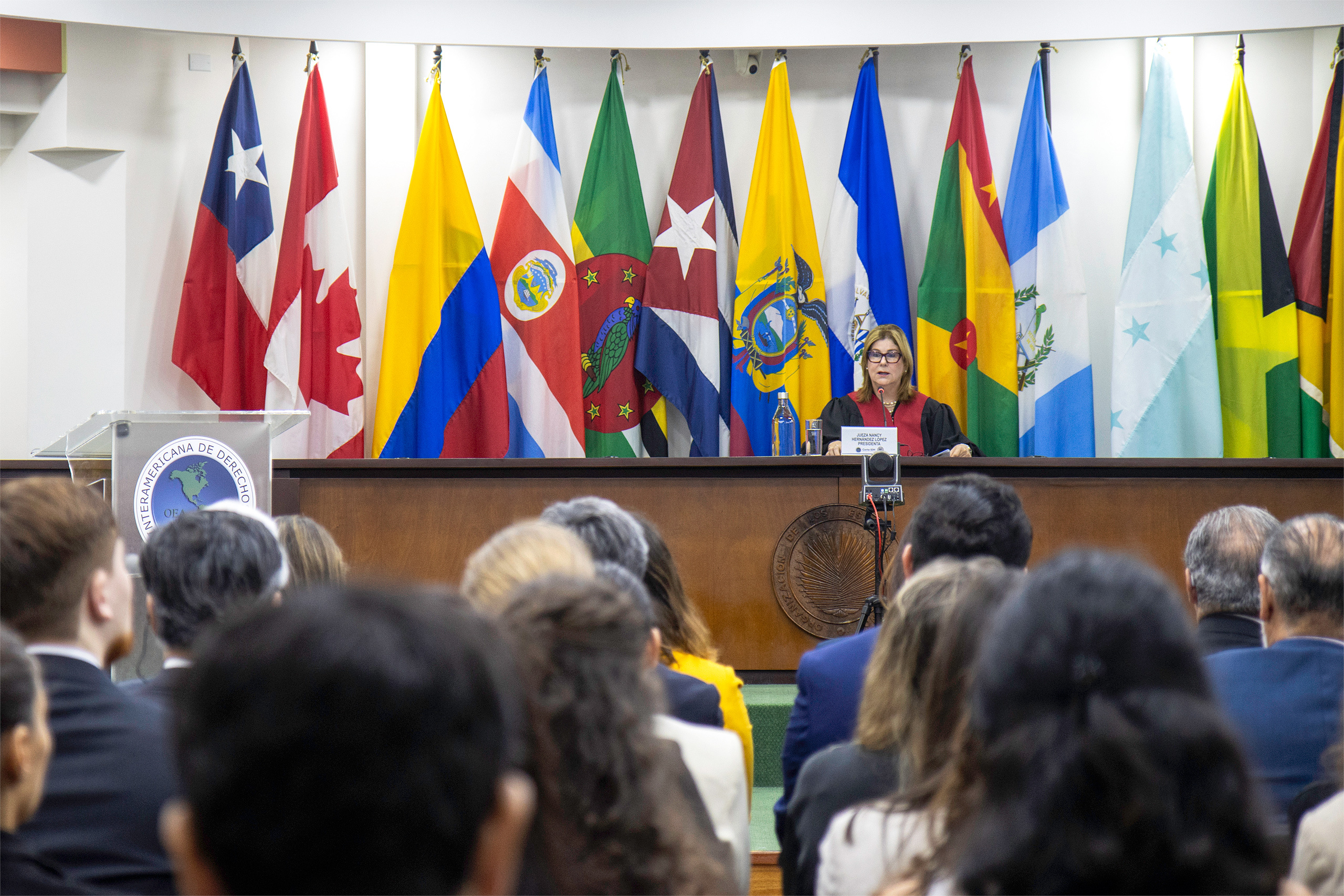
The much-anticipated “advisory opinion on the climate emergency and human rights”, published by the Inter-American Court of Human Rights (IACHR) on 3 July, is a detailed 234-page document covering a broad body of international and regional law.
It provides a “very rich roadmap” for responding to the climate emergency across society, including setting a series of standards for national climate strategies that could be very important for the forthcoming COP30 climate summit in Brazil, says Viviana Krsticevic, executive director of the Centre for Justice and International Law (CEJIL), a human rights NGO that supported Colombia and Chile’s request for the advisory opinion.
The right to a healthy climate
The IACHR’s founding purpose is to interpret and apply the American Convention on Human Rights, a treaty ratified by most of the 35 members of the Organization of American States (OAS). But its newly published opinion takes into account a broad range of national, regional and international laws and principles. And it affirms that the findings apply to all members of the OAS, including the United States and Canada, which do not recognise the court’s jurisdiction.
The court confirmed the right to a healthy environment, which it has established in previous rulings, but said for the first time that this includes the right to a healthy climate. It defines this as “a climate system free from dangerous anthropogenic influence that is dangerous to humans and to nature as a whole”.
A climate system free from dangerous anthropogenic influence that is dangerous to humans and to nature as a wholeThe Inter-American Court of Human Rights describing a healthy climate
The document outlines specific legal responsibilities for states to uphold human rights at risk from climate change, which include the right to life, health, clean water, education and work. These rights apply to future generations, it concludes, as well as people alive today.
States themselves must take “urgent and effective” actions to prevent environmental and climate-related harm and to adapt where necessary, and must guarantee comprehensive reparations when rights are breached. They cannot adopt regressive policies, the opinion clearly states.
Holding fossil fuel industries to account
The inquiry was instigated by the governments of Colombia and Chile in 2023. The Costa Rica-based IACHR received 260 written submissions and held a series of hearings last year, in Barbados and the Brazilian cities of Brasília and Manaus. A wide variety of states and regional bodies, academics, civil society groups and individuals took part. The court deliberately held hearings in the Caribbean and Latin America so that it could hear from those most affected and at risk from climate change. The outcome has been keenly awaited, as it forms one of a number of high-profile climate litigation cases activists hope will galvanise tougher action to tackle climate change.
The governments of Chile and Colombia welcomed last week’s opinion. In a statement, they said it “constitutes a milestone in the regional consolidation of international human rights law in relation to environmental protection”. And they said it reaffirms their joint commitment to combatting the climate emergency “by developing clear legal standards that guide more effective responses to this global challenge”.
Among other things, the opinion stresses the importance of the regional Escazú Agreement – Latin America and the Caribbean’s landmark environmental treaty, which entered into force in 2021. That agreement seeks to improve access to information, address widespread impunity for crimes against environmental defenders, and ensure stronger rights for communities to be consulted on the impacts of large development projects.
The advisory opinion sets out legal responsibilities for corporations to minimise their impact on the climate and for states to effectively regulate companies under their control. It singles out the exploration, extraction, transportation and processing of fossil fuels, cement manufacturing and agro-industry as the biggest emitters of greenhouse gases. Furthermore, it says states should pass laws so that transnational corporations and conglomerates can be fully held to account for the emissions of their subsidiaries.
Climate change is not a niche issue. It is a systemic crisis that cuts across all rights and must be addressed as such by statesLaura Restrepo Alameda, campaigner for Climate Action Network Latin America
States also have a duty to ensure a fair transition to a cleaner society in which human rights must still be safeguarded, says the court. This is a particularly urgent problem in Latin America and the Caribbean where mining for critical minerals needed for transition technologies such as electric vehicles is leading to serious social and environmental problems.
The IACHR opinion also explicitly recognises the rights of nature for the first time and says states have a duty to restore damage to ecosystems caused by climate change.
‘More than a legal breakthrough’
Writing on X, Colombian environment minister Lena Estrada Añokazi said it was a “historic” decision. “This ruling confirms what Indigenous peoples have said for centuries: there are no human rights without Mother Earth,” she said. “It’s not just a legal breakthrough; it’s a reaffirmation of life.”
The new opinion marks a defining moment for the region, said Laura Restrepo Alameda, a campaigner for Climate Action Network Latin America. “It reminds us that climate change is not a niche environmental issue or a single-sector issue; it is a systemic crisis that cuts across all rights and must be addressed as such by states.”
Youth representatives, who had participated in the hearings before the court, celebrated the court’s explicit recognition in its opinion that the climate crisis has a disproportionate impact on children and future generations.
“The court respects the intergenerational principle as an enforceable principle,” said Mariana Campos Vega, Latin America deputy front convenor for World’s Youth for Climate Justice. “This would not have been possible without the engagement of children and youth … the most significant result is that the court recognised our voices.”
Climate litigation heats up
The IACHR is the second of four top courts to produce a climate-related advisory opinion, a document which is technically non-binding but is considered authoritative because it summarises existing law. It is the only one so far to focus on human rights, although the African Court on Human and People’s Rights has recently begun its own process.
The International Tribunal for the Law of the Sea (Itlos), was the first to publish its opinion last year. That court concluded that greenhouse gases are pollutants that are wrecking the marine environment, and states have a legal responsibility to control them – a decision that is slowly filtering into climate litigation and diplomacy.
The International Court of Justice (ICJ), whose role is to harmonise and integrate international law, is due to publish its opinion on 23 July. It held two weeks of hearings last December.
Ralph Regenvanu, climate change minister for Vanuatu, which spearheaded the request to the ICJ and was the first country outside the Americas to contribute a written submission to the IACHR, said all regional and international courts have an important role to play in advancing climate justice.
“Together, they can pave the way for a more integrated approach to international law that addresses the human rights dimensions and remedies the historical climate injustices that the Global South increasingly suffer from in the climate emergency,” he said.