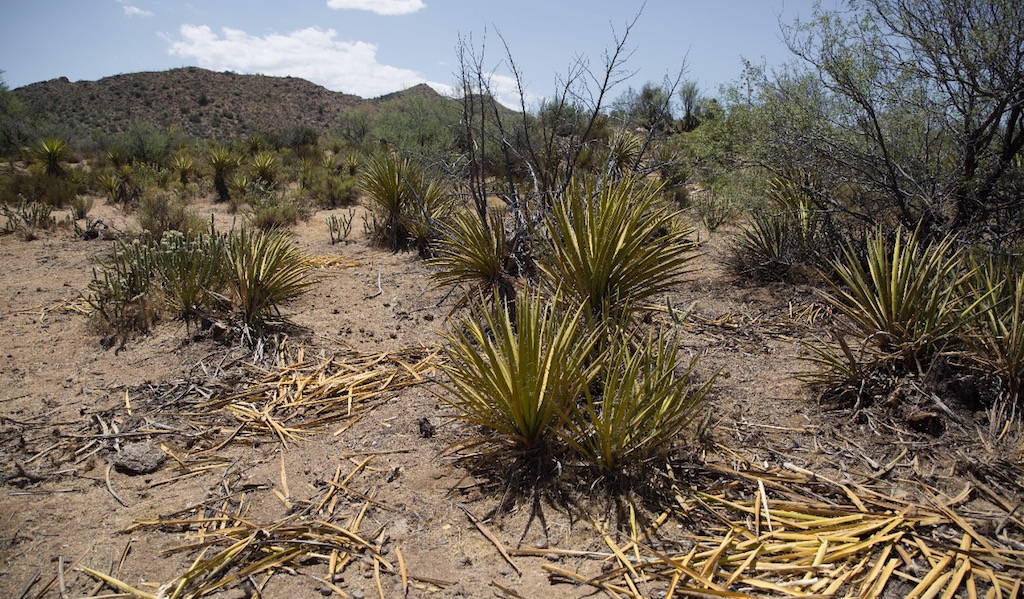
Yucca schidigera – or palmilla – is a thick plant that can reach five meters high and resist both the inclement heat and freezing nights of the Californian desert. The sharp leaves that sprout from its trunk like those of the maguey or agave conceal a cluster of white flowers.
According to Baja Agro International, the main company in Mexico dedicated to its production and export, yucca has numerous uses ranging from naturopathic medicine, to that of a sparkling agent and flavouring in soft drinks, as well as an ingredient in poultry, swine, cattle and aquaculture feed. It is also used in domestic pet food.
However, yucca’s unique properties as an animal immune system booster and means of increasing weight gain in livestock have alerted agricultural markets to its commercial potential. At the same time, criminal gangs keen to capitalise on yucca’s nascent popularity but who care little for the long-term preservation of the plant are also taking notice.
Yucca can be traded in various forms online. On Alibaba, the popular Chinese commerce site, prices for yucca extract range from US$10 to $50 per kilogramme. And on Amazon for up to $56 dollars per kg.
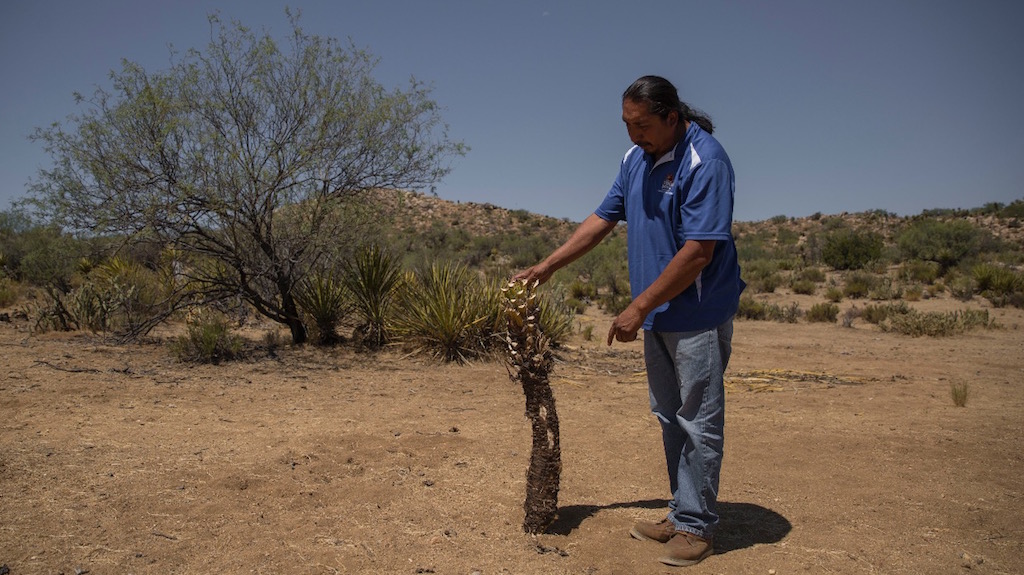
Elías Espinoza is a Kiliwa indigenous landowner in the Ejido Tribu Kiliwas Arroyo de León territory, communal lands given by the government to farm workers where yuccas grow like mushrooms. He says that armed groups break into indigenous land in Valle de la Trinidad, a town south of Ensenada in northwestern Mexico, to steal the Yucca and sell to local companies that process and export it to the US and China among other destinations.
Those of us who legally cut and have permits know that everything that comes out of the Trinidad Valley cannot be legal
Elías explains that he and his workers take great care to cut the plant according to quality standards demanded by buyers. They know they must peel stems completely, plucking those near flush with the root without damaging it.
“[The traffickers] cut as they want and that’s how they take it,” he says. “They cut the top and leave the leaf. We take the time to work on it well, because if we leave those bits and pieces, the company punishes us.”
Yucca: a natural alternative
Baja Agro International, the main yucca company in Mexico that has a presence across the production chain, says it product reaches 50 countries, including China. Mexico’s Ministry of Agricultural Development recently recognised the growth of the company, which has the US and China as its two main export and distribution destinations.
Given the comparatively small sales of yucca until now, precise data for the quantities traded are hard to come by. International trade databases often include yucca in figures for the animal feed it is an ingredient in.
Although yucca is not widely used in China yet, it could reduce the environmental impact of animal production. China banned growth-promoting antibiotics as a feed additive in January 2020, creating a market opportunity for yucca. However, its desirability continues to sow the seeds for theft and the intimidation of indigenous communities who find themselves at the mercy of armed groups.
“The theft of the yucca cannot be stopped,” Elías laments as he tours the ejidos. “The plants at some ranches are finished and now they’re coming for the remaining ones.”
Landowners have a permit granted by the state and federal government for the sustainable extraction of the plant. This stipulates that only 50% of the plants born from a single root can be cut, guaranteeing its permanence. Collected plants are sold at US$450 per tonne.
Trucks can carry between 30 and 32 tonnes, Elías explains. In a single trip they can collect almost US$15,000 worth of yucca, which could be more if the villagers had more vehicles and workers.
Thieves eye lucrative crop
Yucca thieves come in groups of three or four. They arrive armed and enter communal territory from different access points, according to Cirilo Bañuelos of the Ejidos Commissariat.
Elías recalls that last July, landowners erected a fence at the entrance to the ejido. They padlocked it but proved useless and took longer to install it did for criminals to find another way in. Inhabitants took turns to watch the entrances at night but they soon found themselves defenseless.
Cirilo says that on one occasion they managed to spot a truck as it was entering. On trying to intercept it, a man pointed a long gun at them. The thieves left with the plants in vehicles carrying foreign plates that are likely stolen.
Elías and Cirilo say the problem is not new but has increased in the last two years. Recently, they decided to follow the thieves, tracking them to Llano Colorado, a town less than 5 kilometres from the ejido where the Kiliwas live.
From there, shipments go to Ensenada where they are sold for between US$150 and $250 – around half the price of the legal crop – to companies that extract the saponin, the active component of the plant, to export it either in liquid or powder form, Elías says.
“Those of us who legally cut and have permits know that everything that comes out of the Trinidad Valley cannot be legal because practically all of us sell to one or two companies,” he says. “The rest must be supplied another way.”
According to Jesús Alejandro Ruiz Uribe, a federal delegate in Baja California, yucca is the victim of organised crime. Beyond those stealing and buying it, authorities are permitting its exploitation.
For a company to be able to buy and export a species such as Yucca, it requires a permit known as a forest remission that is granted by the National Forestry Commission (CONAFOR), Uribe explains. This guarantees that the species they commercialise complies with Mexican environmental regulations.
Last month, during the meeting of the Agrarian Board – an agrarian prosecutor, combining federal agencies – Ruiz Uribe and affected groups agreed to install a checkpoint in Valle de la Trinidad since efforts to halt yucca theft thus far suffered from weak law enforcement.
“Someone is not doing their job,” Uribe says, “under the complicity of authorities, companies are taking this plant to other countries. They have more than 55 types of use and that is why in places like China or India [where it does not grow] buy it in large quantities.”