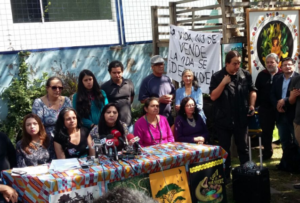
On December 21 the Ecuadorean government issued an order to dissolve Quito-based NGO Acción Ecológica, which for 30 years has worked to defend land rights and protect against environmental degradation in the Amazon.
Ecuador’s ministry of the interior concluded that in mobilising opposition to a Chinese-owned copper mining project in the province of Morona Santiago, the organization was no longer acting according to its founding principles and must close down.
Acción Ecológica objected that it had always followed its mission: to uphold the principles of buen vivir, a philosophy of life that is normally translated as ‘living well’ or ‘good living’ and which denotes alternatives to economic development based on respect for the rights of nature. Buen vivir refers to legal-philosophical principles of living in harmony with, and offering legal protections to, the natural world. In Ecuador, respect for the rights of nature is enshrined in the 2008 constitution.
The case of Acción Ecológica adds fuel to a lively and ongoing debate in Latin America about how buen vivir and rights of nature coexist with other legal frameworks and who guarantees their implementation.
Beyond economic development
Buen vivir is the idea that there are alternatives to economic globalisation that are based on a “good life” and fullness of life. The idea, which reflects indigenous values and traditions, is not to be confused with notions such as “standard of living” or “economic growth” defined in monetary or economic terms. It includes a spiritual component and a notion of community in which harmony between people, and between people and nature, is integral to social life and economic activity.
It is growing in popularity, especially in Ecuador and Bolivia, where it articulates a language of resistance to the negative social and economic effects of economic growth and corporate capitalism.
Closely allied to the idea of buen vivir, and its emphasis on harmony with the natural environment, is the belief in rights of nature. The belief that nature has rights is deeply embedded in Andean culture, and relates to the idea of Pacha Mama, or Mother Earth, an Andean goddess who sustains life on Earth. Ecuador was the first country in the world to include rights of nature in its constitution.
“Nature, or Pacha Mama, where life is reproduced and occurs, has the right to integral respect for its existence and for the maintenance and regeneration of its life cycles, structure, functions and evolutionary processes. All persons, communities, peoples and nations can call upon public authorities to enforce the rights of nature,” article 71 reads. The 2008 constitution of Ecuador also contains the phrase sumak kawsay (an old Quechua expression that corresponds to buen vivir and may be translated as ‘good way of living’).
In Bolivia, the legislature passed the Law of the Rights of Mother Earth of 2010. This recognises seven rights of Mother Earth: the rights to life; to the diversity of life; to water; to clean air; to equilibrium; to restoration; and to pollution free living.
In both countries individuals and groups can take action through the courts to uphold and protect the rights of nature where they have been violated.
Mere rhetoric?
Proponents argue that in legal terms the idea of rights of nature is a new and emerging jurisprudence that needs time to settle in and build up a body of case law through the courts. They argue that the emphasis on buen vivir and rights of nature indicate that Ecuador and Bolivia are serious about pursuing a genuinely indigenous model of development, rather than one determined by external investors.
Both Ecuador and Bolivia have sought to weaken their dependence on international economic institutions, in particular by withdrawing from the International Centre for Settlement of Investment Disputes (ICSID), a body created by the World Bank to adjudicate disputes between transnational investors and host governments. The ICSID has been accused by social and environmental groups of favouring foreign investors at the expense of host countries. Bolivia was the first country in the world to withdraw from ICSID in 2007, with Ecuador the second in 2010. However, since defaulting on foreign debt in 2009, Ecuador has had limited finance options and this has arguably led to an increased economic dependence on China, to which it owes an estimated US$15 billion.
While president Rafael Correa has acted to increase the share that their countries receive in tax revenues from oil and mining corporations, it seems that environmental conservation and upholding rights of nature is not the main priority. This was apparent with Ecuador’s 2007 proposed Yasuní Ishpingo Tambococha Tiputini (Yasuní-ITT) scheme under which the government of Ecuador would desist from exploiting oil reserves in the Yasuní National Park if the international community compensated it for doing so. But after just US$13 million was pledged by international donors Ecuador abandoned the scheme and reasserted its right to develop the area.
Ecuador and Bolivia are seeking to redefine what sovereignty is. Since Correa came to power in Ecuador and Morales in Bolivia, the notion of plurinationalism has become more important in each country. The plurinational state is not to be confused with the multinational state (such as the United Kingdom and Switzerland). Plurinationalism, rather, embodies a new form of sovereignty in which the traditional sovereignty of the state co-exists with indigenous ideas of nation and self-determination.
However, the two countries remain susceptible to external pressures. The action by the government of Ecuador in shutting down Acción Ecológica followed a complaint by Chinese mining company Explorocobres (EXSA). It can be read as a weakening of national sovereignty at the behest of a powerful international investor.
International recognition
The growing popularity of Earth jurisprudence is not limited solely to Latin America. Proponents of Earth jurisprudence argue that the idea that nature is comprised of objects is a false premise of mainstream legal systems that treat the environment as resources that can be subject to property rights. They argue for the subjectification, as opposed to the objectification, of nature; treating nature and its ecosystems and species as subjects with their own rights, in much the way that liberal democracies treat people as subject citizens with rights.
This idea has gained some recognition at the sub-state level in the United States. For example, two public authorities in the state of Pennsylvania (Tamaqua Borough County and Pittsburgh) have passed ordinances recognising the rights of nature.
Non-state recognition of these rights also extends beyond Latin America’s borders and such groups as Acción Ecológica. In 2012, global conservation network the International Union for the Conservation of Nature and Natural Resources (IUCN), adopted Resolution 100, “Incorporation of the Rights of Nature as the organizational focal point in IUCN’s decision making”, which calls for nature’s rights to become a “fundamental and absolute key element for planning, action and assessment” for the organization.
Bolivia and Ecuador have played a central role in bringing the concepts of buen vivir and rights of nature to global attention. Ensuring that they are upheld in their respective countries, however, remains a work in progress.
The two countries remain heavily wedded to top-down extractivist models of economic development, with nature’s rights violated on a daily basis. It seems that respect for the rights of nature will remain abstract and theoretical without a functioning legal framework to enforce them.