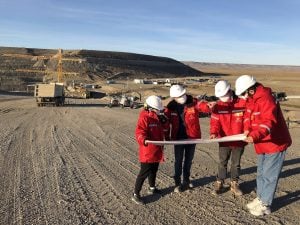
Copper is increasingly hot property. Electric vehicles require at least twice as much copper as traditional cars; solar and wind energy projects require between four and six times more than fossil fuel-based systems. Copper is fundamental to the global energy transition and, given that it produces more copper than any other country, Chile is a key player.
From 2023 to 2024 alone, Chile’s exports of the mineral to China, its largest market, grew by more than 19%.
Mining activity is concentrated in the northern region of Antofagasta, where copper is the driving force behind the economy and prosperity of its nearly 700,000 residents. Copper mining is known as “Chile’s salary” while Codelco, the state mining company and world’s largest copper producer, has been accused in the Chilean senate of being a “state within the state”.
Calama in Antofagasta is considered Chile’s copper mining capital. This city of almost 200,000 people is 2,400 metres above sea level in the Atacama Desert, and fed by the Loa River. To the north of Calama lies a huge industrial mining complex, which concentrates most of Antofagasta’s 126,000 mining-related jobs. From here, Codelco operates three huge mines, including Chuquicamata, the world’s second-deepest open-pit mine.
“It’s impressive,” says the Calama native Andrea Vásquez Alfaro, as she looks out from her car at the walls of the Talabre tailings dam. This 30-kilometre-long barrier contains a slurry lagoon, all just 10 kilometres from the city centre.
Tailings dams:
Designed to prevent the liquid and solid waste created during mining processes – known as “tailings” – from contaminating nearby communities and environments
Waste from the Chuquicamata mine has been accumulating in Talabre since 1952. In recent decades, waste from the Radimiro Tomic and División Ministro Hales mines has also been dumped here. All three are operated by Codelco, alongside Australia’s BHP, which also has other operations in Chile. Because of its mountain-like colour and dimensions, the tailings deposit looks like just another formation in the middle of the desert – a factor that helps to conceal its danger.
“It never stops impressing me, nor do I want it to stop impressing me, because the day that happens means that I have normalised it, that I have normalised this landscape of hell,” Vásquez Alfaro says after a long silence. A sociologist, she also directs the coordinating committee for the Defence of the Loa River and Mother Earth. This is the main local environmental group at the forefront of lobbying the authorities over Calama’s environmental and health crisis.
The exposed surface of Talabre’s tailings dump is being perpetually eroded by the wind and dispersed into the wider environment. In turn, failures in the containment systems have caused the dam to contaminate groundwater, reaching the Loa River and the city’s main aquifer.
Questioning mining here is like questioning the homeland or religionAndrea Vázquez Alfaro, Defence of the Loa River and Mother Earth
Prompted by a complaint filed in 2019, Chile’s environmental regulators filed charges against Codelco in August last year.
Vásquez Alfaro has joined forces with Sergio Chamorro, the lawyer representing the National Federation of Chilean Villagers (Fenapo), and Reinaldo Diaz Duk, who runs Calama’s municipal environmental monitoring station. Together, they lead a coalition of 20 social organisations, the Coordinadora, which is pursuing a legal claim of environmental contamination against the state – following almost two decades of complaints.
“Questioning mining here is like questioning the homeland or religion,” says Vásquez Alfaro. “It is a culture that only understands exploitation. For them, there is no life in the desert, only resources, and we are a hindrance. But we are not going to leave.”
Pollution and disease
Appreciating the scale of an open-pit mine can be overwhelming. Every element is counted by the thousands or millions: the rock, dynamite, toxic chemicals, industrial acids and detergents. Adding to this picture is the water requirements, the heavy machinery that operates for much of the day, and the polluting residues. But Calama does not have one open-pit mine – it has three. The Radimiro Tomic, 40 kilometres from the city, the giant Chuquicamata, 20 kilometres away, and at a mere 15 kilometres’ distance, the División Ministro Hales.
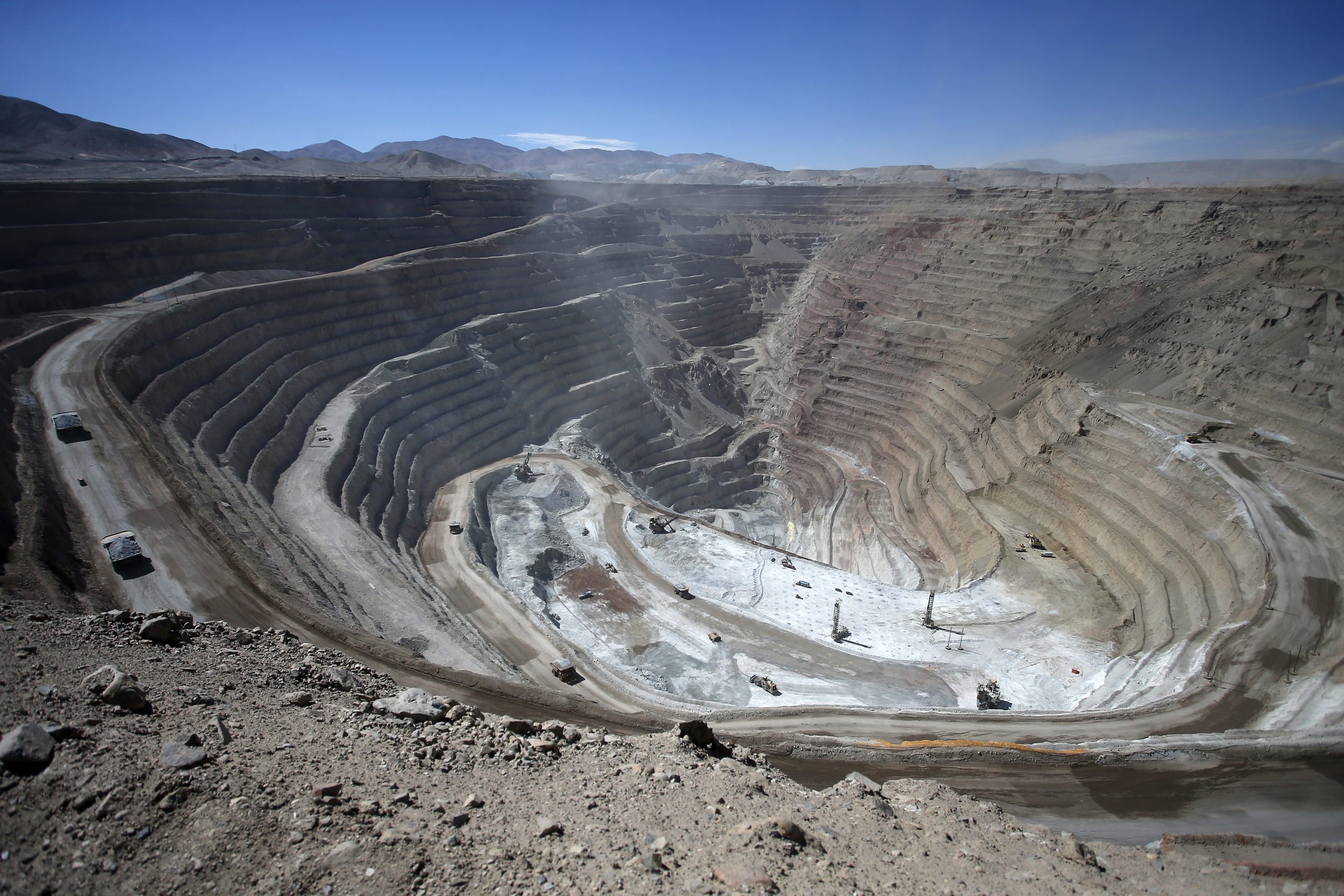
This is the “hellish” landscape Vásquez Alfaro refers to. The wind from the Andes blows the accumulating mining dust across Calama every night. Respite does not come until midday, when the warmer currents of the Pacific Ocean clean the air for a few hours.
More than a century of intensive, large-scale copper mining in Antofagasta has created both social and environmental consequences. The region has one of the highest cancer mortality rates in the country, according to Ministry of Health data; lung cancer rates are almost three times the national average.
In 2009, the government declared Calama to be “saturated” with particles that breached national air pollution limits. Annual monitoring has indicated uninterrupted saturation ever since. These heavy metal particles include lead, arsenic, nickel, molybdenum and cadmium, which are extremely detrimental to health.
According to Chilean regulations, authorities should have enforced the implementation of an environmental decontamination plan no later than 12 months after declaring saturation. That plan was presented in May 2022, 13 years later. Immediately rejected by citizens and groups including the Coordinadora, the plan was accused of being based on false scenarios, and of providing insufficient solutions. It was accepted by the authorities, but later annulled by Chile’s supreme environmental court – the same court that accepted the environmental pollution lawsuit led by Coordinadora in April this year.
The judgment ruled that “the environmental authority removed a monitoring station that previously served as the basis for declaring the city a saturated zone”, which meant there was not enough data to properly prepare a decontamination plan.
A potentially historic demand
Born in Chuquicamata to a family of miners, Reinaldo Díaz Duk spent 20 years working for a company that provided air pollution monitoring services to Codelco. He was fired in 2015, after which he decided to share his accumulated knowledge with the organisations fighting back. In 2023, Díaz Duk took charge of Chile’s first municipal air monitoring station, which is financed by the municipality of Calama.
“The station is our tool for refuting the false narrative that pollution is decreasing [claimed by Codelco], keeping us far removed from the manipulation of the past,” explains Díaz Duk.
The monitoring station also functions as an awareness-raising tool. Díaz Duk regularly organises training workshops and informative talks for neighbours and students, teaching them how to operate the station and take samples.
Air pollution saturation levels remain high. Recent scientific studies have revealed an increase of heavy metals present in the environment during periods of heightened mining activity, as well as dispersion covering a radius of as much as 80 kilometres. Meanwhile, media alerts and public denouncements from the Chilean Medical Association (CMC), which has described the situation as a health emergency, reinforce citizens’ demands. Other warnings detail higher rates of respiratory disease, cancer, and children with autism and genetic syndromes.
Since Calama was declared saturated, permits have been granted for more than 700 mining projects that affect air pollution in the regionSergio Chamorro, lawyer from the National Federation of Chilean Villagers
Sergio Chamorro is the lead trial lawyer in the supreme environmental court case. He also represents several Indigenous communities in other mining-related cases. Chamorro explains to Dialogue Earth that the state has systematically failed to safeguard public health and enforce decontamination – despite its legal obligation to do so in cases of saturation.
“In the lawsuit, we show that since Calama was declared saturated, permits have been granted for more than 700 mining projects that affect air pollution in the region,” says Chamorro. These approved projects have included nine expansions to the Talabre tailings dam and the creation of the Ministro Hales Division mine in 2010; Codelco plans to continue exploiting and expanding the latter for the next 30 years.
Dialogue Earth approached the environment and health ministries, and the implicated companies for comment but received no response.
“The state will want to negotiate, to commit to another dialogue table, another mediating body. But all that has already failed many times here in Calama. Our intention is to see this through to the end,” says Chamorro.
He clarifies that the claimants are seeking a ruling. “The first thing we want is that, as the law says, the polluter pays – in this case, Codelco. And then that the granting of new permits is completely cancelled. Finally, we want the state to do what it has never done so far: studies on the health of the population that determine the degree of impacts, and the appropriate compensation for those who are proven to have been harmed by the contamination.”
“Nobody here can be against copper mining,” concludes Chamorro. “That is not where we stand. We understand its importance, both for the region and for the country and the world. What we are against is this model to which we are subjected. Of resigning ourselves to live and die contaminated.”