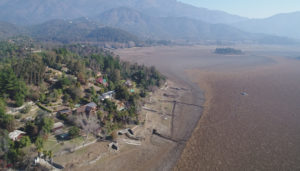
Residents of Chile’s central and Metropolitan regions eagerly awaited storms predicted for the middle of August. Although flood warnings were place for the Andean foothills, they needed water. The annual rainfall deficit was 80% in some areas. The rain arrived, but far from the intensity expected.
With 12 years of uninterrupted mega-drought and a water shortage decree, today every storm counts. Worryingly, projections say the current situation will become permanent, even if there are more rainy years.
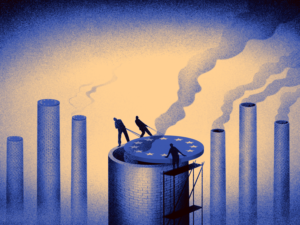
Climate change is steadily decreasing rainfall, so Chile will not only have to adapt to this new scenario, but will also have to revise its plans to move away from hydroelectric energy, which relies on a steady flow of water. And also to achieve carbon neutrality by 2050.
Chile’s drought: Minimal improvement
According to recent data from the General Water Directorate (DGA), the recent rains increased the average volume of water in reservoirs by 18%. Hydroelectric power currently accounts for almost 30% of Chile’s energy matrix.
Even so, the outlook is far from auspicious. A few days earlier, the Ministry of Energy published a decree seeking to curb electricity rationing which runs until 31 March 2022. It aims to reduce the impact of the water deficit on users, increase generation capacity and encourage voluntary savings.
We are facing the most intense and extensive drought in our history
The mining sector, the country’s main export, has already begun to suffer from the lack of water. While many mines have installed desalination plants, or will do so, some already expect drops in production due to water shortages. This is the case of Antofagasta PLC, which revised down its copper production estimates from between 730,000-760,000 tonnes to between 710,000-740,000.
On 26 August, a few days after rains quenched the thirsty reservoirs, agriculture minister María Emilia Undurraga declared an agricultural emergency due to the water deficit in the regions of Coquimbo, Valparaíso, O’Higgins and Maule. The Los Lagos region was already classified as such. The minister warned that the emergency was not simply a one-off, but a reality of climate change.
“We are facing the most intense and extensive drought in our history,” said Guillermo Donoso of the Catholic University’s Centre for Water Law and Management. ” The projections (due to climate change) are for a reduction in rainfall in the central north and central-south, and with increases in temperature in all regions of the country,” he added.
While fluctuations in annual rainfall are possible, there are many unknowns, according to René Garreaud, deputy director of the Centre for Climate Science and Resilience. “There is an indication that the lack of rainfall is due to climate change, in addition to the natural climate variability,” he said.
This will depend directly on global greenhouse gas emissions and how much the average global temperature eventually rises. “Although these are not absolute forecasts, but projections, if the temperature rises between 1.5 and 2 degrees Celsius, Chile will have more droughts, but if it rises more, the scenario for the country will be even worse,” Garreaud warned.
Different fronts
The connection between water scarcity and climate change is only now coming to light.
The growth in water consumption rates is keeping pace with the rate of economic growth in many countries. “This is happening in Chile, but in a context of a growing water deficit, the increase in consumption will not be feasible to maintain,” explained Guillermo Donoso.
More and bigger reservoirs, desalination plants and wastewater reuse are part of water supply management today. However, Donoso warned that such solutions are not sustainable if they do not factor-in demand management.
In Chilean cities, average water consumption is 170 to 180 litres per person per day, one of the highest in OECD countries. “There are even areas where consumption exceeds 300 litres,” Donoso said. On top of this, around 35% is lost in the distribution network because of poor infrastructure.
Chile does not have a head office that directs all administrative bodies that manage water, said Elizabeth Garrido, director of the School of Environmental Sciences and Sustainability at the Andrés Bello University.
“There is no central coordination and each one manages the issue from its own interest, human consumption, irrigation and contamination, among others. That’s why it’s very important to move forward with institutionalisation,” she added.
The National Water Roundtable, formed in October 2019, seeks to address these through public consultations and other fora. Meanwhile, Congress is discussing the reform of the Water Code, which allows for the private ownership of the resource.
“It’s important to think about proposing a downscale in consumption that clearly defines how this will be achieved; how much consumption will be guaranteed, the 50 to 100 litres per person established by the World Health Organisation, and whether it should only be provided through the network or whether water trucks will also be considered,” Donoso said.
If the temperature rises between 1.5 and 2ºC, Chile will have more droughts, but if it rises more, the scenario for the country will be even worse
New conflicts over water will arise if these issues are not tackled, he added.
Elizabeth Garrido agrees. Chile’s natural conditions mean water is not well distributed. But organization also plays a part. Each geographical area must make its own adjustments.
There are some signs of progress. Today, the company Nueva Antofagasta desalination plant supplies 85% of the water to Antofagasta, a city in the far north of Chile that has some 425,000 inhabitants. It is the largest such plant in Latin America. All of the water that supplies Tocopilla, a town of 20,000 inhabitants a little further north, is desalinated from.
Yet, the electricity generation emergency is equally urgent than not having water. Chile has set itself the goal of being carbon neutral by 2050. To achieve this, it has a plan to close its coal-fired power plants.
As reservoir levels decrease, the reopening of one shuttered plant has already been mooted. Although the move was rejected, the alternatives are scarcely better. According to estimates by the National Electricity Coordinator, high-polluting diesel could account for 18.7% of the energy matrix by October, a rise on current levels of almost 9%.
The latest IPCC report presented discouraging scenarios for Chile, with more droughts and more heatwaves. Maisa Rojas, an author of the report, said that the road to carbon neutrality requires close scientific support so that political decisions are made on the basis of scientific evidence.