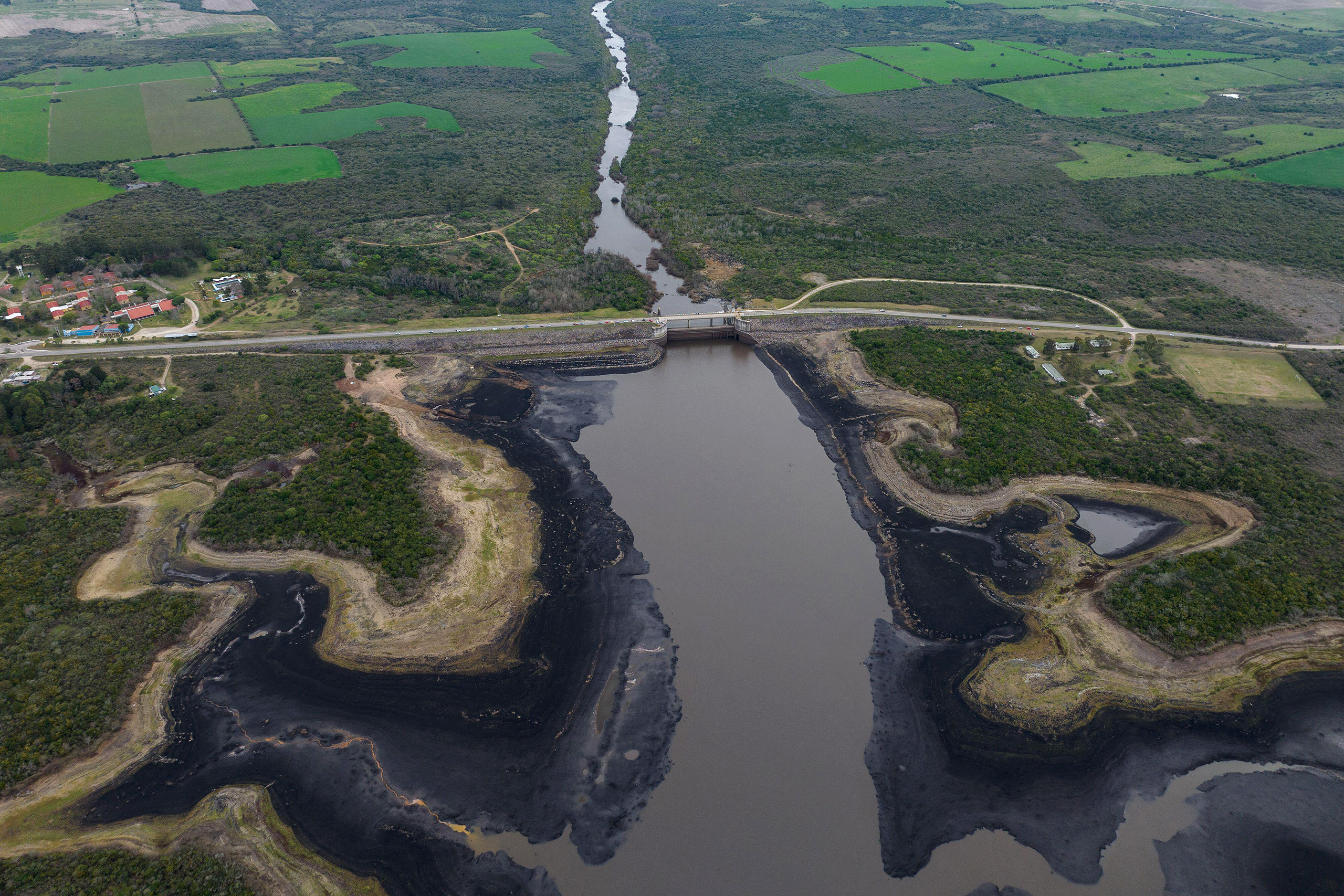
The drought of 2023 produced one of the starkest images of Uruguay’s water crisis: Paso Severino reservoir, south-central Uruguay, practically empty. Lack of rainfall caused the drying up of the Santa Lucía Basin, which is the Montevideo metropolitan area’s only source of fresh water. The government was forced to supply 1.7 million people with a mix of fresh and salt water for 70 days.
Uruguay has struggled with drought since 2018, with more than 60% of the country affected between 2022 and 2023. Successive governments have flip-flopped on what to do. The country’s previous president, Luis Lacalle Pou, proposed the Neptuno Project – a water intake plant to be built on the Rio de la Plata Estuary.
The current president, Yamandú Orsi, has scrapped that project since he assumed office in March last year. Instead, his administration has revived old plans to build a dam in Casupá, in the central department of Florida. The plan has the potential to solve Uruguay’s water issues, but farmers claim they have been left in the dark regarding details of the necessary seizure of 46 farms. Meanwhile, others say progress on the dam has been too slow.
The Casupá dam
Casupá is located in eastern Florida, near the department’s borders with Lavalleja to the east and Canelones to the south – and approximately 90 km north of Montevideo. The town lies amidst valleys, mountain ranges and wetlands. Its name means “on the edge of the big forest” in Guaraní, an Indigenous language of South America.
The dam project dates back to the 1960s, resurfacing in 2019 as the water crisis underlined the need for secure supplies. An environmental impact study was carried out in 2017. In October 2025, the government received a loan of USD 130 million from the Development Bank of Latin America and the Caribbean (CAF) to fund both an update of this study and the dam’s eventual construction. Meanwhile, bids have been submitted for the project. Construction is slated to begin in early 2027 and reach completion in mid-2029.
What is La Niña?
La Niña is the opposite phase of El Niño in the El Niño-Southern Oscillation (ENSO). During La Niña, cooler-than-average sea temperatures are noted in the central and eastern equatorial Pacific. Like El Niño, it affects patterns of rainfall and atmospheric pressure worldwide.
In the meantime, Uruguay is experiencing another summer of uncertain water supplies. The current summer months – usually November to February – have been marked by below- or near-normal rainfall in much of the country and higher than usual temperatures. This has been influenced by the La Niña phenomenon, according to the Uruguayan Institute of Meteorology (INUMET). On 30 December, Uruguay’s State Waterworks (OSE) activated measures in anticipation of drought, including emergency infrastructure preparation and the announcement of water conservation guidelines.
The meteorologist Nubel Cisneros tells Dialogue Earth that water shortages are going to become significant during January and February. He predicts this summer’s rainfall will be between 40% and 60% below average.
Environmental impacts
The Casupá dam may be a potential long-term solution, but it will have several impacts.
Some 426 hectares of native forest and 787 hectares of natural grassland will be cleared, according to a report commissioned by the OSE. The dam’s environmental impact assessment features 26 species prioritised for conservation by SNAP (the government’s National System of Protected Areas) that are thought to be implicated in this land clearing. That includes birds such as the white-winged grassquit, spotted lizard (Stenocercus azureus), and mammals like the marmosa.
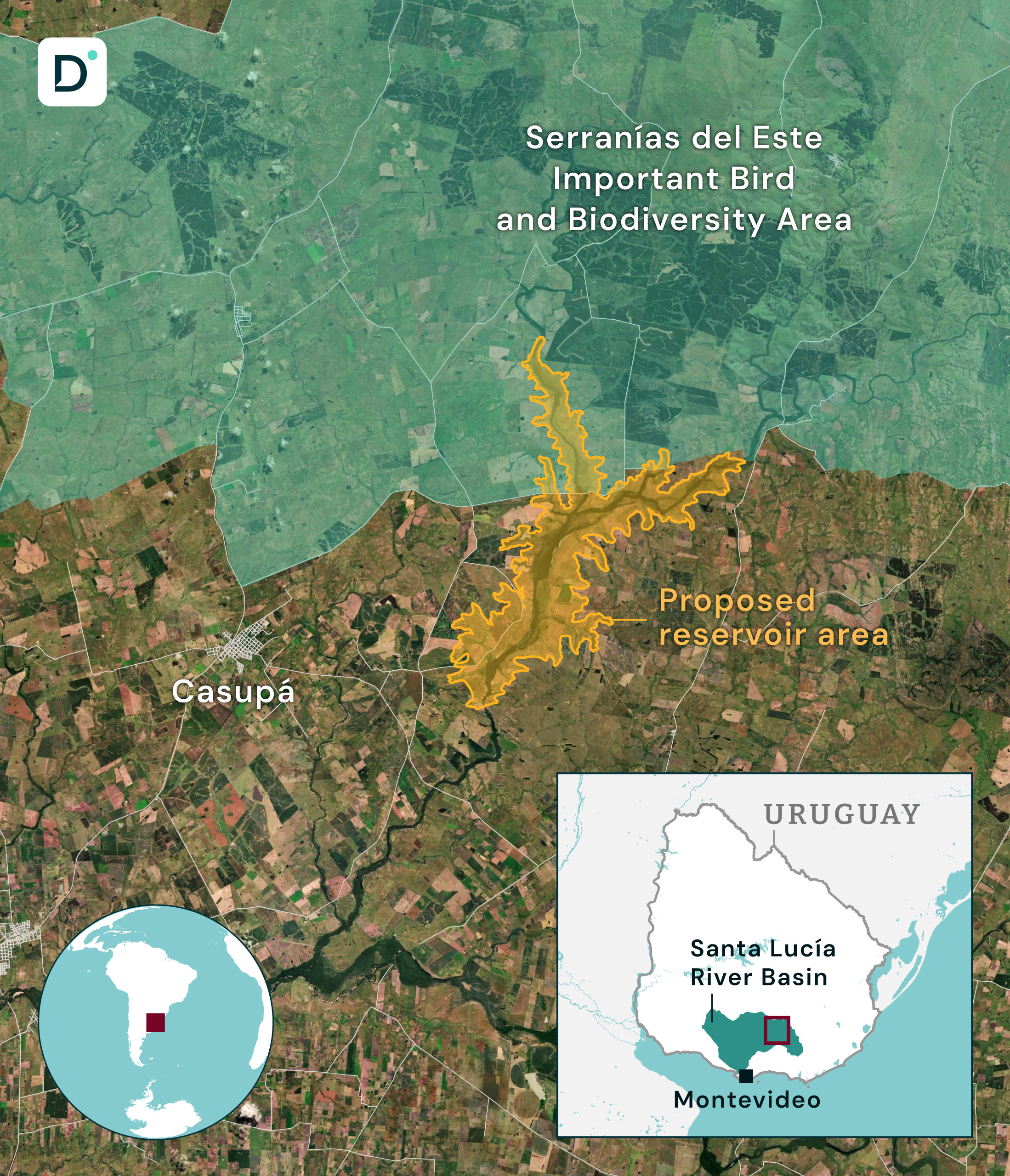
Furthermore, the proposed reservoir area encroaches into Serranías del Este, which has been identified as an Important Bird and Biodiversity Area (IBA). The IBA initiative lists thousands of sites around the world that are considered important for the conservation of birds.
Leticia Peralta works with her family to take care of about 1,000 head of cattle within the dam’s proposed reservoir zone. Forty per cent of their farmland would be flooded. Peralta’s camera traps have recorded some of the local wildlife: “It is very important to keep their habitats and ecosystems intact, because if they move there, it is because everything is in balance.”
The project as presented by OSE includes a wildlife rescue programme, which would transfer low-mobility species to nearby conservation areas. A buffer zone of approximately 800 hectares around the reservoir would be installed, with the intention of compensating for the loss of native forest and grassland, by restoring ecosystems and biological corridors.
The current condition of the Santa Lucía Basin is also of concern. The dam’s environmental impact assessment acknowledges the basin’s excess phosphorus levels, caused by forestry and agriculture pollution that leaches into these waters. The assessment projects that the dam’s reservoir could thus also contain high levels of phosphorus, which would facilitate algal blooms and compromise the water’s suitability for human consumption. As with the existing Paso Severino dam, this water would need to be treated before being distributed.
María Selva Ortiz, president of the NGO Friends of the Earth Network (REDES-AT Uruguay), points to 2013, when cyanobacteria leaked into the Aguas Corrientes water treatment plant and the entire Montevideo metropolitan area received tap water with a bad taste and smell.
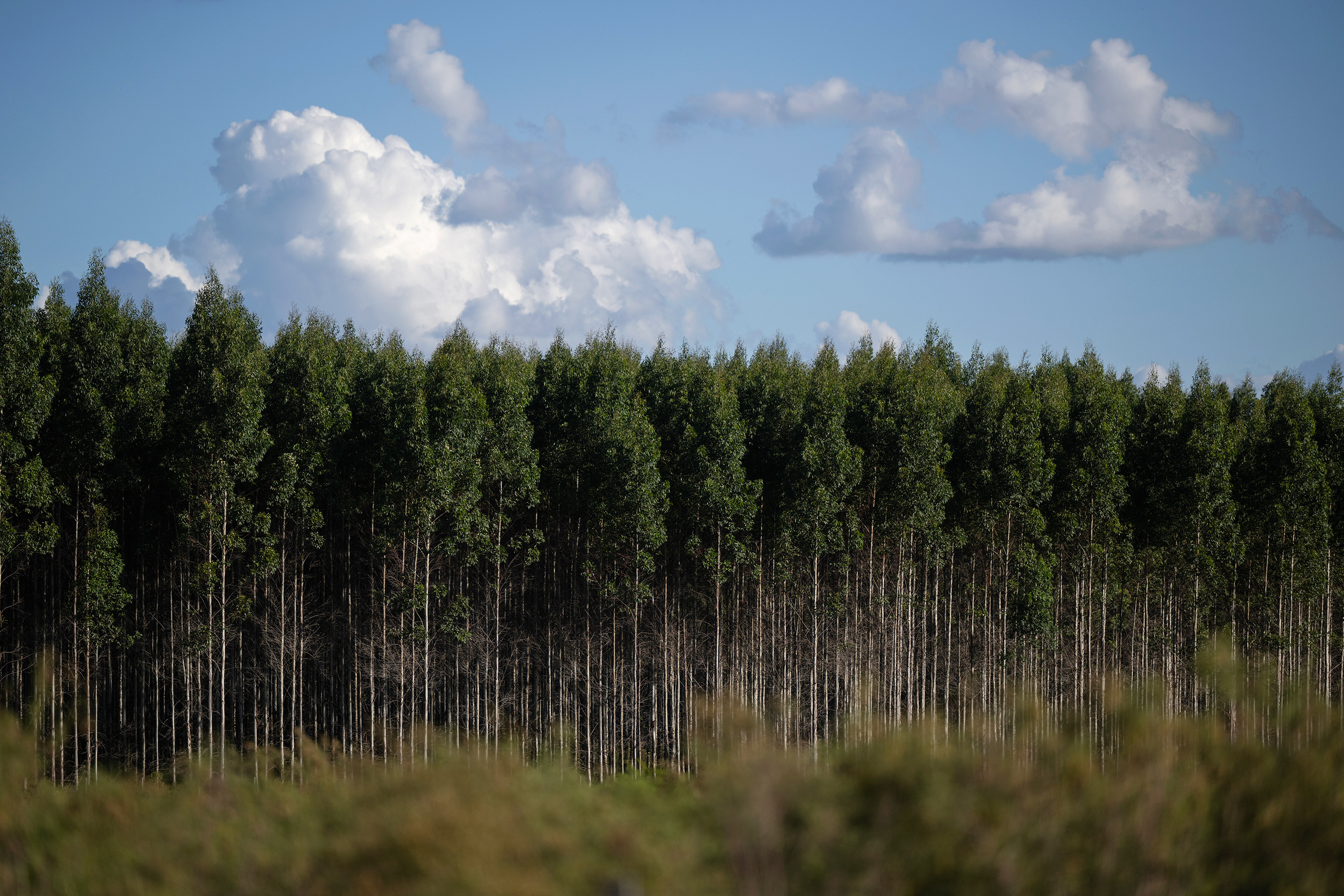
José Langone, a retired biologist who worked for OSE for 35 years, warns it could take longer than expected for the Casupá dam to become a key provider of drinking water. He describes the 10,000 hectares of eucalyptus trees located to the north of the dam, for example, which would compete for this water.
The role of communities
The area to be permanently flooded for the Casupá reservoir covers 2,126 hectares. That rises to 3,935 hectares including the buffer zone, which would be temporarily flooded when water levels are high. This undertaking will require the total or partial expropriation of 46 farms.
“We don’t know who or how many will be expropriated,” Carlos Sarrosa, an agricultural engineer and livestock producer, tells Dialogue Earth. “They didn’t do any social or economic studies, and announced it as a political campaign slogan.” Sarrosa says he is yet to receive clear, official information, even though three of his farms – about 300 hectares – will be flooded.
We need a new water culture, because our societies developed in a world that no longer existsMiguel de França Doria, Unesco’s World Water Assessment Programme
Peralta agrees: “The information remains the same. They don’t know how, when or who will be in charge of the project, nor how they will help those affected, nor how they will mitigate the environmental, social or agricultural damage.” The environment minister Edgardo Ortuño visited the area in September and October, telling 80 affected families that the project would go ahead.
Luis Oliva, mayor of Casupá, has acknowledged to Dialogue Earth that the initiative is causing friction between farmers and the town’s 2,300 inhabitants – “where there are few sources of employment”. He expects the population to increase by 50% during construction, which could lead to real estate growth, increased demand for rentals, tourism opportunities and improvements in roads and infrastructure. However, having defended the project, he now admits having reservations since learning about the potential damage of the necessary land seizures.
Governance
Farmers in the area claim OSE has admitted to not having on-site measurements of the land where the dam will be built; some surveying studies have been carried out using measurements via drones and satellites. OSE has acknowledged that environmental studies are lacking, according to the local farmers, and that these depend on the Environment Ministry.
Eight Uruguayan and eight foreign companies have bid for the project. Among the companies are China International Water & Electric Corporation, Sinohydro Corporation, and a consortium composed of CCCC Water Resources and Hydropower Construction, Yellow River Engineering Consulting and the Uruguayan company Impacto Construcciones.
Both the Environment Ministry and OSE declined to respond to Dialogue Earth’s inquiries. Before taking office at the ministry, Ortuño was director of the OSE during Uruguay’s previous administration. In an interview with Dialogue Earth at the time, Ortuño suggested the Neptuno project was being rushed for electoral reasons – he stressed the need to build consensus for new infrastructure projects.
On its website, the Environment Ministry acknowledges the need to update Casupá’s environmental impact study.
Alternatives
The geologist Marcel Achkar, from the sciences faculty at Montevideo’s University of the Republic (Udelar), believes it is necessary to decentralise the water system using local sources, smaller watercourses and groundwater. He also proposes reducing the losses of “unbilled water” – that lost due to distribution failures – which stands at approximately 50% in Uruguay. This is well above the regional average of 30-35%. For Achkar, restoring the Santa Lucía Basin is crucial: “It’s a race against time. It is still possible to restore its environmental quality.”
When he was the intendant of Canelones, President Orsi himself warned of the deterioration of the basin in 2023, citing “unacceptable” sand mining practices that were altering the river’s course. The majority of pollution in the area comes from agricultural activity, according to Ortiz.
Langone points out that “only 7% of the basin has not been impacted by humans, and only 2% is native forest.” During his tenure at OSE, a water treatment plant was built in Aguas Corrientes. He says another should now be built at Juan Lacaze (in the department of Colonia), which could reduce water-salinity issues.
Ortiz adds that one of the advantages of the new dam would be the possibility of keeping the water running more reliably in times of crisis.
The future
Some critics remain frustrated about the lack of progress. “We are in the same place we were during that extreme drought,” says Langone, referring to 2023’s historic disaster.
He also points out that no plan has been implemented to repair the pipes in Montevideo, which are responsible for a large part of water losses.
Miguel de França Doria, from Unesco’s World Water Assessment Programme, says Uruguay must change its broader relationship with water. He says the country needs to promote resilience, limit the use of drinking water to human and animal consumption, take advantage of aquifers and improve efficiency. He acknowledges that the proposed dam could be a part of such a strategy.
“We need a new water culture, because our societies developed in a world that no longer exists,” he concludes.