


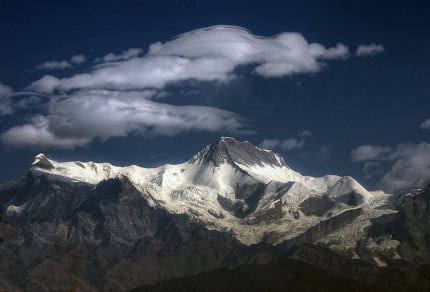

Nepal’s glaciers have shrunk by 24% and its ice reserves by 29% over the past three decades, revealed a new report released this week by the International Centre for Integrated Mountain Development (ICIMOD). The study is one of the most comprehensive surveys of Nepal’s glaciers to date using the latest satellite technology.
ICIMOD has also released new data from Bhutan showing that while the number of glaciers has increased, the total area of glacier cover has decreased by 23% over the past thirty years. “It could be due to the fragmentation of glaciers rather than formation of new ones so number is increasing but overall glaciated area is decreasing,” said Arun Bhakta Shrestha, an expert from ICIMOD.
Experts say a decrease in glacier area means ice is melting faster. This can lead to the filling up of glacial lakes and increase the risk of outburst flooding which could have severe impact on people living downstream.
“Glaciers are showing signs of shrinking, thinning, and retreating. Among others, this is leading to the formation and expansion of glacial lakes, which could lead to an increase in the number of glacial lake outburst floods”, said Samjwal Bajracharya, a glacial expert at ICIMOD.
“If the present trends persist, the glacier ice mass will gradually reduce, which will impact on the availability of water resources as well as glacial hazards,” added Bajracharya. More than 1.3 billion people rely, at least in part, on water from these glaciers which feed Asia’s major rivers.
The accuracy of past glacier studies has been questioned because they have relied on satellite images rather than research on the ground. However, this new research involved field studies carried out at various glaciers in Nepal and Bhutan. “It’s not possible to visit every glacier but we had conducted field surveys of some of the glaciers in Nepal and Bhutan to compare with the satellite image data, which has made this research more reliable and accurate than ever,” added Bajracharya, who is lead author of both research reports.
Although the link between climate change and glacier melt is still ambiguous, scientists claim that the current glacier melt in the Himalayas is due to reduced precipitation and warmer temperatures.
The issue attracted controversy in 2007 after the Intergovernmental Panel on Climate Change (IPCC)—the top UN climate change science body – claimed the Himalayan glaciers would disappear by 2035. The IPCC later admitted the figures were grossly overestimated. The IPCC’s fifth assessment report released this year said the Himalayas would shrink by 45% by 2100, if global average temperatures rose by 1.8 degrees Celsius.
“We know there are controversies on climate change and glacier melt is not an exception but we wanted to come up with better science to understand glaciers at least in two countries of the region,” says Eklabya Sharma, director of operations at ICIMOD.
Up until now there has been very little research into climate change in the Himalayas and the region was identified as “black hole” for data in the IPCC assessment reports. “Our mission is to fill this gap and to better inform people where this important piece of information will play a critical role” said David Molden, director general of ICIMOD.
“Changes in glaciers provide some of the clearest evidence for climate change, and glacier shrinkage, and in some cases disappearance, indicate the speed of the present change on a global scale,” said Dr. Rishi Ram Sharma, director general of department of hydrology and meteorology of the Government of Nepal. “However, it is not an easy task to map those inaccessible areas using limited resources,” he said.
Major findings from Nepal:
- The country has 3,808 glaciers covering a total area of 3,902 square kilometres and estimated ice reserves of 312 cubic kilometres.
- The total glacier area decreased by 24% between 1977 and 2010, and estimated ice reserves by 29%.
- The number of glaciers increased by 11%, a result of fragmentation following glacier melt.
- The rate of glacial area loss between 1980 and 1990 was almost twice the rate of the subsequent two decades (1990-2010).
- The average glacier covers an area of one square kilometre. The Ngojumba glacier in the Dudh Koshi sub-basin is the largest single glacier with an area of 79 square kilometres.
Major findings from Bhutan:
- The country has 885 glaciers, covering a total area of 64,216 square kilometres, or 1.6 % of the total land cover in Bhutan.
- Bhutan lost 23.3 % of its glacier area between 1980 and 2010.
- The shrinking and fragmentation of glaciers between 1980 and 2010 resulted in a 14.8% increase in the number of glaciers.
- Glaciers at elevations over 5,200 metres above sea level are melting much faster.