


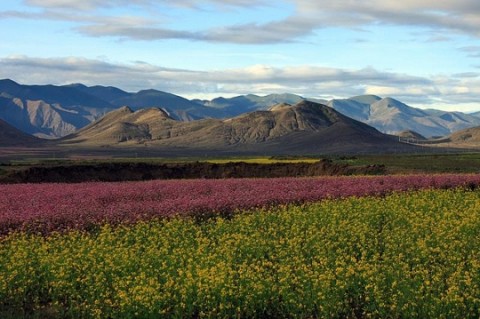
Every spring in south-west China, there is an explosion of colour in the Daxue Shan, a mountain range on the eastern Tibetan plateau. As the terrain rises toward the snowy mountain peaks, shrubs give way to alpine meadows filled with tiny yellow and purple flowers.
Western botanists have travelled to mountainous corners of China, India and Myanmar since colonial times in search of rare plants and flowers. Some of their trans-Himalayan specimens are now in storage at botanical institutions across Europe and the United States.
Yet a handful of scientists are travelling to mountainous areas of Asia today with a new purpose: probing the effects of climate change and other factors on alpine meadow ecosystems. Their emerging research suggests that alpine shrubs are colonising the meadows, and that alpine plants are essentially walking up mountainsides in search of cooler temperatures and new habitats.
“As these meadows disappear, species are disappearing,” said Jodi Brandt, a professor at Dartmouth College in the United States who studies alpine ecological dynamics in south-west China.
Brandt and other scientists reported last year that at least 39% of alpine meadows they studied had converted from meadows to shrubs in a study site in north-west Yunnan province between 1990 and 2009. Their study, in the journal Biodiversity Conservation, said there appeared to be a broader conversion occurring across the region from herbaceous to “shrub-dominated” ecosystems. Part of the reason, they wrote, was that declining snow cover often gives shrubs a competitive advantage over herbaceous plants.
And in a February paper in the journal Human Ecology, Brandt and other scientists charted a nearly 70% decline in meadow area from 1974 to 2004 in China’s Jiuzhaigou national park, in Sichuan province. Brandt said that in her study sites, climate change appeared to be one of several causes of meadow shrinkage, along with overgrazing by yaks.
The presumed causes are so intertwined that it is unclear which has a greater impact, she added. However, “If shrubs take over everywhere, Tibetans would have to abandon their herding practice — and yak herding for Tibetans is a very strong cultural thing.” She said shrub plants are generally considered less nutritious than alpine meadow plants, and that yaks who graze on them typically produce lower-quality milk.
Important role of alpine meadows
Alpine meadows, which lie above the tree line but below the snow line, function as “sponges” by absorbing melting snow and acting as natural water towers. They typically have high herbaceous species richness and are filled with plants well-adapted to harsh climates. For example, in northern India’s Sikkim Himalaya, nearly a third of plant biodiversity is found above 4,000 metres, and some plants live at above 5,500 metres.
And on some mountains, alpine meadows provide the leaves, tubers and rhizomes for traditional medicines. In India’s Uttarakhand province, the root of the plant Aconitum balfourii, which grows at up to 4,000 metres, is used to treat rheumatism.
But although alpine plants are well-adapted to cold climates, scientists say they also tend to be highly sensitive to climatic changes.
In Europe, scientists have been studying the apparent influence of climate change on mountain ecosystems since at least 2000, often with support from the Vienna-based Global Observation Research Initiative in Alpine Environments (GLORIA).
In a 2012 study of ecological changes on 66 European peaks, plants were found to have migrated an average of 2.7 metres upward between 2001 and 2008.
The study, in the journal Science, said that although the average number of species on European mountains appeared to be increasing with warmer temperatures, the long-term effect could be to “homogenise” species composition on mountain summits.
GLORIA-linked researchers are now processing data from a similar, seven-year study of several Asian mountains, and Brandt said the publication of their findings would likely attract more international interest in Asia’s alpine ecosystems. But for the moment, comprehensive data about them is still relatively scarce.
“On the ecology side there’s so little known about these ecosystems,” says Raj Pandit, the director of the Center for Interdisciplinary Studies on Mountain & Hill Environment in New Delhi. “You can assume they work similar to the Alps, but a lot of things in Asia don’t work the same.”
Emerging research in Asia appears to support the emerging hypothesis that climate change is a key factor contributing to shrub encroachment in alpine meadows, and that further warming may threaten the survival of rare alpine plants.
A 2013 study in the journal PLoS One, by Pandit and three other scientists, for example, found that 87% of 124 endemic plants surveyed in India’s Sikkim Himalaya were migrating up mountains, partly in response to a warming climate. The study, which compared contemporary data with 19th century records, warned that continued warming there may lead to “exacerbated species extinction” in upper alpine regions.
And in Iran, climate change and competition from drought-tolerant species that live at lower altitudes is threatening dozens of alpine plants, in part because the “potential to escape to suitable cold habitats is highly limited,” according to a 2011 study by researchers from Austria and Germany. Like Brandt’s 2013 study from south-west China, it noted that earlier snow melt appeared to be disadvantageous for some mountain plant species.
But Pandit said scientists in the Himalayas typically would rather focus on rivers and potential ecological threats posed by hydropower dams. He said comparatively little attention is paid to dynamics of floral communities, partly because conducting research in remote Himalayan mountain chains requires of trekking through steep terrain at up to 5,000 metres.
Another obstacle, he added, is a lack of interest from Indian policymakers.
The loss of more alpine plants “would be a great loss to the whole world because these species have not been scientifically investigated in detail,” Pandit said. “But at the government level, nobody even asks me, ‘what should we do?’”
In China, the government has given more than 1 billion yuan (US$160 million) per year since 2000 for climate change adaptation projects, according to Xu Jianchu, regional coordinator for East and Central Asia at the World Agroforestry Centre. He said the Canadian government had also committed nearly US$1.5 million between 2012 and 2015 for a project to improve water governance across the Asian highlands in response to climate change.
Xu cautioned that climate change is only one of several complex factors influencing alpine ecosystem change, and that building local knowledge and responses to changing conditions should be a key policy priority. But he said there is often a disconnect in China between emerging research on alpine regions and village-level policies for people who live there.
“We lack a messenger to take our message to local communities,” Xu said.