


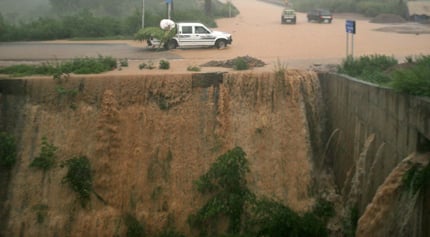

Recent monsoon rains and the destruction they have left in their wake in major cities of Pakistan’s Punjab province provide a grim picture of the inability of urban settlements to cope with intense downpours in a warming world.
The television footage showed torrents of water gushing into homes, of people wading in at least four feet of water, of army helicopters rescuing people from rooftops, submerged arteries and underpasses of the eastern city of Lahore, and news flashes of deaths due to roof and wall collapses or electrocution, or of being swept away by the angry waves. The civic agencies with their army of men and motorised suction pumps waged a losing battle against the vagaries of nature.
Reports of destruction caused in distant villagers marooned and of bridges connecting remote settlements and landslides is another story altogether.
See also:
Floods create havoc in Jammu and Kashmir
Floods kill scores in Pakistan
Pakistan floods not worsened by action in India
But to climate scientists like Ghulam Rasul, the deputy director general at the Pakistan Meteorological Department, the weather event such as the one witnessed in Pakistan, is the beginning of the new normal in years to come. The aberration in weather patterns will be exacerbated by inadequate and poor planning and poor governance, he said.
By September 6, the death toll had crossed 100 in Punjab and Pakistan administered Kashmir. The Punjab Chief Minister, Shahbaz Sharif, has announced an immediate compensation of Rs 500,000 ($4,900) to the relatives of each person killed and Rs 100,000 ($980) for those injured in rain-induced incidents.
“The reason for this heavy precipitation is quite clear; it is a consequence of climate change,” Rasul told thethirdpole.net. He explained that the current “spell of rainfall persisted for longer period than usual.”
It would have been normal and “routine” if the monsoon system coming from the Bay of Bengal, crossing India had reached the border of Sindh and moved northwards and it had rained along the way when the winds reached Punjab before reaching the foothills of the Himalayas.
Terming the current nexus a “triangular interaction,” Rasul said, “In this particular instance, the monsoonal system overstayed its journey over the plains of Punjab where the cold wind interacted with surface temperatures that were high, leading to increased heat energy. This, in turn, caused enhanced precipitation.”
Rasul warned that intense and heavy rainfall causing urban flooding is going to be a regular feature in future.
While Naseer Memon, heading the NGO Strengthening Participatory Organisation, finds it difficult to establish a connection between such lone events to climate change, he says these events provide a reality check on the ability of urban areas to cope with flooding from intense downpours. “Improper land use, poor urban infrastructure and haphazard/unregulated settlement are visible reasons that converted a weather event into a disaster,” he told thethirdpole.net.
Comparing the destruction and loss of life caused in cities of Punjab near the Chenab river to Islamabad, he said the federal capital also received heavy showers but no casualties were reported. The cities badly affected included Lahore (268 km from Islamabad), Gujranwala (202 km) and Sialkot (192 km).
“It indicates the difference of infrastructure and compliance with regulations,” said Memon, author of a book called Malevolent Floods of Pakistan. He added that the populated settlements in flood plains have brought miseries to communities.
Endorsing Memon, Rasul said: “We have newer settlements mushrooming everywhere but nothing is regulated and developers are not bound by building regulations. Many of the new housing development schemes have no sewage system and if they do have it, it has smaller drainage pipes which do not have the capacity to carry out storm water.”
“If you look at our policies, including the climate policy, you will find much wisdom there, but then it remains confined to those sheaves of paper,” Rasul said, terming Pakistan “the best policy maker but the worst implementer”.
Urban planner, Farhan Anwar, author of Urban Resilience and Climate Change, a recent publication, described the “lack of research-based adaptation measures” as one of the reasons for the devastations being witnessed currently.
He said there was no “mapping of hazard zone that can locate the exposed people and assets in the projected flood zone so that a vulnerability profile can be developed there and efforts made to reduce their vulnerabilities and increase resilience.”
In addition, he said, no financial flood insurance mechanisms existed. “Often, such a calamity does not only damage their dwellings but also their means of earning and sustenance” compounding their problems, pointed out Anwar, adding that the government should initiate a flood insurance scheme based on the probability of the flooding event.
And while short term emergency response and shelter facilities get provided in the case of a disaster, he said there was a lack of an integrated evacuation and disaster risk management plan with provisions for relevant actions embedded in the appropriate legislative and institutional frameworks.
Anwar pointed to an urgent need to “determine the potential frequency and magnitude of possible urban flooding scenarios”.
He recommended a need for “establishment of flood plains” where the communities and assets and their vulnerability factors can be combined to produce an “index” of flood vulnerability. “This can then be plotted using census data to map vulnerability.”
In addition, said Anwar, the drainage network needs to be assessed in detail for its capacity to cater to extreme flooding scenarios. “Response measures such as provision of better housing options, training in first aid and basic rescue drills, relocation, knowledge and access to clearly disseminated evacuation plans etc. need to be put in place. Increase in green and open spaces in strategically located parts of the city can also act as a defence as such spaces act as infiltration basins,” he told thethirdpole.net.