



Following an on-ground survey by a high level team of India’s National Disaster Management Authority (NDMA), the government in the Himalayan state of Jammu and Kashmir now has a clear picture of the potential disaster created by a Ladakh river blockade due to a massive landslide in the Zanskar region, some 350 km east of the state’s summer capital Srinagar.
thethirdpole.net has learnt through reliable sources that the experts and the authorities have decided to breach the lake using explosives. They are afraid that if no swift action is taken, the water accumulating behind the January 15 landslide can burst through the rubble and endanger hundreds of lives in 40 villages downstream, apart from washing away about 50 bridges and other infrastructure.
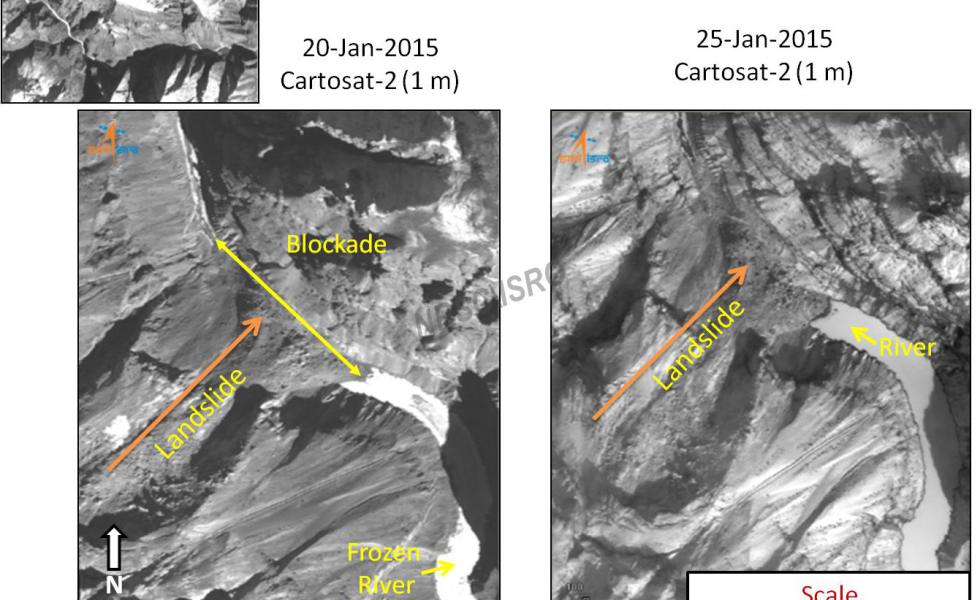
As reported by thethirdpole.net last week, the landslide blocked the river Phutkal in Zanskar-Kargil, creating a lake where water keeps accumulating constantly. Earlier an aerial survey of the affected area was carried out, but it had not produced reliable information.
Also read: Huge landslide blocks river, threatens Ladakh
On February 11, a 10-member team comprising hydrologists, geologists and road experts carried out an on-ground survey after landing in the area in an Indian Air Force helicopter. “This was nothing short of a heroic effort to land in the area as it was not only dangerous, but the temperature in the area is around minus 35 degrees Celsius,” Kargil’s Deputy Commissioner Prasanna Ramaswamy told thethirdpole.net.
He said that the team has given the administration a fair idea of the potential disaster. “Apart from getting the accurate figures of the lake and the landslide, they have also got soil and rock samples which will help in devising an effective strategy about the safe release of water,” Ramaswamy said.
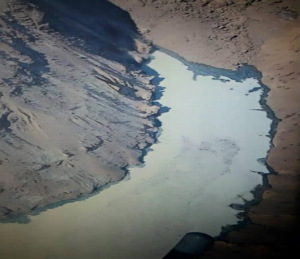
For the first time, the NDMA experts have given a figure about the volume of impounded water. There are 30 to 40 million cubic metres, and more water keeps accumulating. They have also informed that the blockade is 450 metres long and 50 metres high, while the lake is spread over an area of five square kilometres.
Ramaswamy said that while mitigation of the potential disaster is being handled by the NDMA, the district administration is fully prepared to deal with any eventuality. The deputy commissioner – the top bureaucrat of the district – informed that they have already started an operation in response to the potential disaster. It has been named “Operation Khatak”. The Tibetan word Khatak is considered auspicious in Ladakh.
What caused the landslide?
“We have laid out a comprehensive programme for the rehabilitation of the affected people though we are hopeful of averting the disaster,” Ramaswamy said, adding that this is the first time he and the NDMA experts have had to deal with this kind of situation. Kargil residents told thethirdpole.net that they have never heard of such river blockades. “This is something I am hearing of for the first time,” Gulzar Hussain, 79, said over the phone from Kargil.
Fida Wazeer, a government official, expressed similar feelings adding that it may be a manifestation of changing climatic conditions.
Mohammad Sultan Bhat – who heads the Geography department in Kashmir University – said that such a huge landslide could be the result of an avalanche or a rock. “It could also have happened because of the high velocity of the upper stream or because of an active fault which induces landslides,” Bhat theorised. “Rivers in our area are geologically controlled.”
Winter temperatures, hovering around minus 40 degrees Celsius in the area, have come to the aid of the authorities. “Breaches have not occurred because the lake is frozen up to a depth of five to six feet,” said Skalzang Wangyal, Executive Councillor for Zanskar Affairs in Ladakh Autonomous Hill Development Council (LAHDC). “Otherwise, it could be a different story.”
“Just imagine what will happen when this lake will start melting from March. So, we should hurry to save some 40 villages from total destruction,” Wangyal said.
Rohit Kansal, divisional commissioner of Kashmir and Ladakh, said, “Now we have got the details, you should expect action soon.” He refused to elaborate.