


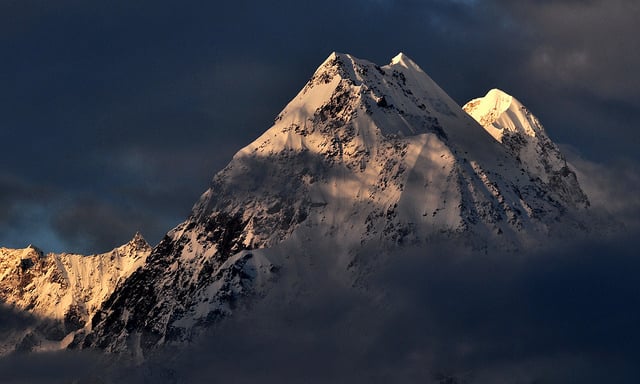
The mighty Himalayas are not acting as a barrier to pollution from South Asia, as previously thought, a new study by scientists at the Chinese Academy of Sciences’ Institute of Tibetan Plateau Research in Beijing suggests.
“Many people assume that pollutants piling up on the southern slope of the Himalayas would not go anywhere because the mountains are simply too high,” said Cong Zhiyuan, an environmental scientist and co-author of the new paper, told Nature.
However, research conducted by Cong and his colleagues shows that there are similar concentrations of pollutants on either side of the Himalayan range, suggesting emissions drift from South Asia over the Tibetan Plateau. There is also indirect evidence collected from ice core samples taken from the southeast Tibetan plateau which showed increasing levels of soot during times of high levels of industrial activity in India.
The source of the soot in the Himalayas is primarily attributed to biomass burning, according to the study. The researchers came to this conclusion by analysing dicarboxylic acids in aerosols and the specific markers of biomass burning – levoglucosan and water soluble potassium. Biomass is a common cooking fuel in South Asia, where firewood and dung cakes are often used by households and access to clean alternatives is low.
The researchers found the markers to be present in all seasons but they particularly peaked in the pre-monsoon period, when there are a large number of forest fires and agricultural burning in the southern Himalayan foothills. Other studies, for example one by the Nepal Climate Observatory-Pyramid station, show that the pre-monsoon season is the ‘fire’ season in the region, further adding to evidence of biomass burning as the key source of soot.
Cong’s analysis suggests that the simultaneously prevalent up-valley wind in the southern slopes and down-valley wind on the north play a role in transferring this soot over the Himalayas onto the Tibetan plateau and glaciers.
A recent article on thethirdpole.net looked at how soot should be studied to understand the melting rate of glaciers. Soot or black carbon are light absorbing aerosols – deposits of such aerosols on glaciers darkens the snow and causes increased absorption of energy. This increased absorption can accelerate melting of snow and glaciers. A project launched last year by Norwegian and Indian research institutes aims to study the sensitivity of the Himalayan glaciers to soot.
Understanding this phenomenon is important as the Himalayas are the source of 10 major rivers that provide water for about 1.3 billion people living in the basins. If glacial melt is accelerated due to soot 20% of the world’s population living in the region who are already facing water stress and frequent floods, will be exposed to an increased risk to their livelihoods.
The migration of pollutants over the Himalayan range will thus have implications for South Asia and highlights India’s contribution to pollution on the northern side of the Himalayas.
However the study does not find to what extent this trans-Himalayan pollution contributes to the overall level of soot on the Tibetan Plateau.
“Pollutants might be blown from eastern China or come from biomass burning elsewhere on the plateau,” suggested Veerabhadran Ramanathan, an atmospheric scientist at the Scripps Institution of Oceanography in La Jolla, California in an interview with Nature.
While the study shows a correlation of levels of soot on either side of the Himalayan range, the causal relationship is not definitive. Further evidence will be needed to support Cong’s findings to confirm the extent to which South Asia’s pollutants play a role.