Climate

Floods wreak havoc in Assam, Arunachal Pradesh

Flood woes are back in India’s northeast region with agriculture land destroyed, key roads washed away and more than 200,000 people affected in the states of Assam and Arunachal Pradesh
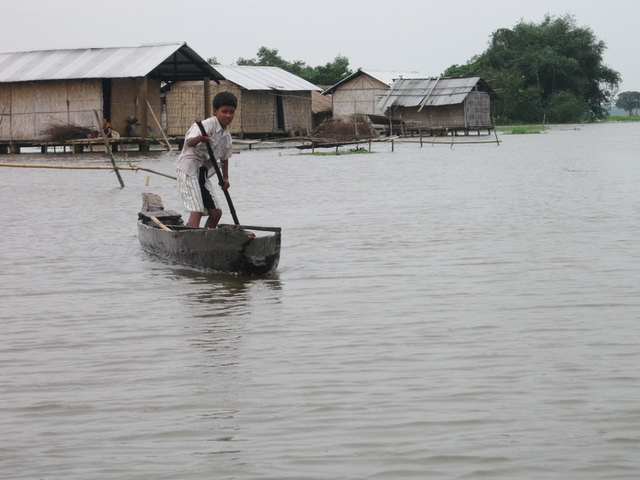
<p>(Photo: Oxfam International)</p>

(Photo: Oxfam International)

The monsoons have barely begun and incessant rains over the past few days have already caused several rivers—including the Brahmaputra—to overflow, wreaking havoc in India’s northeast states of Assam and Arunachal Pradesh.

Thousands of people have been affected, crops destroyed and normal life disrupted with the rains washing away portions of roads and triggering landslides.

According to the Assam State Disaster Management Authority (ASDMA), 195,243 people have been affected by the floods so far. The rains have caused rivers, including the Brahmaputra, to overflow and breach the embankment, thereby flooding villages and destroying crops. An estimated 553 villages in 13 districts of the state have been affected by the floods.

Among the worst affected districts are Assam’s Dhemaji, Lakhimpur and Barpeta with 134,000 people from these areas itself. In the Tinsukia and Sonitpur district, four relief camps have been set up by ASDMA.

Majuli, a large river island in Jorhat district, is one of those severely hit by the rains. Khagen Deka, a resident whose village near the embankment has been flooded because of the overflowing Brahmaputra, said that he and his family have relocated to their relative’s house in another village to escape the disaster.

“My uncle lives not too far from our village but his is a chang ghar (stilt house) so there is no fear of the flooding water. My family and I have taken refuge with him with just our basic belongings until the water recedes,” Deka said.

Many in Majuli, especially those near the embankment live in similar houses. While precious lives can be saved by this, chunks of the island are eroded every year during the monsoons, threatening the very existence of the island in the future.

Along with people, animals have also been badly affected by the floods. Crops in 8,245 hectares of land have been destroyed as well.

“Floods are a perennial affair in Assam, but it’s difficult to predict anything because there are various factors involved—rainfall here, rainfall in the mountains where the water flows into the rivers, climate change…Having said that, this wave of flood is basically an inundation and can be termed as moderate,” an ASDMA official told thethirdpole.net

The official also added that the “situation is unlikely to become worse in the near future”.

The situation is similar in nearby Arunachal Pradesh.  A large portion of the national highway, NH-415, has been washed away by the rain water, disrupting road communication between the state capital Itanagar and Banderdewa via Karsinga.

Ironically, the road connecting Itanagar and Banderdewa was reopened just a few months back after restoration work post being affected by last year’s flood. This break in road communication can have serious implication on local people since the price of essential commodities may rise.

The rain water has also flooded low lying areas like Pasighat. Many villages have been cut off and power supply in the lower Dibang Valley district has also been disrupted, plunging villages after villages in darkness.

Floods are an annual worry for the region, claiming many lives and destroying vast swathes of crop land and property worth millions. Last year, for instance, 67 people were killed and 4.2 million people affected across Assam.
Cookies Settings

Dialogue Earth uses cookies to provide you with the best user experience possible. Cookie information is stored in your browser. It allows us to recognise you when you return to Dialogue Earth and helps us to understand which sections of the website you find useful.

Required Cookies

Required Cookies should be enabled at all times so that we can save your preferences for cookie settings.

Dialogue Earth - Dialogue Earth is an independent organisation dedicated to promoting a common understanding of the world's urgent environmental challenges. Read our privacy policy.

Cloudflare - Cloudflare is a service used for the purposes of increasing the security and performance of web sites and services. Read Cloudflare's privacy policy and terms of service.

Functional Cookies

Dialogue Earth uses several functional cookies to collect anonymous information such as the number of site visitors and the most popular pages. Keeping these cookies enabled helps us to improve our website.

Google Analytics - The Google Analytics cookies are used to gather anonymous information about how you use our websites. We use this information to improve our sites and report on the reach of our content. Read Google's privacy policy and terms of service.

Advertising Cookies

This website uses the following additional cookies:

Google Inc. - Google operates Google Ads, Display & Video 360, and Google Ad Manager. These services allow advertisers to plan, execute and analyze marketing programs with greater ease and efficiency, while enabling publishers to maximize their returns from online advertising. Note that you may see cookies placed by Google for advertising, including the opt out cookie, under the Google.com or DoubleClick.net domains.

Twitter - Twitter is a real-time information network that connects you to the latest stories, ideas, opinions and news about what you find interesting. Simply find the accounts you find compelling and follow the conversations.

Facebook Inc. - Facebook is an online social networking service. China Dialogue aims to help guide our readers to content that they are interested in, so they can continue to read more of what they enjoy. If you are a social media user, then we are able to do this through a pixel provided by Facebook, which allows Facebook to place cookies on your web browser. For example, when a Facebook user returns to Facebook from our site, Facebook can identify them as part of a group of China Dialogue readers, and deliver them marketing messages from us, i.e. more of our content on biodiversity. Data that can be obtained through this is limited to the URL of the pages that have been visited and the limited information a browser might pass on, such as its IP address. In addition to the cookie controls that we mentioned above, if you are a Facebook user you can opt out by following this link.

Linkedin - LinkedIn is a business- and employment-oriented social networking service that operates via websites and mobile apps.