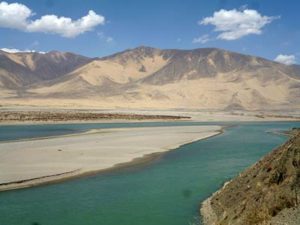
![<p>The Indus River flowing through Ladakh in J&K [image by Athar Parvaiz]</p>](https://dialogue.earth/content/uploads/2016/09/The-Indus-River-in-Ladakh-Kashmir-Photo-Credit-Athar-Parvaiz-768x576.jpg)

The 1960 World Bank-mediated Indus Waters Treaty between India and Pakistan is considered one of the great success stories of water diplomacy, especially as it has survived the India-Pakistan wars of 1965, 1971, 1999 and much bad blood during and after the wars. Tension between the two countries is again at a peak following a terrorist strike in Kashmir, and some Indian commentators are speaking of reneging on the treaty as a non-military option to pressure Pakistan.
On September 18, 2016 an attack was carried out on an army base in the garrison town of Uri, 75 kilometres north-west of Kashmir’s summer capital Srinagar, near the Line of Control (LoC) that effectively divides Kashmir between India and Pakistan. Eighteen Indian army personnel and four terrorists were killed in the attack, and India has blamed the attack on militants from Pakistan.
India and Pakistan have long been embroiled in diplomatic face-offs over Kashmir and have fought three wars, but have so far managed to uphold the treaty that provides mechanisms for resolving disputes over water-sharing.
Under the treaty, Pakistan received exclusive use of waters from the Indus and its westward flowing tributaries, the Jhelum and Chenab, while the Ravi, Beas and Sutlej rivers were allocated for India’s use.
Using water as weapon
Just two days before the Uri attack, an Indian author on water disputes, Brahma Chellaney, wrote that, “India should hold out a credible threat of dissolving the Indus Water Treaty, drawing a clear linkage between Pakistan’s right to unlimited water inflows and its responsibility not to cause harm to its upper riparian.” Other commentators, too, such as Yashwant Sinha, who has served as both foreign minister and finance minister in a previous government, have suggested that the treaty be abrogated.
Officially the Indian government has said little. In response to a question, the spokesperson of India’s Ministry for External Affairs, Vikas Swarup, merely said, “For any such treaty to work, it is important that there must be mutual cooperation and trust between both the sides.” He avoided going into details.
The mediator
The World Bank – which negotiated the treaty and sets up an adjudicator in case of disputes – has not made an official statement either. Speaking to thethirdpole.net, a World Bank spokesperson said, “The World Bank’s role in the Indus Waters Treaty is limited and strictly procedural.”
Putting this in perspective, Ashok Swain, who teaches at Department of Peace and Conflict Research, Uppsala University, Sweden, said that World Bank is co-signatory for certain provisions of the Indus Waters Treaty and its role is limited to a dispute regarding the implementation of the treaty, not its abrogation. At most the World Bank would step into, as per the treaty, to appoint a “neutral expert”, or help set up a Court of Arbitration, in case of a dispute.
On whether India can create any problem for Pakistan by stopping water, Swain said that India does not have the enough storage facility to create a supply problem immediately for Pakistan.
“It has to raise its dam structures and that will take time. There is also another angle to it. India, even if it wants to, cannot take the water out of Kashmir Valley. So, the water of the three rivers (Indus, Jhelum and Chenab) will remain in their basin and India cannot divert that to other areas due to geographical reasons. India can stop the supply for some time, but cannot divert it.”
Acting within the treaty
Uttam Sinha, a research fellow at New Delhi based Institute for Defence Studies and Analyses (IDSA) also disagreed with those asking for scrapping the treaty.
“For sending a message to Pakistan, we don’t necessarily need to go to the extent of scrapping the Indus Waters Treaty. We can even send a strong message to Pakistan by using the waters of western rivers of Indus basin for irrigation, electricity and storage of up to 3.6 Million Acre Feet (MAF), well within the norms laid down in the treaty,” Sinha told thethirdpole.net.
“Scrapping the treaty would rather act against our own interests and international standing as it would cause anxiety among our other neighbours like Bangladesh and Nepal with which we have water-sharing treaties, apart from earning us a bad image in the global community.”
Azeem Ali Shah, a Lahore based researcher with the International Water Management Institute (IWMI), told thethirdpole.net, “A unilateral withdrawal from the Treaty will bring World Bank into the dispute. It will also incite further anxiety among Pakistani people and might lead to violence.”
Despite a huge debate generated in the media, the silence of the principal parties, whether it is the Indian government or the World Bank, seems to indicate that the treaty is safe for the time being. The former chief minister of the Indian state of Jammu & Kashmir, Omar Abdullah, tweeted, “Will stick my neck out and say that nothing will happen to Indus Waters Treaty. It survived four wars and a J&K assembly unanimous resolution.” Jammu & Kashmir Assembly had passed a resolution in 2003 asking India and Pakistan to review the treaty which had not considered the developmental needs of the state, which mostly hosts the three rivers allocated to Pakistan.
“Such statements in favour of scrapping the treaty can only be treated as mere propaganda, not a diplomatic option,” Medha Bisht, who teaches International Relations at South Asian University, told thethirdpole.net. One major reason for this is that India is itself a middle riparian country for two of the six rivers mentioned in the treaty. The Indus and the Sutlej flow from Tibet, and there is no treaty between China and India to manage the relationship. One senior Indian commentator has even claimed that China has indicated it would act to divert waters from India if India decided to divert waters from Pakistan. Such a scenario, though, would lead to flooding and huge damages to all three countries. This highlights that, more than anything else, such treaties survive not just because of trust or goodwill, but because they serve the interests of all the nations involved.
See also: Indus Waters Treaty: an unjustified resentment and: Water issues spark furore in Jammu & Kashmir Assembly