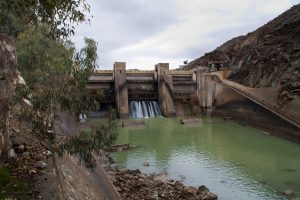
![<p>The Kishanganga project site in 2012 [image by Athar Parvaiz]</p>](https://dialogue.earth/content/uploads/2014/08/IMG_2233-1024x768.jpg)

India has accused the World Bank of following procedures not in consonance with the Indus Waters Treaty (IWT). The IWT governs the sharing between India and Pakistan of water of the six Indus Basin rivers. Facilitated by the World Bank, this treaty, signed in 1960, is considered one of the most successful water-sharing agreements in the world. As a signatory to the IWT, the World Bank has a narrow and very well defined role to help arbitrate between the two countries.
In the dispute over the Kishanganga and Ratle hydropower dams, both located in the Indian state of Jammu & Kashmir, on August 22 this year Pakistan had sent a request that a Court of Arbitration be set up. On October 4, India requested that a Neutral Expert be appointed. The World Bank has decided to appoint both a Court of Arbitration and a Neutral Expert. The announcement was made on October 10.
The simultaneous announcement of the two processes has annoyed India, and a statement made by its Ministry of External Affairs (MEA) reads, “It was pointed by the Government to the World Bank that the pursuit of two parallel difference/ dispute resolution mechanisms – appointment of a Neutral Expert and establishment of a Court of Arbitration – at the same time is legally untenable.”
“Inexplicably, the World Bank has decided to continue to proceed with these two parallel mechanisms simultaneously. India cannot be party to actions which are not in accordance with the Indus Waters Treaty.”
Article IX, section (6) of the IWT reads: “The provisions of Paragraphs (3), (4) and (5) [dealing with the Court of Arbitration] shall not apply to any difference that is being dealt with by a Neutral Expert.” While this suggests that a Court of Arbitration cannot be appointed after a Neutral Expert has been appointed, it is silent on the possibility of parallel processes. Given that Pakistan made a request to appoint a Court of Arbitration a month and a half before India’s request of appointing a Neutral Expert, it would have been impossible for the World Bank to process India’s request in preference to Pakistan’s.
“It is unprecedented in the history of the Treaty that India and Pakistan are initiating separate processes,” a spokesperson from the World Bank’s headquarters in Washington DC told thethirdpole.net. “Under both the process of appointing a Neutral Expert and the process of drawing of lots, the Bank’s role is limited only to the exercise of procedural functions, which do not touch upon the factual or legal merits of the contested issues. The Bank does not perform — and the Treaty does not contemplate — any role for the Bank in the determination of the contested issues arising between the two countries. The Bank is obligated by the Treaty to undertake the roles assigned to it for both appointing a Neutral Expert and drawing lots for the selection of an appointing authority for umpires on a Court of Arbitration, and is proceeding to exercise this procedural function.”
This is the first time that a single country, Pakistan, has made the request that a Court of Arbitration be set up. The only occasion when such a Court was set up earlier was in 2010, when Pakistan instituted arbitral proceedings against India in relation to the Kishanganga Hydroelectric Project. In that case India and Pakistan agreed bilaterally on the appointing authorities for umpires, and the World Bank was not involved.
The official response by the World Bank acknowledges that this simultaneous appointment of the Neutral Expert and Court of Arbitration is problematic, especially as the Neutral Expert and/or the Court of Arbitration would require the cooperation of both governments to do their work. Senior Vice President and World Bank Group General Counsel Anne-Marie Leroy said, “What is clear, though, is that pursuing two concurrent processes under the treaty could make it unworkable over time and we therefore urge both parties to agree to mediation that the World Bank Group can help arrange.”
The spokesperson said the World Bank would offer to help arrange an internationally respected figure to mediate, knowing that if two parallel processes are in play, there are likely to be contradictions. No such provision for mediation exists within the treaty itself. “In light of the spirit of cooperation and goodwill that is at the heart of the Treaty, and consistent with the Bank’s historic role as a neutral, pragmatic and proactive partner to both countries, the Bank has offered to both countries an independent third-party mediator,” the spokesperson told thethirdpole.net. “This mediator could try to achieve an agreement on how to resolve the matter regarding the two dams. This offer was made without prejudice to the validity of the Request for Arbitration by Pakistan or the request for a Neutral Expert by India.”
One of the reasons that the IWT has worked well in the past is that the dispute resolution mechanisms are so clearly laid out. But if the dispute resolution mechanisms themselves are in dispute then it is difficult to see how the treaty can continue to work. And despite the words of the World Bank spokesperson, there seems to be little hope of seeing the “spirit of cooperation and goodwill” that the Bank suggests lie at the heart of the treaty.