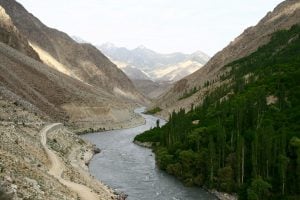
![<p>The Indus could be a river of peace [image by Karunakar Rayker]</p>](https://dialogue.earth/content/uploads/2017/03/Indus-Valley-Karunakar-Rayker-768x478.jpg)
The Indus basin is one of most contested pieces of real estate in the world. With the headwaters in China, flowing through India and the turmoil-ridden region of Kashmir, into Pakistan, with a branch going into Afghanistan, and flowing back into Pakistan, the rivers of the Indus system traverse a veritable smorgasbord of interstate conflict. The impacts of climate change on the glaciers in the region, as well as changes in land management practices and water usage have added pressure and unpredictability to the basin. While the Indus Waters Treaty, signed in 1960, between India and Pakistan, remains an important marker of cooperation, it required a great deal of political will, and fortuitous international conditions to make it possible. Even then, the Treaty was basically one of non-cooperation, with three rivers reserved primarily for Pakistan’s use, and three for India’s.
But while political will may be missing, and international conditions inclement, the need of the countries to cooperate has only grown greater over time. If nothing else, the countries need reliable information of the larger basin to plan their own use of water. All four countries are facing acute water stress, though some are more strained than others. All the countries are also facing immense pressures towards growth, and sustainable growth can only be managed with sustainable use of water resources. – eds
I was at a local corner store in Uganda last week and noticed the profusion of rice being sold, rice from either India or Pakistan. It’s highly likely that this rice, being consumed in eastern Africa, was produced in the Indus basin, using Indus waters, and was then processed and shipped to Africa. That’s not exceptional in its own right and is, arguably, sign of a healthy global trading system.
Nevertheless, the rice in question is likely from a system under increasing stress, one that is often simply viewed as a hydrological – i.e. basin – unit. What my trip to the corner store shows is that perhaps more than ever before a system such as the Indus is no longer confined – it extends well beyond its physical (hydrological) borders.
Not only does this rice represent embedded ‘virtual’ water (the water used to grow and refine the produce), but it also represents policy decisions, embedded labour value and the gamut of economic agreements between distribution companies and import entities, as well as political relationship between East Africa and South Asia. On top of that are the global prices for commodities and international market forces.
In that sense, the Indus river basin is the epitome of a complex system in which simple, linear causality may not be a useful way for decision makers trying to determine what to do and how to invest in managing the system into the future. This biophysical system has, integral to it, social, economic and political systems in which elements of climate, population growth and movement, and political uncertainty make decisions hard to get right.
Like other systems, it is constantly changing and endlessly complex, representing a great deal of interconnectivity. This poses questions about stability, sustainability, and hard choices and trade-offs that need to be made, not least in terms of the social and economic cost-benefit of huge rice production and export.
So how do we go about planning in a system that is in such constant flux?
Coping with system complexity in the Indus is the overarching theme of the third Indus Basin Knowledge Forum (IBKF) being co-hosted this week by the International Centre for Integrated Mountain Development (ICIMOD), the International Institute for Applied Systems Analysis (IIASA), the International Water Management Institute (IWMI) and the World Bank. Titled Managing Systems Under Stress: Science for Solutions in the Indus Basin, the forum brings together researchers and other knowledge producers to interface with policymakers to work together to develop future direction for the basin while improving the science-decision-making relationship.
Participants from four riparian countries – Afghanistan, China, India and Pakistan – as well as from international organisations that conduct interdisciplinary research on the factors that impact the basin will work through a ‘marketplace’ for ideas, funding sources and potential applications. The aim is to narrow down a set of practical and useful activities with defined outcomes that can be tracked and traced in coming years under the auspices of future fora.
The meeting builds on the work already done and – crucially – relations already established in this complex geopolitical space, including under the Indus Forum and the Upper Indus Basin Network. By sharing knowledge, asking tough questions, and identifying opportunities for working together, the IBKF will hopefully pin down concrete commitments, both from funders and policymakers, but also from researchers to ensure high quality outputs that are of practical relevance to this system under stress, both from within and externally.
Scenario planning
Feeding into the IBKF, and directly preceding the forum, the Integrated Solutions for Water, Energy and Land Project (ISWEL) brought together policymakers and other stakeholders from the basin to explore a policy tool that looks at how best to model basin futures. This approach will help the group conceive of possible futures and model the pathways leading to the best possible outcomes for the most people. This ‘policy exercise approach’ will involve steps to identify and evaluate possible future pathways:
- specifying a ‘business as usual’ pathway,
- setting desirable goals (for sustainability pathways),
- identifying challenges and trade-offs,
- understanding power relations, underlying interests, and their role in nexus policy development
- developing and selecting nexus solutions,
- identifying synergies, and
- building pathways with key milestones for future investments and implementation of solutions.
The rice that helps feed parts of East Africa plays a key global role – the challenge will be ensuring that this important trading relationship is not jeopardised by a system that moves from pressure points to eventual collapse. Open science-policy and decision-making collaboration is a key to making sure that this does not happen.