A few decades ago, we were able to swim in our local streams, drink river water, participate in rituals along riverbanks and travel by boat. But these pleasant recollections are now just distant memories. Rivers in Asia are in a dire state.
While pollution is the most visible symptom of river ill health, the issue of their anaemic flow is far greater and, prior to the past two years, has been mostly ignored.
Many rivers have been depleted by excessive abstraction for irrigation, industry and human consumption. Basin water tables have fallen as supply-side-oriented administrations rapaciously suck the life-giving waters from them. In addition, rivers are increasingly bearing the brunt of climate change as rainfall becomes erratic in their basins or, in the case of snow-fed rivers, glaciers retreat.
The Indus, Ganga and Brahmaputra rivers are sub-continental rivers which are both snow-fed and dependent on tributaries. They are all transboundary rivers and, even within their countries, flow through several administrative jurisdictions. These conditions throw up titanic challenges in developing basin management plans and governance structures.
Visible pollution problem
Pollution has degraded many of the region’s rivers. There are known technical solutions, such as sewage and effluent treatment plants, pumping stations and solid waste management, addressing the problems of chemical and organic pollution as well as plastics.
Moreover, investors are keen to dedicate capital to solving this problem, and it can be overcome in a relatively short time horizon. Therefore, the ruling establishment class of big business, state government, central government, regulators and so on has become more serious about addressing river pollution by using capital-intensive technology.
Despite this encouraging momentum, the problem has grown very large and is still expanding, and the amount of finance is limited. When solutions are implemented it is with limited success.
For example, Delhi alone has about 30% of India’s sewage treatment plant capacity but the Yamuna river is far from clean. Likewise the Ganga, despite being India’s national river with vast funding poured into treatment infrastructure, is still one the most polluted rivers in the world.
Less attention to flow
On the other hand, little attention has been paid to depleted and dry rivers, despite a relation to pollution. If there is less water compared to the amount of pollution, the river will, perforce, be more polluted. Only in the past few years have persistent efforts by NGOs begun to register with governments. Also, as governments try to develop waterways they are starting to realise the problem as projects are constrained by the inadequate flow.
The Cauvery river in south India, for example, does not flow to the sea most of the year, aggravating the problem of saltwater intrusion in its delta. The Yamuna is almost dry for most of its course downstream of Hathnikund Barrage in the summer, and is anaemic until its confluence with the life-restoring Chambal.
The restoration of river flow is, therefore, the real challenge. It is only possible to rejuvenate and conserve rivers by prudent management of their basins – and it can take decades to show results, especially as the dynamics of climate change play out. India’s National Water Policy over the years has stressed the need for river basin management, but the idea has never really taken off.
Misguided interventions
Over time, powerful state water bureaucracies, or hydrocracies, have taken control of the region’s intrastate and interstate rivers. These establishments view rivers only as a water resource rather than living ecosystems and thrive on the business of extracting and diverting water by building dams, barrages and canals.
India has 14 major rivers (basin area exceeding 20,000 square kilometres), 42 medium rivers (basin between 2,000-20,000 sq km) and 55 minor rivers (basin less than 2,000 sq km). There are also thousands of local streams, rivulets and drainage courses.
The critical state of rivers, from the first-order stream to the highest-order river, has inspired environmental activists and riverine communities to protect and revive rivers and streams. But a lack of understanding about river basins has led to misguided approaches. While some believe in deepening river beds through excavation (resulting in temporary rain-fed pools rather than flowing water), others believe in planting trees in riparian zones (the area between a river or stream and the land), draining ground water flow that would otherwise join the river.
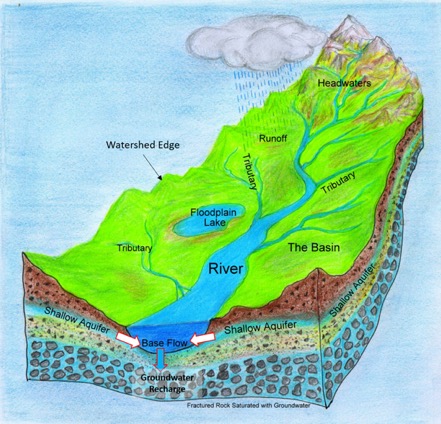
This is complicated by the fact that extensive data is only available on only larger rivers. There is a glaring lack of data when it comes to small rivers and streams.
This lack of localised data and the absence of basin management planning capacity among activists has hampered the development of comprehensive understanding as well as structured interventions at the local level, both by local authorities and activist groups. It has also enabled damaging developmental activity and unwanted interventions to slip through.
Rational basin planning
INTACH seeks to address this gap by offering a guide to civil society groups that will enable them to develop basin plans for medium and minor rivers.
Basin planning would not only lead to a more informed citizenry, but also to an informed dialogue with the establishment, leading to rational perspectives and sensible interventions, both for river revival and developments.
The approach emphasises estimating a water budget for the basin.
This takes the form of a simple calculation, using the same principle as a financial budget that subtracts expenditure from revenue. ‘Expenditure’ refers to total domestic consumption, industrial consumption, irrigation and adequate flow. It is subtracted from ‘revenue’, or precipitation which transforms into surface water, groundwater, soil moisture and evaporation. The calculation then informs policy choices that focus on attaining and maintaining flowing rivers.
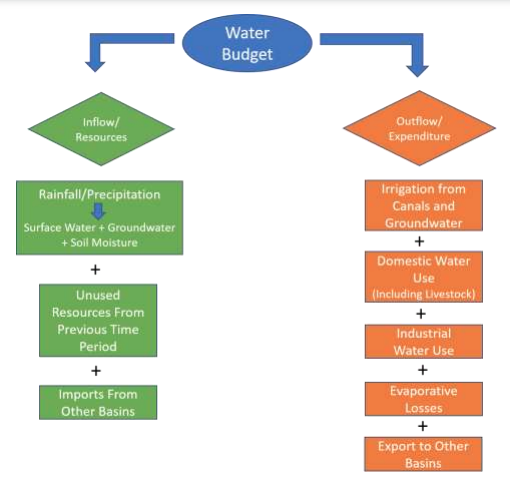
In a case study on the Hindon basin, INTACH calculated the large mismatch between the basin’s resources and the amount of water being used. This information can be used by civil society groups and policymakers to advocate for sustainable decisions, and is beginning to influence Hindon basin administrators. The National Mission for Clean Ganga has forwarded our guidebook to various administrators in the Ganga basin.

After a water budget is developed, the government needs to set up basin management organisations (BMOs) composed of stakeholders such as corporations and farmers, which would refine the budget based on the annual data variation. The BMOs would cut across administrative boundaries which presently do not coincide with basin boundaries.
It is very much a work in progress. Bureaucracies offer tough resistance when they see their powers being diluted, and complexities arise when rivers are interstate and/or transboundary.
Improving the flows of tributaries will enhance flows in higher-order streams. This approach is now being initiated in the Ganga basin, with the tributary management programme of Namami Gange (NMCG), which is still in its infancy.
As noted earlier, sub-continental basins offer titanic challenges. The first step in the journey of a thousand miles is to prioritise basin management at the sub-basin level.