China’s annual Lianghui rarely disappoints as a source of new buzzwords. But this year, the meeting of the National People’s Congress and the National People’s Political Consultative Conference instead saw the revival of one that’s been around for a few years.
At a press conference with journalists on March 9, Chen Jining, Minister for Environmental Protection, fell back on a familiar term, the “ecological red line”, when responding to a question about environmental degradation on the Yangtze. Chen was clear that strict baselines for environmental protection would be established in the Yangtze Basin, which is one of China’s most densely populated and industrialised regions.
Although the term has been heard before, it is especially significant this year because of an accompanying concept called “ecological space”. In late February, Chen published an article that worked through his ideas around environmental protection. He described China’s development as having “artificially divided” the natural environment by economic function.
He went on to say that if China is to develop sustainably then it will require an “ecological space” that is unrestricted by economic activity. Chen goes on to rank it alongside “urban space” and “agricultural space” as one of three key spaces in need of tailored management. He said that ecological red lines are “the most important, the most key part of that space, needing…implementation of the strictest protection and utilisation controls.”
Deputy Minister Huang Runqiu has pointed out that the Chinese government discussed ecological red lines as far back as 2011, and as a measure of success in implementing ecological civilisation targets. But the concept only seemed to genuinely influence policy when Chen Jining took over the Ministry of Environmental Protection (MEP) in 2015.
In early February the Party Central Committee and the State Council jointly published a key document, Opinions on Defining and Protecting Ecological Redlines. This made clear that local Party committees and governments are responsible for the protection of ecological red lines and set a timetable for setting them.
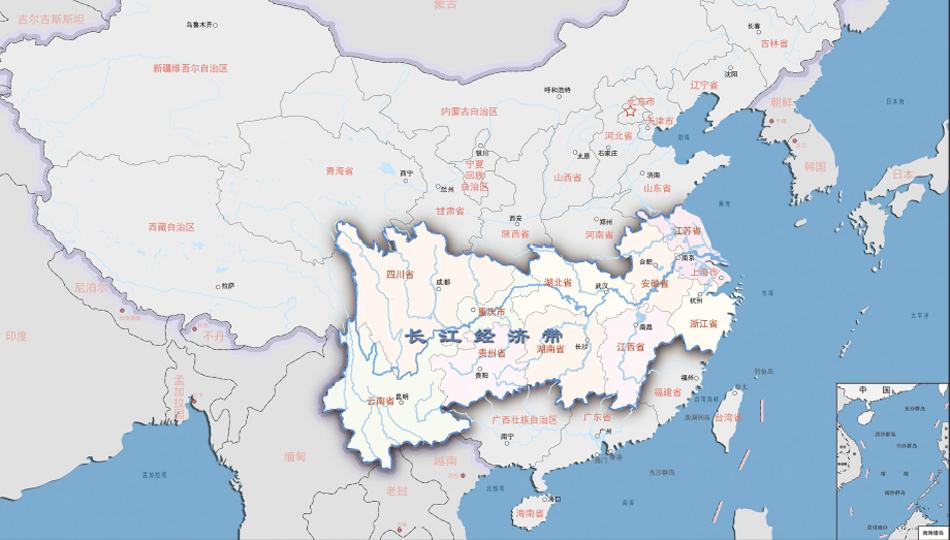
Specifically, by the end of 2017, provinces and municipalities in the Beijing-Tianjin-Hebei region and the Yangtze Economic Belt will have set red lines, with other localities to follow by the end of 2018. By 2020 the process will have been completed.
By the end of 2017 provincial governments in the Yangtze Economic Belt will have set their ecological red lines. Image: https://www.gov.cn
Many questions remain though. What power will “red lines” have? Why are there different timings? And what challenges lie ahead? To help answer these questions chinadialogue spoke to environmental protection expert Peng Yingdeng, a researcher at the National Centre for Urban Pollution Control Technology. Peng was formerly head of the Peking University Atmospheric Pollution Institute, and is also a member of the MEP’s panel of environmental impact assessment experts.
China Dialogue (CD): We’ve seen red lines before for arable land and forestry. What’s the difference between those and the ecological red lines being talked about now?
Peng Yingdeng (PYD): China’s territory is generally classed as one of three types: production spaces, living spaces, or ecological spaces. Areas used for production – agriculture, factories, industrial zones – are classed as production spaces. Cities and residential areas are living spaces. Ecological spaces are generally nature reserves, or reserves protecting sources of water – areas with an ecological function. The arable land red line was set within the agricultural [production] space. The ecological red lines are defined within the ecological space.
Previously the forestry authorities had forestry red lines, the water authorities had red lines for protection of water sources, the marine authorities had their own red lines. The ecological red lines will bring all these together, ending inter-departmental conflict. These red lines will be set and implemented by government, rather than individual departments. Note that the ‘Opinions on Defining and Protecting Ecological Redlines’ was issued jointly by the Party Central Committee and the State Council – not the Ministry for Environmental Protection. Any disagreements between departments will now be resolved within the red line system.
CD: What effect will the red lines have?
PYD: It’s like drawing a border and saying no development is permitted within that border. The environmental authorities will set ecological red lines and promote the “three lines, one list” approach. The three lines are ecological red lines, minimum environmental quality baselines, and upper resource usage limits; the list is a blacklist of environmentally-damaging activities that are not permitted. Specifically there’ll be rules about where you can develop, where you can’t develop, and how much development is permitted.
CD: Why will ecological red lines in the Beijing-Tianjin-Hebei region and the Yangtze Economic Belt be set earlier?
PYD: What these two [areas] have in common is that they are China’s most important in terms of economic, societal, political, and geographical location, and also most affected by pollution. The Beijing-Tianjin-Hebei region faces grave air pollution challenges, while the Yangtze Economic Belt suffers mainly from water pollution.
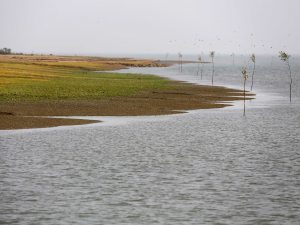
There are two reasons there’s an urgent need to protect the Yangtze: grave ecological damage and grave water pollution. Many provinces along the river have seen reduced ‘ecological baseflow’ – the amount of water needed to flow through a river to keep the ecosystem functioning. Many rivers in the Yangtze system no longer have the flow to maintain basic ecological functions. For example, Poyang Lake in Jiangxi and Dongting Lake in Hunan are shrinking and the ecological functions they provide are reduced.
There are many chemical factories and industrial zones built along the rivers, with waste water discharged into the Yangtze where it damages water quality. Forty three percent of the country’s waste water, 37% of its chemical-oxygen demand and 43% of its nitrates are released here, and there are serious drinking water issues.
The water environment in the Beijing-Tianjin-Hebei area is even worse, with many rivers dried up for two thirds of the year, with no ‘ecological baseflow’ at all, as shown by the higher frequency of dark and foul bodies of water than in the south. The implementation of ecological red lines will improve protection outcomes in the north.
CD: We’ve heard about setting ecological red lines for some years, but the outcomes haven’t been ideal. Why?
PYD: One issue was mentioned already: different departments were setting their own red lines, and those conflicted. Also, it’s harder for some local governments to implement these due to differing stages of development. So this time, implementation will be staggered; more developed areas with graver ecological issues, such as the two regions discussed, will take the lead.
CD: What restrictions on industrial development will result from the setting of ecological redlines in the Yangtze Economic Belt?
PYD: It will be forbidden to build new heavy and chemical industry zones within a kilometre of the Yangtze and major tributaries, and those already present will have to be relocated. All chemical plants will have to be situated within a chemical industry zone, under the zone’s management, as this is where the [supporting] infrastructure is best. There will be a strict ban on the building of new petrochemical or coal-chemical plants on the river’s upper and middle reaches.
CD: How hard will it be to implement this?
PYD: It’ll be a bit easier for richer places such as Shanghai and Jiangsu. Less developed areas such as Yunnan and Guizhou will find it harder, particularly where there are gaps in regulatory coverage.
There are still attempts in Yunnan to build new chemical plants away from main rivers and tributaries, especially at the county level. So there’s still a lot of pressure on the Ministry for Environmental Protection. If ecological redlines aren’t set those projects may go ahead.
Environmental impact assessment procedures prior to construction have already been simplified. If there isn’t effective oversight during and after construction then there will be a risk of environmental degradation regardless of whether or not redlines have been set.