


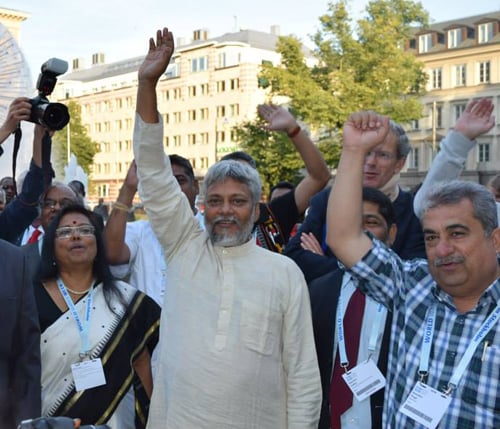

Amidst a gathering of over 3,000 people from around the globe to celebrate 25 years of World Water Week in Stockholm, Rajendra Singh is being awarded the Stockholm Water Prize on August 26.
On the eve of the award ceremony, Singh – often called the waterman of India – spoke exclusively to thethirdpole.net (TTP) about the challenges of water conservation and community rights on water.
This year’s winner of what is often called the Nobel Prize on water says commercialisation of water will not solve the problems the world is currently facing as businesses are driven only by money not value.
TTP: What do you think is the biggest challenge in the water sector?
Singh: Corporate agencies are seizing water rapidly, so stopping them is the biggest challenge of this time. Licensing and pricing water won’t solve problems; it only hands over precious water resources to a person or group that is highly motivated towards earning rather than learning. So ultimately, it is the community who knows the value of water to conserve or use it.
Europe and America started killing the community’s rights over water and it is rapidly increasing in other parts of the world including South Asia, so they have to realise that it’s not the way. We should not copy them. Our modality of conservation should respect community rights over resources. To bring this realisation is the most challenging thing and if we understand the value of community rights then there won’t be problem in getting water to anyone in this planet. There is a bit of rights still not captured in South Asia but it’s very likely that it will be done soon and the corporates are hovering around searching for the right time.
TTP: How do you see the current developments in the water sector, especially on hydropower?
Singh: The current hydropower development is disastrous and it will lead us nowhere. It is possible to develop hydropower and preserve the rights of rivers and people but the hydropower lobby is so unidirectional that it doesn’t provide any space for possibilities of changing the current pattern of development. It is because the river has been seen only through the eyes of money. I am not against hydropower development but the way rivers are being killed in the name of power generation will one day put our lives at risk. The current hydro project development kills the river as well as the rights of people around it. Engineers have already provided various models that allow the river to flow and also generate electricity but developers or governments are not willing to even hear that there are alternatives to the current development model.
TTP: What do you think is the way out then?
Singh: The only way out is establishing communities all over the world. The river shouldn’t give everything to us, it has to flow and we should respect the right of the river to flow. We started thinking that pricing water will solve all problems, which is wrong. Water was managed earlier when there were no companies, so seeing solution through pricing water is one of the biggest problems.
We can benefit from water resources but broader community participation is essential. We have to understand the value of nature. See what we did in Rajasthan (India) was to just capture the rainwater and store it in the land. Then it can be used for irrigation, land recharge, drinking or anything else. Thousands of people have been involved and the most water-deprived part of India is getting its own water through such a traditional way of conservation. Seven (previously dry) rivers are flowing in more than two decades because of the water restoration initiative. We don’t need big things, but we have to respect nature and most importantly learn what water is, rethink about the way we have been exploiting resources. Water can connect everybody and every country.
Also see India’s waterman demands water security law
TTP: Do you mean no infrastructure should be built?
Singh: No, what I am saying is don’t calculate drops and convert them into money. It will make you forget everything and rivers will be killed, lakes will be degraded, only those who can pay will get water and the poor will be left behind. What I am saying is apply traditional methods to recharge water where there is less water, use wisely where there is too much water. The problem now is we see money only and we forget rivers have to flow. We have forgotten to respect nature; we are so much driven by economy.
TTP: Many experts say the next war will be over fresh water; what do you think?
Singh: I agree, but there is still time to rethink about how we want to use water and that may avoid a future war. Water can be a tool for global peace rather than war. If you keep on monetizing water and forget that each individual has his/her responsibility towards water management then it’s sure that there will be war. Water has to bring us all together. Water is the fundamental right of every human being, water is not a commodity, and we should stop to think only about money when it comes to water.