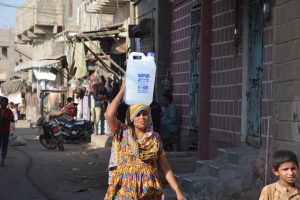
![<p>While the government may have set up electricity poles, the lines often do not reach the villages of the marginalised, or the marginalised within villages [image by: Harini Calamur/Flickr]</p>](https://dialogue.earth/content/uploads/2018/05/wired-Harini-Calamur-768x576.jpg)
Moyna is in class six and has to study by the light of a kerosene lamp or candles to finish her homework. Her village, Buraburi, has no electricity. Located in the district of Goalpara in the Indian state of Assam, the village has been brought under the Prime Minister’s Saubhagya (rural electrification) scheme. Unfortunately no work has yet been done to provide electricity to the 20-odd households here.
The Assamese daily newspaper Asomiya Pratidin reported that the children of Buraburi were joined by their parents to protest the claims of Prime Minister Narendra Modi that electricity had reached each village in India. With electricity poles being set up in a village in Manipur, the government said there was now no village without access to it.
On May 5, the demonstrators of Buraburi contradicted this claim by carrying candles and kerosene lamps in their protest march.
Buraburi is a small village. Tengasot, also in Goalpara, is bigger, with 120-odd households. It has electricity wires, but they connect only a few households. Even there, power supply is so erratic that no one has bothered to buy more than a bulb or two.
Bhupen Bora, Congress Party leader and former legislator in the Assam assembly, lists villages where only 40-60% of homes have electricity connections – Tulsibil in Kokrajhar district, Kulimari in Nagaon, Baligaon Bomgali in Sonitpur, Miligaon in Lakhimpur, Sivnagar in Dhemaji, Nagaon F.V. in Kamrup, Chiring Chapori in Darrang and Mazar Chuburi in Udalguri district.
Majuli, an island on the Brahmaputra river, is the constituency of Assam Chief Minister Sarbananda Sonowal. The 2011 Census says that out of 31,732 households in Majuli, 6,889 (21.71%) used electricity, while 23,899 (75.32%) homes depended on kerosene. 828 households (2.61%) used solar energy.
For Rongina, a worker at the Rengam Industrial Women’s Cooperative in Majuli, life is tough without electricity in her home. Very few members of her Mising community – listed as a Scheduled Tribe in the Indian Constitution as a historically disadvantaged group – have electricity. Those lowest on the socioeconomic ladder are almost invariably the last to get connected to the grid.
“I would say only 50 % of Majuli now has electricity. Because of the terrible condition of roads in the island, work to install electricity poles and connect it with the grid is a major task,” says Haren Bhuyan, another Majuli resident.
Saubhagya’s official website, maintained by the central Ministry of Power, says that out of 232,190 rural households in Arunachal Pradesh, electrification had been completed for 147,240 households by October 10, 2017. Since then, North Eastern Electric Power Corporation Limited (NEEPCO) has stopped surveys for new projects in the state, reportedly as a fallout of popular protests against hydroelectricity projects that are threatening to displace thousands – the 330 MW Kurung project, the 3,750 MW Siang, the 120 MW Nafra and the 160 MW Dibin project.
According to a journalist based in Itanagar, the capital of Arunachal Pradesh, the electrification of census villages is complete on paper, but in about half the villages, the only sign of electricity are poles that are not connected to any household.
No money, no power
The problem is not confined to Assam or Arunachal Pradesh. In state after state, the poorest village homes are still not connected to the electricity grid even when the facility exists in the village – the residents simply don’t have the money to pay for the initial costs of wiring, and the installation of the meter.
This problem gets compounded in the Himalayas because it is more expensive to wire up every home in the mountains. As in the rest of India, the poorest households are in the remotest parts of villages.
Pradeep Kumar is now used to electricity, working as he does as security guard at a house in South Delhi. There is a ‘desert cooler’ in the guardhouse. Whenever he goes to his parents’ home near Ramgarh in Uttarakhand, he is reminded of what a blessing electricity is.
“There are electricity poles passing through our village and going to all the tourist hotels in Ramgarh and up the mountains to Mukteshwar. But in our Dalit neighbourhood, no one has the money to pay for the wiring and the meter. A few people hooked wires to the poles and got electricity, but then the officials came and cut down the wires. They also fined those people. So now, no one in our neighbourhood has electricity. That was how it was when I grew up and went to the village school. I don’t know when it will change.”
Kuldeep Singh, who works as cook in a house down the road from where Pradeep Kumar works, finds the situation even more ironic. “Here I work in an open kitchen, so the air-conditioning in the dining room keeps me cool throughout the day. I was told that a part of this electricity comes from Nathpa Jhakri, which is (a hydroelectric project) right next to our village in Himachal Pradesh. The wires from the dam go over our farms, but none of us in our part of the village is connected to it.”
“The last time I went to the village, I checked how much it would cost to get a connection to our home. The officials told us it would cost around INR 20,000 (USD 297) for the wiring, and we would have to keep a deposit of INR 5,000 (USD 74) for the meter. We fully understand the advantages of electricity, but where will we get INR 25,000 (USD 371)? That’s the situation with all our neighbours in the Dalit part of the village. Only the Thakurs have electricity at home.”