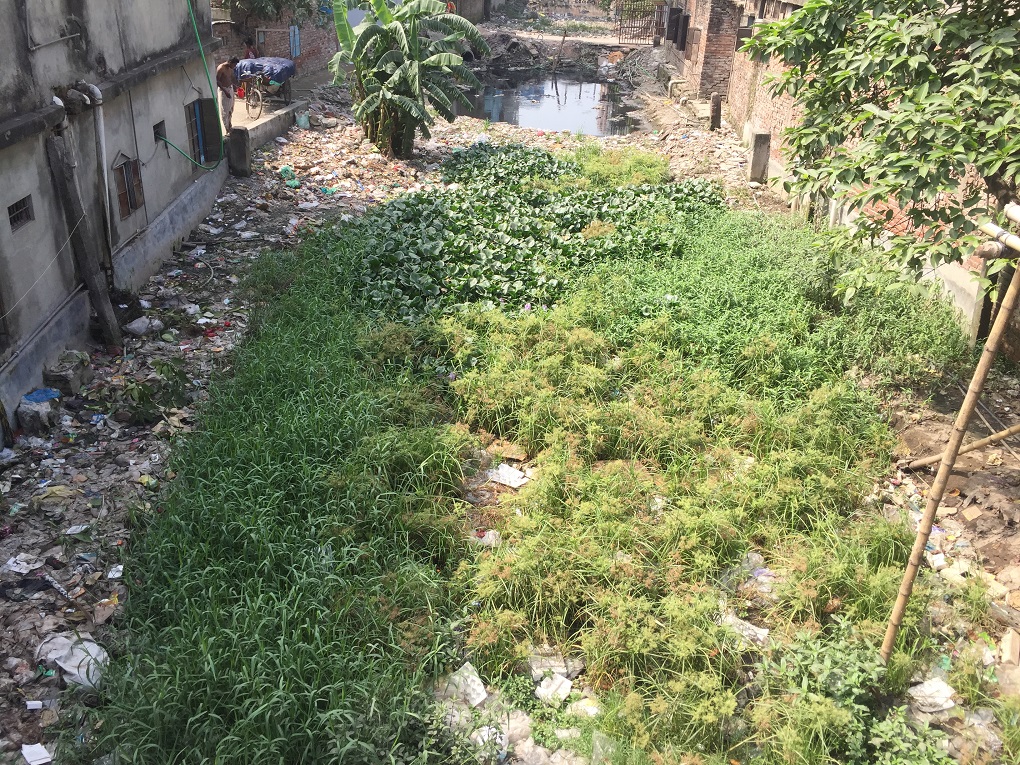
![<p>Blocked by trash and plastic, Dhaka’s drains are just not capable to dealing the monsoon rains [image by: Masum Molla]</p>](https://dialogue.earth/content/uploads/2018/06/IMG_3964-768x576.jpg)

Historically, two things always come together in Bangladesh – the annual national budget session in parliament and the monsoon.
The monsoon is welcomed by every farmer in Bangladesh, which is a predominantly agricultural based economy heavily dependent on the annual rains. But for the cities, especially for Dhaka and Chittagong, the May-July monsoon is nothing short of a nightmare because of all the water-logging, which is intimately linked with the irresponsible disposal of popular non-biodegradable polythene bags that end up clogging the sewers.
Dhaka’s sewers will never induce memories of a Batman movie where entire armies can be accommodated under the city. Here, the sewers comprise of a very primitive network of concrete pipes most of which are less than 1 metre wide.
Furthermore these pipes serve a city with a population density of 44,500 people per square kilometre, making it the most densely populated city in the world. The second most densely populated one is Mumbai, in India, with 31,700 people per square kilometre.
There are many areas in Dhaka – Dania, Paltan and Demra to name a few – that go under several feet of water after just a couple of minutes of heavy rain. The sewers in these areas are so clogged up by polythene that even this amount of water overwhelms them.
Abul Maal Abdul Muhith, the only finance minister in Bangladesh who has presented 10 national budgets, recently said, “In addition to promoting environment-friendly domestics products, the move of proposing a supplementary duty on polythene and plastic bags will help check environmental pollution and reduce water-logging problems in Dhaka city.”
Every year, the government spends a fortune on preventing water-logging in the cities with very little success. Winter in Bangladesh is usually very dry, which means people forget about water-logging and the authorities face no pressure to act. But, as the rains start becoming heavier, the authorities suddenly realise that the allocation to improve the metropolitan’s sewers have remained unspent. Hasty plans are made to deal with this, and are – by the very nature of rushed implementation – imperfect and wasteful.
Despite desperate planning and policymaking for many years, it has also utterly failed to find any sustainable solution to the urban water-logging problem during monsoon. For example, in 2018, the Dhaka Water Supply and Sewerage Authority (WASA) is going to spend BDT 1.93 billion (USD 23 million) to tackle the city’s water-logging problem. From 2013-16, the government spent a staggering BDT 3.03 billion (USD 36 million) to free the city of water-logging.
Like every year the Dhaka Water Supply and Sewerage Authority (WASA) is implementing an emergency excavation of 25km of canals, which remain clogged with plastic bags and cause water logging during monsoon. The program also includes removing garbage from 290 km of drains.
The extra duty will try and limit the need to deal with this, by encouraging people to use biodegradable plastic bags by reducing the price gap between biodegradable and non-biodegradable packaging materials. At present, the average price of a regular plastic bag is BDT 1 (USD 0.01) while a biodegradable plastic bag costs around BDT 5 (0.06).
The government wants to reduce the price gap. This doesn’t mean the government wants to make the price equal. If it really wanted to do that overnight, it would have imposed a 25% duty, which would destroy the non-bio plastic industry and render the several hundred thousand workers in this industry jobless. Instead it wants to encourage a transition. There is also the issue of waste segregation although Bangladesh does a decent, if not commendable, job of recycling. According to a study by Waste Concern, urban areas in Bangladesh generate 633,129 tonnes of plastic waste annually. Out of this, 51% (323,000 tonnes) is recycled.
In Bangladesh, the plastic industry produces basic products for readymade garments, construction materials, packaging and household goods. The government doesn’t have any solid data on the demand for regular polythene. However, the Department of Environment (DoE) estimates that the annual per capita plastic consumption in Bangladesh is around 8 kilogrammes.
Mohammed Ziaul Haque, director of the DoE, said the government is actively considering legislation to make the use of biodegradable packaging mandatory for all manufacturers.
Bangladesh has a proud record of legislating against hazardous use of plastics, becoming the first country in the world to ban the use of plastic bags in January 2002. Unfortunately because the biodegradable packaging materials such as jute remain costly, there has been virtually no slump in the popularity of non-biodegradable polythene.
However, one policy decision made in 2010, when the government introduced the Mandatory Jute Packaging Act stipulating the use of jute bags for paddy, rice, wheat, maize, sugar and fertilizer, helped in significantly reducing the use of plastic packaging in the agriculture sector.
At present, around five million biodegradable plastic bags are produced in Bangladesh annually, an insignificant amount against the ever-growing demand. The government now wants to ensure a solid supply of biodegradable plastic bags before declaring their usage mandatory.
Currently only one local company, Expo Accessories Ltd, produces biodegradable polythene bags for garment exports; but the production is entirely dependent on imported raw materials – jute cellulose, synthetic polymer as binder, and cross-linker for chemical reaction – making the end product expensive.
Bangladesh Jute Mills Corporation (BJMC) has recently introduced technology to produce a biodegradable polythene alternative called “Sonali Bag” by mixing polymer and jute. This may be the path to the future
“Currently we are producing 3,000 bags every day. Eventually, we want to increase production to 15,000 bags per day,” said Mubaraok Ahmed Khan, inventor of the Sonali Bag technology.