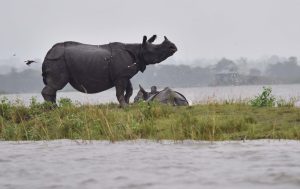
![<p>A woman contemplates her flooded home [image by: Munna Saraff]</p>](https://dialogue.earth/content/uploads/2017/08/08-768x512.jpg)
Frustrated NGOs are again thinking of suing the governments of rich nations over their inaction in combatting climate change-induced loss and damage.
An abiding nightmare of many developed country governments is a slew of lawsuits seeking compensation in the International Court of Justice, as these countries have been responsible for most of the build up of greenhouses gases in the atmosphere.
This is why developed country delegations pushed for legal liability to be removed from the Paris Agreement at the UN climate talks two years ago. The trade-off was that rich nations would “enable action and provide support to developing countries” to deal with the loss and damage.
But, says Harjeet Singh, the global lead on climate change at ActionAid, “there has been hardly any work on this”. An international mechanism to work on the issue of loss and damage – called the Warsaw International Mechanism – was set up at the 2013 climate summit in Poland. Singh has been an observer to some of its executive committee meetings.
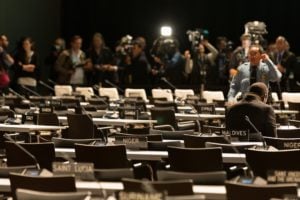
“Loss and damage is at the core of the COP23 agenda,” said Singh on the sidelines of the UN climate summit in Bonn, Germany. “It is now the third pillar to combat climate change, becoming more important as the first two pillars [mitigation and adaptation] were not strengthened when they were supposed to be.
“We need tangible results in the area of loss and damage in this COP, and we have an opportunity because it is being presided over by Fiji, a country already being affected by sea level rise and storms that are becoming more frequent and more intense,” Singh said.
The Warsaw International Mechanism (WIM) has three areas of work: knowledge generation, coordination, and enabling action and providing support to developing countries.
“There has been some work on the first two, but hardly any on the third,” Singh said.
The main problem is that there has been no progress on finance in this area. There is no estimate on how much money is and will be needed by countries suffering climate change-induced loss and damage now and in the future. WIM is preparing a report on this, but it is not scheduled for completion until June 2019. Meanwhile, the fact that such a report is being prepared is being used by COP23 delegates Bonn – mainly from the United States and Australia – to block all discussions on finances around loss and damage.
Many governments have emphasised the role of insurance firms in dealing with loss and damage; firms which have already reported record payouts this year following a series of storms in North America and the Caribbean, and floods in South Asia. But insurance policies do not take care of climate impacts that are relatively slow, such as drought, sea level rise and ocean acidification, Singh pointed out.
Sandeep Chamling Rai, senior adviser for global adaptation policy at WWF International, pointed out that 25 million people worldwide are already being displaced every year due to the effects of climate change.
“We need to deal with this collectively, and developed countries cannot keep putting off the issue. It must feature in the global stocktake of steps being taken by governments around the world to combat climate change.”
We want to hear from you! Tell us what you think about The Third Pole and you could win $100. Take our survey here.