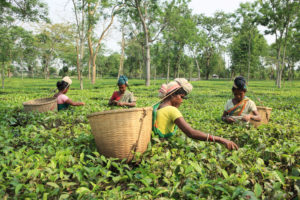
It is a rocky, uneven path down to the spring where the women of Damthang village in South Sikkim go to fetch their water and trudge uphill with filled containers. Still, they are happy their spring – called Gaddi – now has enough water: they do not have to walk all the way down to the river, saving them about an hour each trip.
Trekking up and down with them, Roshan Rathod, research consultant at the International Water Management Institute (IWMI), has learnt how to move on these difficult pathways. She slides down when it is too steep to walk.
Rathod is in this region of the eastern Himalayas – at an average elevation of 1,800 metres above sea level – to study how mountain springs that have gone dry due to climate change are being rejuvenated.
The Indian government’s think-tank Niti Aayog estimates about half the springs in the Indian Himalayas have gone dry. There are nearly three million springs in the Indian section of the Himalayas, and they are essential water sources for around 50 million people.
Rathod is trying to find the best model for springshed management. She has already studied how springs are being revived in nearby villages in West Bengal. After studying Sikkim’s famous Dhara Vikas model of spring rejuvenation, she will move to Meghalaya, Arunachal Pradesh, Nagaland and document and study the rejuvenation of 15 more springs. She is worried about moving around Arunachal Pradesh, where it is difficult to find transport.
After all of this research in the Himalayas, her report will be submitted to Niti Aayog and may lead to a national policy on springshed management.
To prepare her report, Rathod speaks with bureaucrats at state, district and local levels; she speaks with NGOs; most of all, she speaks with communities. She walks to the top of a hill to check the trenches that have been dug to hold rainwater so that it can percolate downwards through the year; she walks downhill to speak with residents, especially the women who fetch water; she walks further downhill to the spring to check how instruments measuring water flow are faring.

Her fieldwork is limited to the summer (March to May in most of India). Monsoon rains can cause landslides; in winter the areas can be snowbound. Since 2016, Rathod has been doing fieldwork in various parts of the Himalayas on water, gender and livelihood issues. As well as the tough terrain, she must negotiate social and cultural taboos.
Rathod recalls about three years back one of her projects in Uttarakhand involved going to a village on a hilltop, inaccessible by any mode of transport but a two-hour walk carrying all her luggage.
Gathering springshed data
Data collection from the field can be a major challenge in the Himalayan region, says Rathod. Residents tell her that water flow in the village spring has increased after trenches were dug on top of the hill.
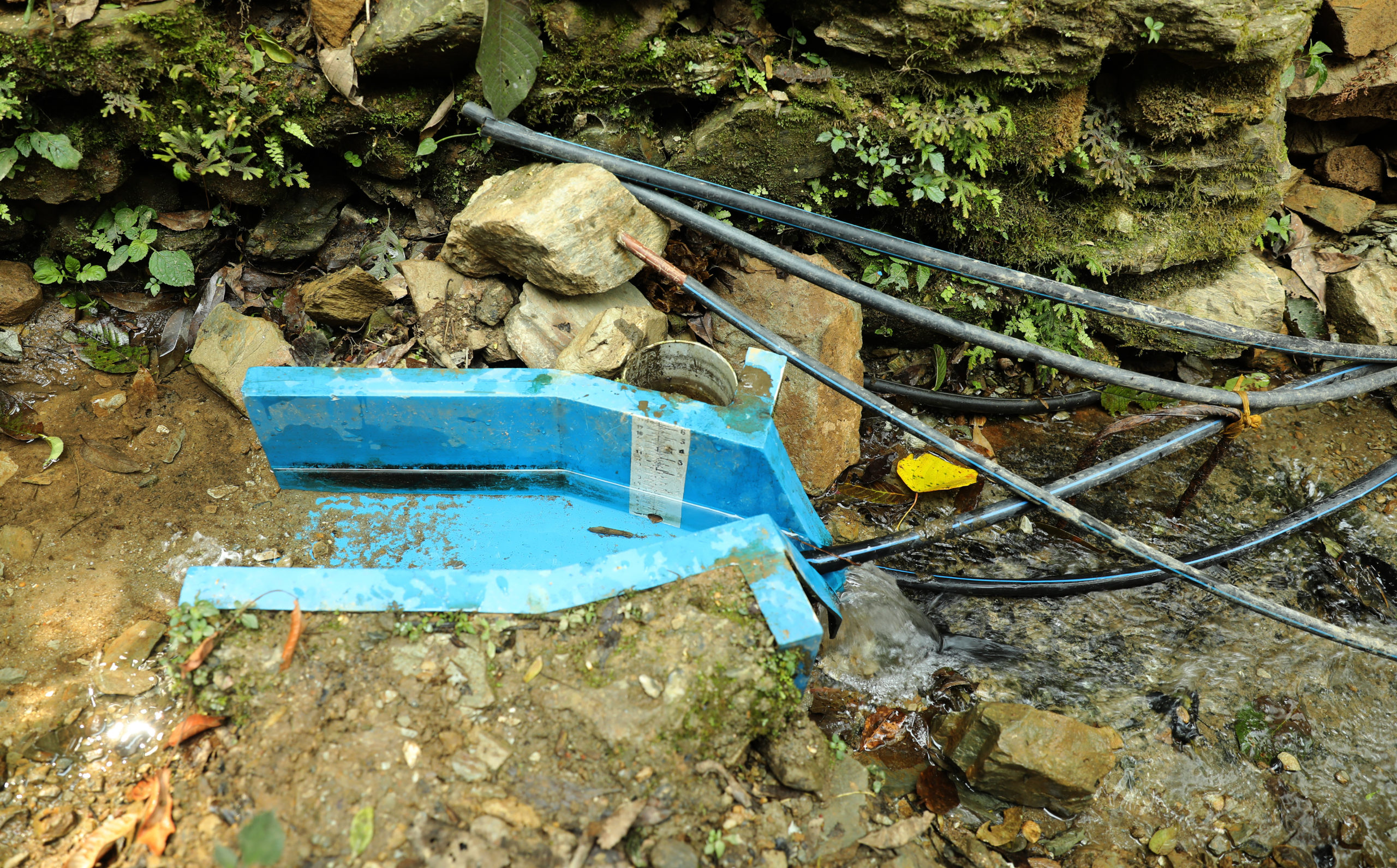
She and her colleagues reach Gaddi spring and try to retrieve data from a water flow recorder, so they have proof of what they are told. There is data from July 2019 to August 2020, but nothing after that. The recorder’s battery is dead.
“Springshed management is backed by a lot of anecdotal evidence,” says Rathod. “But getting long-duration data to prove the concept is a challenge. Everyone understands a watershed. A springshed does not really register in policymakers’ minds because of paucity of data.”
Subhash Dhakal of Sikkim government is part of the team at Damthang village. There are other problems in data collection, he says. Often, data recorders are stolen, mostly out of curiosity – the instruments have only junk value in local markets.
Another team member, Manish Kumar from NGO the Centre for Ecology Development and Research (CEDAR), says: “We found some instruments washed away by streams. We lost a lot of data, though we got some.”
Sociocultural challenges to research in Himalayas
Most research projects surrounding livelihood in the Himalayan region require the active participation of communities, particularly women. However, women in some of these societies are not part of decision-making, though they are affected the most.
“Water collection is traditionally a women’s role,” Rathod points out. “So, one cannot have a project around water security in the Himalayas without the involvement of women. In many Himalayan states, they are not part of the decision-making process. It is unfortunate that in those places, after years and years of work, you are not able to get women on board because you cannot change social dynamics.”
This is particularly true in the western Himalayas, with its strong patriarchal traditions. Even female researchers face additional hurdles as a result.
“Asking questions to men is a big challenge,” says Rathod. “Men find it demeaning to respond to women. Sometimes you also get harassed and abused. Mobilising the community and making them feel that you are not an outsider, and you are here to work with them is a challenge.”
Some problems are common to all researchers, regardless of gender. “When one is in an implementation phase [of a project] on the ground, one can see tangible results. For example, when a trench is being dug, one is able to see the impact of the trench in the spring. But in research we cannot see these results directly. At the end of the day communities ask what the impact of the research will be on them,” Rathod says.
Given the need for more research in the Himalayan region, Rathod believes the involvement of local communities is important to understand and devise solutions to problems. “You need to be a part of the community. Researchers should integrate well with the communities.”
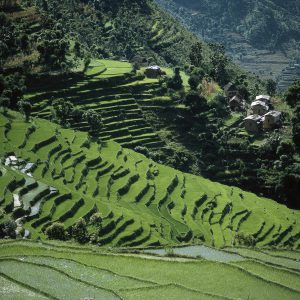
![Gagas valley in Uttarakhand, irrigated by the Gagas river [image by: Hridayesh Joshi]](https://dialogue.earth/content/uploads/2019/02/Springs1-300x172.jpg)