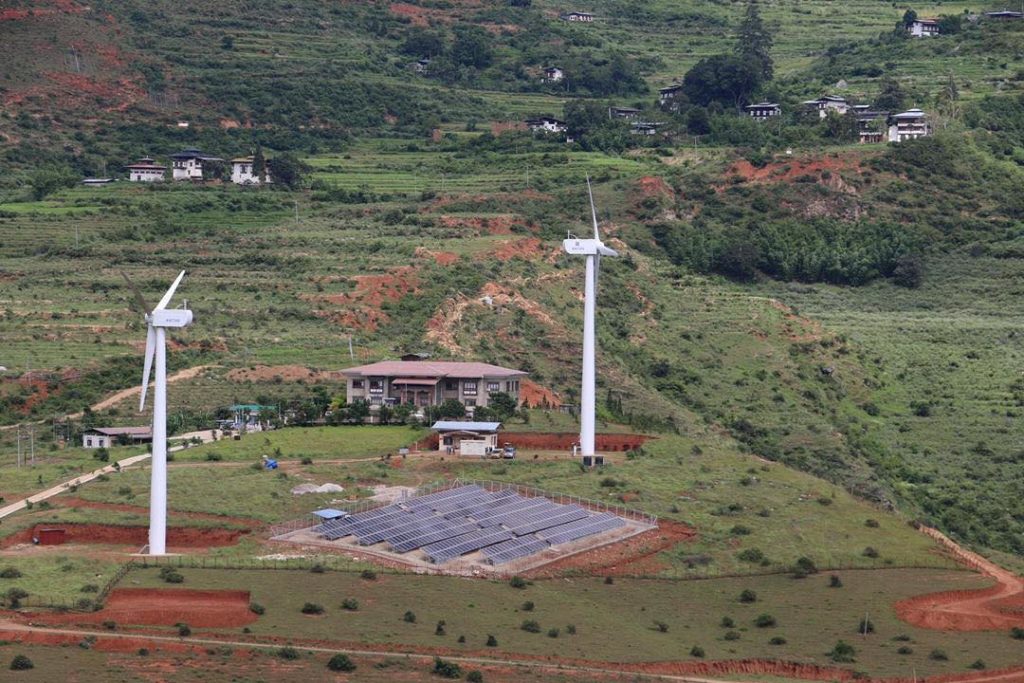

On 27 August, the first ground-mounted solar power plant to be connected to Bhutan’s national grid went online.
170
Households could be powered for a year by the solar plant at Rubesa, given the average household in Bhutan uses 1,567 kWh of electricity per year
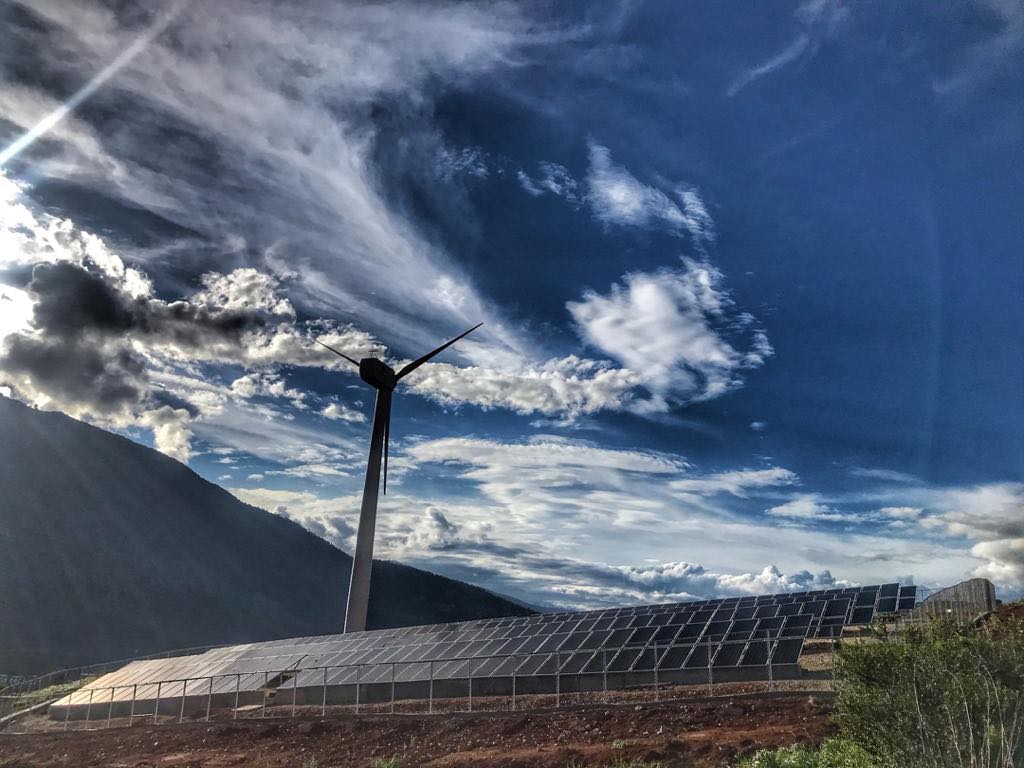
The pilot project, a 180-kilowatt solar photovoltaic (PV) plant was built at Rubesa village, in the western district of Wangduephodrang. It has the capacity to generate about 269,000 kilowatt-hours of energy per year, said Rozal Adhikari, an engineer in Bhutan Power Corporation Ltd’s renewable energy division. The project has been integrated with a 600kW wind farm on the same site.
Nearly all electricity generated in the small landlocked Himalayan country currently comes from hydropower. The project in Rubesa is therefore a step towards diversifying Bhutan’s electricity supply. As well as expanding institutional capacity, it demonstrates the feasibility and viability of solar projects in the country.
The project was executed by the Bhutanese government’s Department of Renewable Energy in collaboration with the Bhutan Power Corporation, a public utility. It received funding support from the Japanese government and was supported by the United Nations Development Programme in Bhutan.
Is this the start of a solar energy rollout in Bhutan?
“Diversification of energy sources has become significant, as we cannot depend solely on a single source of energy – hydropower,” Phuntsho Namgyal, director of the Department of Renewable Energy (DRE), told The Third Pole.
Phuntsho Namgyal said that the solar plant in Rubesa is part of the country’s plan to diversify its energy sources and enhance energy security.
In 2019, the International Renewable Energy Agency carried out a Renewable Readiness Assessment of Bhutan. Its report pointed out the vulnerabilities of hydropower to climate change, as changing river flow affects electricity generation and extreme weather events such as cloudbursts and glacial lake outburst floods can damage dams. In light of the environmental impacts of hydropower and fossil fuels, the authors called for investment in multiple sources of renewable energy.
Rozal Adhikari said that despite being a carbon-negative country, Bhutan is a victim of other countries’ actions. It is already experiencing the impacts of global warming and glacial melting. This is a growing threat to the country’s hydropower projects, Adhikari said, which are currently all run-of-the-river, with no large reservoirs, meaning their output dwindles when water levels are low.
Namgyal said that the renewable energy sector has great potential to provide green jobs, in addition to supplying energy during the winter months or lean seasons, when Bhutan imports energy from India. The country imported electricity worth 180.7 million Bhutanese ngultrum (USD 2.4 million) from India in 2020 – down from BTN 222 million in 2013.
In mid-September, the Department of Renewable Energy inaugurated another project to demonstrate the use of renewable energy. An 11.7-kilowatt-peak solar photovoltaic and 500-litre solar-powered water heating system was installed in the Ministry of Economic Affairs’ office compound.
DRE director Phuntsho Namgyal said that as the department runs workshops and training to promote renewable energy, such a project is helpful as a demonstration.
Rozal Adhikari said at an institutional level, solar-related projects are slowly seeing some light. He said that very recently the UNDP office in Bhutan commissioned a 83.6kW rooftop solar plant, which was integrated to the grid. The World Food Programme is planning to install a 100kW solar plant in its office. And the Centre for Bhutan Studies recently installed solar panels at its office.
Challenges to widespread use of solar
Within the past decade, Namgyal said, the cost of solar power systems has dropped by up to 80% globally.
But Adhikari pointed out that having to import the materials needed for wind and solar, and a lack of skilled workers and expertise, pose a challenge to the wider use of these technologies.
For example, the supply, installation and commissioning of the pilot solar project in Wangduephodrang district was supposed to be completed within four months. However, due to the Covid-19 pandemic and recurrent lockdowns, there was a delay in the supply of materials. As a result, it took around seven months to complete, Adhikari said.
“We also had various challenges such as wind coming under the solar panels,” he said. The heavy winds in the mountainous terrain can damage solar panels and, in extreme cases, even rip them away. In response, Adhikari said, “We had to come up with toe-wall building on the first row to block the wind.” Such local-specific needs helped to build domestic expertise, reducing future dependence on foreign expertise.
An additional problem is that the current low cost of power means people are not incentivised to explore solar energy, according to Adhikari. In Bhutan, the majority of the population live in rural areas, where energy is subsidised. Even those in cities are charged around BTN 3 (about USD 0.04) per unit (kilowatt-hour).
To encourage local people and business to adopt solar power, the Bhutan Electricity Authority is looking to draft ‘Feed-In Tariff’ regulations. Under these, an individual or organisation whose solar system generates excess electricity can feed it into the grid to receive payment for that power.
As renewables ramp up, hydropower will remain dominant
Quoting DRE figures, Namgyal said that Bhutan has the potential to generate 12,000MW of solar energy, 761MW of wind energy and 2,680MW of bio-energy.
In 2020, the country’s hydropower plants generated 11,364 million kWh, according to the records of utility company the Druk Green Power Corporation – dwarfing the most ambitious projections of other renewables.
Aside from the new 180kW plant, the country has installed only 170kW in home-lighting systems. Wind farms capturing just 600kW are operational.
Now, the Department of Renewable Energy is gearing up to take advantage of Bhutan’s renewable resources, according to Namgyal. “We are already in negotiation with the Asian Development Bank and by January 2022, a few big solar-related projects will take off,” said the DRE director.
Adhikari said that some of the upcoming renewable energy projects could include a 30MW solar farm at Shingkhar in central Bumthang, a 17MW solar plant at Sephu in Wangduephodrang, and a 23MW wind farm at Gaselo in Wangduephodrang.
Unlike in the past, the majority of current and upcoming solar-related projects will be connected to the grid. In grid-tied photovoltaic systems, solar and hydropower energy can complement each other – so hydropower electricity can be used when solar energy is in short supply, and vice versa.