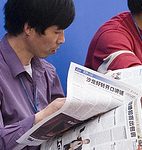
In April 2009, the authorities in Heilongjiang province, northeast China, held a meeting about the enforcement of environmental law and the handling of pollution incidents. However, when journalists were told they could not obtain a list of firms guilty of polluting illegally, some of those present left in anger. Despite the defences offered by provincial officials, doubts about the situation remain.
May 1 this year marked one year since the trial implementation of the Chinese government’s Measures for the Disclosure of Environmental Information. However, the lack of openness in Heilongjiang indicates that problems remain.
In order to understand the achievements and the issues that have arisen this year, and to examine how to further promote environmental disclosure, the environment channel at Sohu.com, chinadialogue and the Natural Resources Defense Council (NRDC) held a seminar looking back at the implementation of the Measures.
In attendance at the meeting were Wang Jin, a professor at Peking University’s Environmental and Resource Law Center and one of the contributors who drafted the Measures; Ma Jun, director of the Institute of Public and Environmental Affairs; Yan Yiming, a noted environmental lawyer; and Alex Wang and Hu Yuanqiong, both from NRDC’s China Project. The meeting was hosted by Qie Jianrong, a reporter for the Legal Daily.
What follows is an edited transcript of the discussion:
Qie Jianrong: How have the Measures been implemented since May 1, 2008? What effects have we seen?
Wang Jin: The disclosure of environmental information is a breakthrough for the process of public participation.
Since the founding of the People’s Republic, our systems have always been secretive: information was confidential on principle; disclosure was the exception rather than the rule. But the Ministry of Environmental Protection (MEP) was the first of all the ministries to publish plans for implementing the Regulations on Governmental Information Disclosure, published last year. Since the publication of the Measures, a series of guides, lists, methods and procedures have been established, and currently that platform is running smoothly.
Ma Jun: The government really has done a lot of work over the past year. Information from the IPE’s Water Pollution Map shows that from 2004 to 2007 there were 2,900 recorded cases of pollution by businesses. But we have already received over 10,000 reports for 2008 alone. The government has acted much more emphatically since the implementation of the Measures.
In 2006, only Shanghai did a reasonable job of disclosing incidences of pollution by businesses. But since the drafting of the Measures in 2007, nearby cities such as Suzhou, Wuxi, Ningbo and Shaoxing have started to take a more systematic approach to disclosing breaches of standards and regulations. Since implementation, some areas that used to lag behind have caught up: for example, Tianjin and some areas in the Pearl River Delta. There have also been some very creative changes: for example, in Wuhan pollution monitoring equipment is connected to the internet, and the public is able to access the data directly.
Hu Yuanqiong: Once the Measures were published, NGOs such as the NRDC, the China Environmental Culture Promotion Association, Global Village and the Center for Legal Assistance to Pollution Victims organised training sessions investigating the role of the new rules and how to use them to effect. Many environmental NGOs, such as Green Cross in Xiamen and Jiangsu’s Friends of Green Environment, used this new legal tool to produce guidance appropriate to their own localities.
Qie Jianrong: Besides these achievements, what problems or failings have been revealed?
Yan Yiming: Since May 4 last year I have been requesting environmental information from the environmental authorities in places such as Henan, Anhui and Jiangsu. Over the year I have got hold of some information, but the requests procedure is tiresome.
The Measures do provide a legal basis, but, generally speaking, local government is still unwilling to act and will look for excuses to avoid doing so. The procedures they provide for obtaining information are difficult and complex: it’s as if they don’t really want to tell you anything.
Despite the legal foundation, it is hard to hold the government to account if it does not disclose environmental information, as it is so powerful. Local governments always have inappropriate influence over the courts, and cases brought by the public will come up against a range of difficulties.
Some local governments, perhaps under pressure to maintain GDP figures, connive with polluting firms or treat them leniently. The companies will refuse to release information, citing commercial confidentiality. However, when the public interest is at stake, I think commercial confidentiality should not apply: information must be disclosed.
Hu Yuanqiong: The Measures state that every March 31, environmental authorities should publish an environmental information disclosure report. But figures from the Procuratorate Daily (Jiancha Ribao) show that as of midnight on March 31, 2009, nine of the State Council ministries; 13 of its 16 directly-subordinate bodies; five of its six administrative bodies; 11 of its 14 directly-subordinate institutions; and 15 of the 19 national bureaus administered by ministries had failed to do so. None of the State Council’s 29 discussion and coordination bodies published a report; only nine of the 31 provincial-level governments published one.
Ma Jun: The biggest problem has been the almost total lack of action from businesses.
The IPE and over a dozen other environmental NGOs sent a joint reminder to almost 30 companies in breach of pollution standards or quotas, but only four or five responded. One multinational said that in a poor market it could not survive too much bad news, so it could not publish data on emissions.
According to the Measures, major polluters who do not disclose information on pollutants can be fined up to 100,000 yuan [US$14,659] by the local environmental authorities, who can then publish the data themselves. But so far not a single firm has been fined. That’s a serious failure.
Qie Jianrong: What causes the problems that have been revealed? What should we do to better promote the disclosure of environmental information?
Yan Yiming: The methods and procedures of disclosure should be improved. Some companies do submit to pressure and publish information, but they will do it on television in the middle of the night. They might as well not publish it.
The data that has been disclosed also needs interpretation, in order to explain to the public what effect it has on their lives in order that they can respond.
Alex Wang: In the United States, oversight of information has become an important method of supervision, after administrative orders and market mechanisms. The Chinese public must learn from this and actively exercise these legal rights if the law is to be effectively implemented and problems with law and implementation are to be identified and solved. If there is an effective mechanism to resolve disputes, then these questions and disputes can be beneficial.
Wang Jin: The disclosure of government and environmental information in China is still relatively difficult. One reason is the tradition of confidentiality: although these new rules have brought a number of breakthroughs, government officials are still opposed to openness. There needs to be a process of ideological change and adaptation.
For decades we have been used to relying on the government. Now we need to learn to continuously put pressure on the environmental authorities to exercise their supervisory duties. When administrative measures fail, legal ones can be used. It is not a matter of winning or losing, it is about helping the legal system understand the importance of this issue.
Currently the Measures cover 17 types of information that the government should disclose. But these categories are broad, and need to be refined with the use of subcategories. Documents that clarify disputed areas are needed to help the public exercise their legal rights.
Ma Jun: Failures in administrative and legal redress are not going to be solved quickly, but we can use other measure to solve these issues. For example, many big firms do not care about a 100,000-yuan fine, but they do feel the pressure if information is made public and available to consumers. There is a huge potential for the use of environmental information in public oversight.
Homepage photo by Green Sohu